


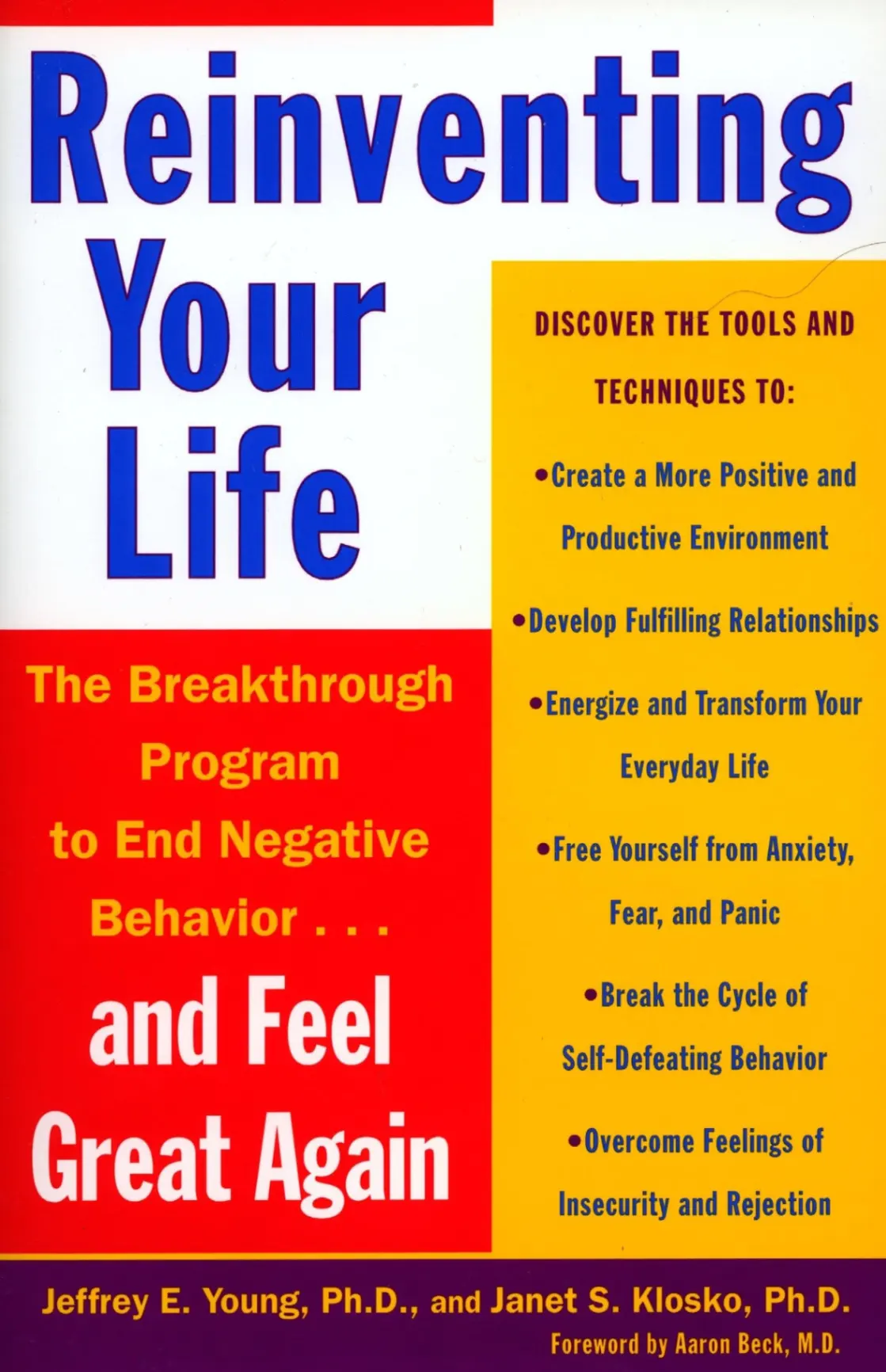
Reinventing Your Life: The Breakthrough Program to End Negative Behavior...and Feel Great Again
 Aaron Beck
Young and Klosko translate schema therapy into a self-help framework, arguing that chronic emotional and relational problems stem from 'lifetraps'—enduring childhood-derived patterns such as abandonment, defectiveness, or emotional deprivation that unconsciously shape adult behavior. The book identifies eleven such lifetraps, provides diagnostic questionnaires for each, and offers a structured program combining cognitive, experiential, and behavioral techniques. Its central mechanism is recognizing how individuals surrender to, avoid, or counterattack against these patterns, then systematically replacing them with healthier responses.
Key Details
Related Books
View AllSimilar books from the same category, ranked by shared topics and reader engagement.


Key Insights — Read in 10 Minutes
https://firebasestorage.googleapis.com/v0/b/wealthy-psyche.firebasestorage.app/o/images%2F1791170979491-81b8WENYV6L.webp?alt=media&token=98fd3d2d-8cea-409e-b9bc-6cf4dd65c500
Lifetraps are enduring, self-defeating patterns originating in childhood that shape how individuals interpret relationships and themselves. Unlike surface-level habits, they are characterized by three features: they are lifelong themes or patterns, they are destructive rather than merely annoying, and they actively fight for survival. The book identifies eleven common lifetraps including Abandonment ('Please don't leave me!'), Defectiveness ('I am worthless'), Emotional Deprivation ('I will never get the love I need'), and Unrelenting Standards ('It's never good enough'). Each chapter pairs a diagnostic questionnaire with case histories and a step-by-step change program, making the schema concept accessible to general readers without clinical training .
How does the book's approach to change differ from standard cognitive therapy?
Reinventing Your Life incorporates cognitive techniques but expands beyond them. The cognitive component includes writing a 'case' against your lifetrap and examining evidence for and against its beliefs. The experiential component invites readers to connect with their 'inner child' and engage in dialogue with the childhood self who originally formed the pattern. The behavioral component asks readers to identify specific behaviors that maintain the trap and systematically replace them. This three-pronged approach reflects schema therapy's foundational insight that enduring personality patterns require more than thought-challenging alone—they require emotional processing and behavioral change .
What is the documented relationship between this book and Young's professional work on schema therapy?
Reinventing Your Life is the popular-level companion to Young's clinical manual, Schema Therapy: A Practitioner's Guide (co-authored with Klosko and Weishaar, 2003). Young founded schema therapy as an extension of cognitive therapy specifically for personality disorders and other chronic, difficult-to-treat conditions. The self-help book translates the same core concepts—early maladaptive schemas, coping styles (surrender, avoidance, counterattack)—into accessible language. Aaron Beck, who wrote the foreword, explicitly praised the book for tackling 'the difficult topic of personality problems' by building on cognitive therapy principles, calling the authors' work 'pioneering' .
What critical reception did the book receive, and what limitations were noted?
Publishers Weekly called it a work that 'ably demonstrates how to deal with issues of abandonment, dependence, trust, social rejection, emotional deprivation, failure and vulnerability,' praising its case histories and diagnostic tools. Library Journal highlighted the range of techniques from experiential to cognitive and behavioral. However, reader reviews frequently note significant repetition across chapters, with each lifetrap following a similar structure that can become tedious over 384 pages. Some critics find the solutions 'simplistic' for complex trauma, and the authors themselves repeatedly caution that the book cannot replace professional therapy. The book's age (1993) also means newer research on trauma and attachment is absent .
Why does the book carry Aaron Beck's name when he did not write it?
Aaron Beck wrote the foreword, not the text. This association is deliberate: Beck is the founder of cognitive therapy, and Young was one of his protégés. Beck's foreword frames the book as a legitimate extension of cognitive therapy into the territory of personality problems, where standard symptom-focused CBT had limited effectiveness. His endorsement lent the book clinical credibility with both professionals and the public. The book's publisher and booksellers list Beck as a contributor precisely because his name signals that the content is grounded in evidence-based cognitive principles rather than pop psychology .
How has the book's framework held up since its 1993 publication?
The core concept of early maladaptive schemas has become a major strand in contemporary psychotherapy research. Schema therapy now has a substantial evidence base, particularly for borderline personality disorder, and the lifetrap model anticipated later developments in attachment theory and trauma-informed care. The specific term 'lifetrap' remains identified with this book, though professional literature uses 'early maladaptive schema.' The book's self-diagnostic questionnaires have been widely reproduced, and the eleven lifetrap categories continue to organize how many clinicians and readers conceptualize chronic relational patterns. Its limitations reflect the field's evolution: newer work emphasizes complex trauma and dissociation more than the 1993 text does.
Wealthy Psyche is an intellectual archive. We do not host, distribute, or sell book copies — physical or digital. We provide structured knowledge to help you think better, faster.