


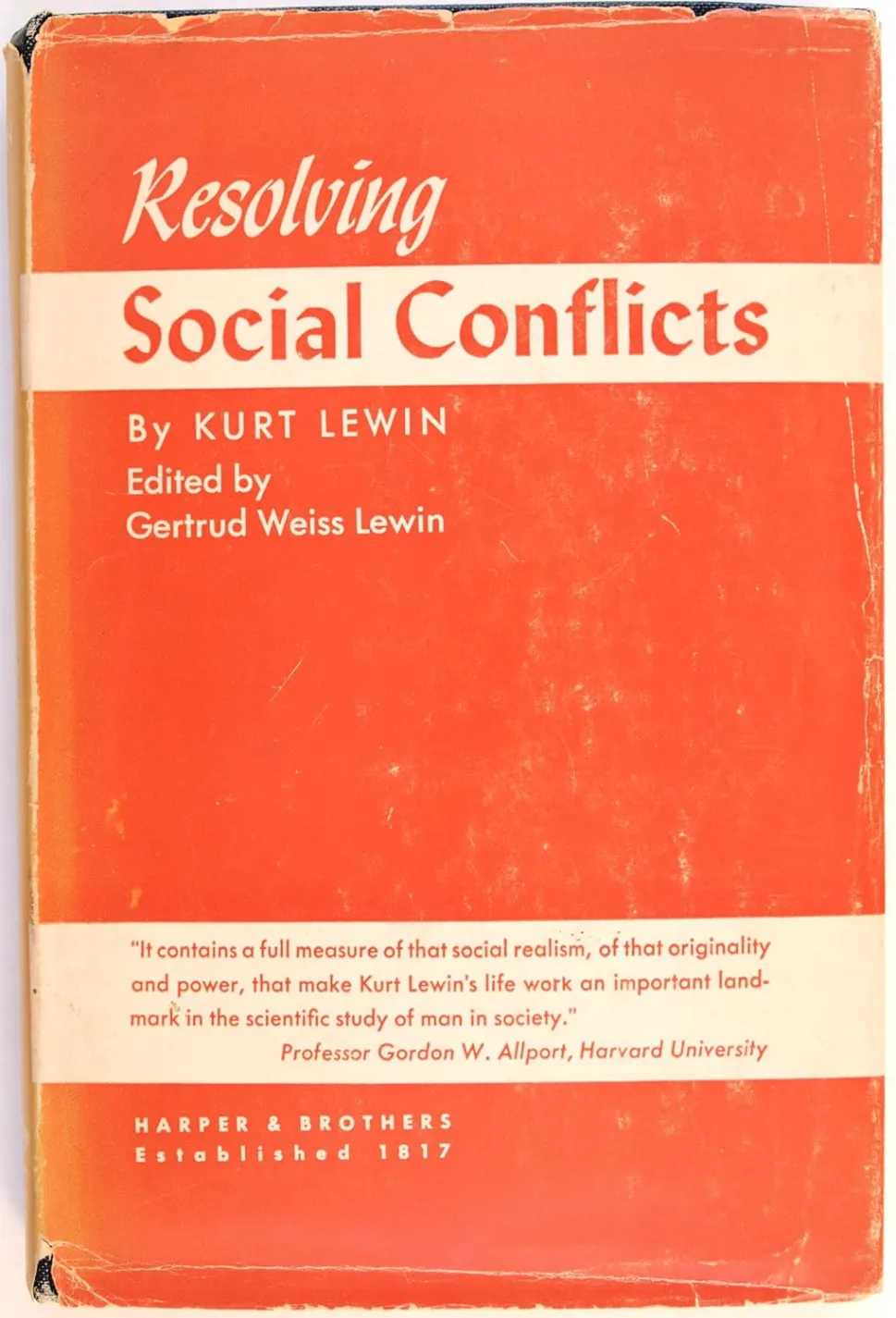
Resolving Social Conflicts: Selected Papers on Group Dynamics
 Kurt Lewin
This posthumous collection of thirteen papers, edited by Gertrud Weiss Lewin, develops the thesis that the group to which an individual belongs constitutes the ground for that person's perceptions, feelings, and actions. Lewin applies field-theoretical concepts—life space, barriers, locomotion, group atmosphere—to concrete problems: re-educating nations after war, conflicts in marriage and industry, and the psychological situation of minority groups facing discrimination. The volume demonstrates that social conflict can be studied experimentally through the deliberate creation of contrasting group climates, establishing action research as a method for both understanding and changing social reality.
Key Details
Related Books
View AllSimilar books from the same category, ranked by shared topics and reader engagement.


.webp?alt=media&token=e122db12-881d-4348-827b-bc8f8f60d681)
Key Insights — Read in 10 Minutes
What is the central thesis of Resolving Social Conflicts, and how does it unify its otherwise disparate essays?
The unifying claim is that the group to which an individual belongs is the ground for that person's perceptions, feelings, and actions—not a backdrop but a constitutive field. The essays, written between 1935 and 1946 on topics ranging from German national character to marriage conflict to Jewish self-hatred, are arranged logically rather than chronologically to demonstrate this thesis across domains. Huntley's 1950 review observed that the underlying consistency of Lewin's thought holds together papers originally written at different times on widely differing topics . The volume thus functions as a demonstration of field theory's range rather than a single sustained argument.
How did Lewin use experimental methods to study social conflicts that seemed resistant to laboratory investigation?
The volume includes Lewin's pioneering experiments on group atmosphere, in which he created authoritarian and democratic group structures for eleven-year-old boys and recorded the consequences. This demonstrated that political atmosphere—previously considered beyond experimental reach—could be manipulated as an independent variable. Lewin also studied organized and unorganized groups under conditions of panic, and designed interventions to retrain overbearing foremen in factory settings. As one analysis notes, Lewin adapted experimentation to complex problems of group life, making problems that seemed utterly inaccessible to experimentation yield to his attack . These designs established the template for what became known as action research.
Why is this book considered a foundational text for action research rather than a conventional social psychology monograph?
The final chapter, 'Action Research and Minority Problems,' explicitly theorizes a mode of inquiry in which research and intervention proceed simultaneously. Lewin argued that understanding social problems and changing them are not separate activities but aspects of a single process: the researcher enters a community, introduces a change, studies its effects, and feeds that knowledge back into further action. This contrasts with the detached observation model of traditional social science. The volume's earlier case studies—the chronic industrial conflict, the marriage conflict analysis—function as demonstrations of this integrated approach. Action research as a named methodology derives substantially from the framework articulated here.
What role did Gertrud Weiss Lewin and Gordon Allport play in shaping this posthumous collection?
Gertrud Weiss Lewin, Kurt Lewin's wife and collaborator, edited the volume after his death in 1947, selecting thirteen papers from the period 1935–1946 and arranging them by theme rather than publication date. Her editorial choices foreground the applied, case-anchored quality of Lewin's work while preserving its theoretical coherence. Gordon Allport, a Harvard psychologist and early champion of Lewin's approach, contributed the foreword, framing the collection for an American audience still absorbing Lewin's influence. The title itself—'Resolving Social Conflicts'—was an editorial decision that emphasizes the practical orientation of the papers over their theoretical contributions.
How does the book's treatment of minority identity differ from earlier social psychological approaches to prejudice?
Lewin analyzes minority identity through concepts like life space, marginal membership, and group belongingness rather than treating prejudice as a matter of individual attitude. He distinguishes between the psychological situation created by external discrimination and the internal dynamics of self-hatred among minority members, arguing that both must be understood as features of a structured field. The essays on Jewish identity and child-rearing were written during World War II and immediately after, giving them a documentary as well as theoretical character. This framework influenced later work on social identity and intergroup relations, though Lewin's specific formulations remain tied to his topological vocabulary.
What have critics identified as the limitations of the field-theoretical approach demonstrated in these essays?
The primary criticism concerns the gap between Lewin's conceptual apparatus and its empirical verification. The topological and vector concepts that organize the analysis are difficult to operationalize and rarely received direct experimental testing. George Levinger's 1957 review noted that Lewin's approach de-emphasizes the formulation of testable postulates in favor of describing situations through structural and dynamic constructs . More broadly, later contextualist critics argued that while Lewin's Galilean strategy was liberating for a generation, it remained insufficiently attentive to historical and cultural particularity. The essays themselves, however, are concrete and accessible in a way that the abstract framework might not predict.
Wealthy Psyche is an intellectual archive. We do not host, distribute, or sell book copies — physical or digital. We provide structured knowledge to help you think better, faster.