


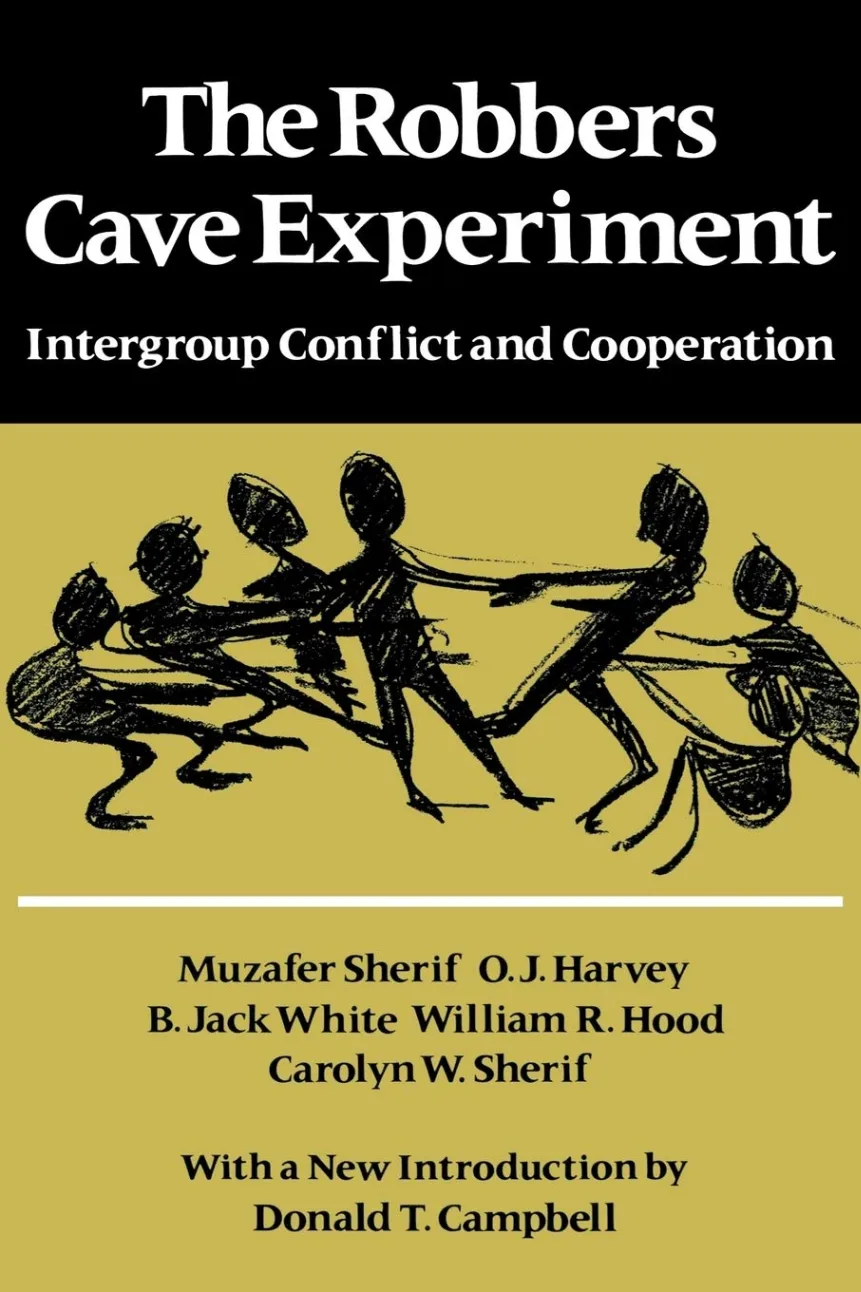
The Robbers Cave Experiment: Intergroup Conflict and Cooperation
 Muzafer Sherif
Sherif and colleagues staged a three-week summer camp at Robbers Cave State Park in 1954 to demonstrate that intergroup hostility is not an inevitable product of human nature but arises from competition for scarce resources. Two arbitrarily formed groups of eleven-year-old boys developed distinct identities, then turned hostile when researchers introduced competitive games with exclusive prizes—burning flags, raiding cabins, and escalating to near-violence. The book's central claim is that conflict can be reversed when groups pursue superordinate goals requiring cooperation, a finding that became the empirical foundation for realistic conflict theory and shaped decades of research on prejudice reduction.
Key Details
Related Books
View AllSimilar books from the same category, ranked by shared topics and reader engagement.


.webp?alt=media&token=e122db12-881d-4348-827b-bc8f8f60d681)
Key Insights — Read in 10 Minutes
What is the central claim of The Robbers Cave Experiment, and what does it reject?
The book argues that intergroup hostility is not an expression of inherent human aggressiveness but a product of competition for scarce resources—what Sherif termed realistic conflict. Two groups of eleven-year-old boys, arbitrarily named the Rattlers and Eagles, developed intense hostility only after researchers introduced competitive games with exclusive prizes, leading to flag-burning and cabin raids. This rejects the assumption that prejudice and conflict stem from individual pathology or deep-seated tribal instincts. The experiment demonstrated that under conditions of cooperative interdependence—superordinate goals that neither group could achieve alone—hostility could be dissolved and intergroup friendship restored, as when the groups jointly repaired a sabotaged water supply.
What specific concept did this experiment introduce, and where is it used today?
The Robbers Cave study established realistic group conflict theory, which holds that intergroup prejudice and discrimination arise when groups perceive themselves as competing for limited resources—jobs, territory, status, or political power . The concept of superordinate goals—objectives that require cooperation across group boundaries—became a foundational principle in prejudice-reduction research and applied settings. Gordon Allport's contact hypothesis, developed in the same period, drew on Sherif's findings while emphasizing additional conditions for positive intergroup contact . Today, realistic conflict theory informs research on ethnic conflict, political polarization, organizational behavior, and interventions designed to reduce intergroup hostility through shared tasks and common threats.
How has the experiment's historical accuracy been challenged by later archival research?
Australian psychologist Gina Perry's archival investigation, published in The Lost Boys (2018), raised serious questions about the experiment's conduct and reporting. Perry found that Sherif's team had run earlier failed versions of the study in 1949 and 1953, and that the 1954 Robbers Cave trial was carefully manipulated to produce the desired outcomes . Researchers tore down tents and trampled belongings to provoke retaliation, provided matches to burn flags, and egged on conflicts while posing as camp staff. Participants were never informed they were subjects or debriefed afterward . Perry's findings do not necessarily invalidate realistic conflict theory, but they complicate the experiment's status as a neutral field observation of spontaneous group behavior.
How does the experiment relate to Gordon Allport's The Nature of Prejudice, published the same year?
Allport's 1954 book and Sherif's Robbers Cave study were contemporaneous landmarks in intergroup relations research, but they offered different emphases. Allport's contact hypothesis argued that intergroup prejudice could be reduced through positive contact under specific conditions—equal status, common goals, cooperation, and institutional support . Sherif's experiment demonstrated the conflict side of the equation more vividly than the contact side, showing that mere contact without superordinate goals could intensify hostility rather than reduce it. Allport acknowledged Sherif's findings, and the two frameworks are often taught together: Sherif explains how competition generates conflict, while Allport specifies the conditions under which contact can repair it. Their relationship is complementary rather than rivalrous.
What are the major methodological and ethical criticisms of the study?
Critics have identified several problems. The participant sample was homogeneous—white, middle-class, Protestant boys—limiting generalizability to diverse real-world conflicts . Researchers actively manipulated events, including staging provocations and supplying materials for vandalism, which undermines claims that hostility emerged spontaneously . The boys and their parents never gave informed consent and were deceived about the study's true purpose. Perry's archival work revealed that two prior iterations of the experiment had failed to produce the desired conflict and were not reported in the published account . These issues reflect mid-century norms in social psychology but raise serious questions about the study's ecological validity and its status as an exemplar of field experimentation.
What is a common misconception about the experiment's findings?
A frequent misreading treats the study as demonstrating that mere contact between hostile groups reduces prejudice. In fact, Sherif found the opposite: when researchers initially tried to reduce tension by bringing the groups together for shared meals and movies, hostility intensified—food fights erupted and name-calling continued . Only when the groups faced superordinate goals requiring cooperative effort did relations improve. The experiment thus rejects the 'contact hypothesis' in its simplest form, showing that proximity alone is insufficient and may backfire. What matters is not that groups come together but that they work together toward a shared objective that neither can achieve independently.
Show 2 more insights
How did the 1961 book differ from earlier published reports of the experiment?
The 1961 book, published by University Book Exchange in Norman, Oklahoma, was the first full-length account of the Robbers Cave study, though Sherif had published a shorter report in Scientific American in 1956 . The book provided detailed narrative and data from all three phases. A 1966 volume, In Common Predicament, reframed the findings for a broader audience concerned with international conflict. The 1961 edition was later reissued by Wesleyan University Press in 1988 with a new introduction by Donald Campbell and a postscript by O.J. Harvey, one of Sherif's collaborators . The original 1961 edition is now out of print, and the Wesleyan edition is the standard scholarly reference.
How has Sherif's experiment influenced later theories of intergroup relations?
The Robbers Cave study provided the empirical foundation for realistic group conflict theory and directly influenced subsequent frameworks. Social identity theory, developed by Henri Tajfel and John Turner in the 1970s, extended Sherif's insights by arguing that mere categorization into groups can produce in-group favoritism even without resource competition—a claim Sherif's theory would not predict . Despite this divergence, both frameworks are often taught as complementary explanations for intergroup bias, with realistic conflict theory accounting for competition-driven hostility and social identity theory explaining the cognitive and motivational roots of group preference. Sherif's emphasis on superordinate goals also shaped the contact hypothesis literature and applied interventions in divided communities.
Wealthy Psyche is an intellectual archive. We do not host, distribute, or sell book copies — physical or digital. We provide structured knowledge to help you think better, faster.