


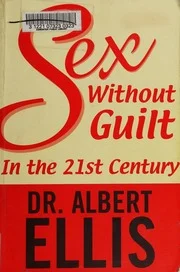
Sex Without Guilt
 Albert Ellis
Ellis argues that sexual guilt is an irrational, culturally imposed emotion that damages personal well-being and relationships. The book rejects the moralistic and psychoanalytic framing of sex as inherently dangerous or neurotic, instead applying rational-emotive principles to sexual behavior: pleasure is not sinful, consenting adults have the right to seek sexual satisfaction in whatever forms they choose, and guilt about sex is a learned disturbance that can be unlearned. Ellis addresses masturbation, premarital sex, adultery, and homosexuality with a direct, non-judgmental approach aimed at replacing shame with rational self-acceptance.
Key Details
Related Books
View AllSimilar books from the same category, ranked by shared topics and reader engagement.


Key Insights — Read in 10 Minutes
What is Ellis's central argument against sexual guilt in this book?
Ellis argues that sexual guilt is not a natural or necessary response to sexual behavior but a learned disturbance rooted in irrational, absolutistic beliefs—particularly the demand that one must not violate puritanical sexual codes. Drawing on his rational-emotive framework, he contends that guilt about consenting, non-harmful sexual activity is self-defeating and serves no useful purpose. The Foreword Review notes that Ellis defends the right of competent adults to choose their sexual behavior freely, as long as coercion or duplicity are absent, and rails against what he calls 'sexual and intellectual fascism'—the tendency to judge people's worth in narrow, repressive sexual terms . The book's therapeutic goal is to replace guilt with rational self-acceptance.
What specific topics did the book address, and how did Ellis handle them?
The 1958 original covered masturbation, petting, premarital sex, adultery, sex without love, sexual censorship, female frigidity, male sexual inadequacy, sex education, and homosexuality . Ellis treated each topic with a direct, non-moralistic approach aimed at dismantling irrational guilt. His chapter on masturbation was particularly notable: Ellis wrote that it is difficult to conceive of a more beneficial, harmless, tension-releasing human act than masturbation performed without puritanically inculcated fears . He applied the same logic to adultery, discussing its pros and cons rather than condemning it outright. The book's chapter structure—including provocative titles like 'How American Women Are Driving American Males Into Homosexuality'—reflects Ellis's confrontational style and his willingness to address taboo subjects directly.
How did the book's treatment of homosexuality reflect its era, and what changed in Ellis's later views?
The 1958 edition included content that would now be considered homophobic, with passages treating homosexuality as a condition to be understood or potentially changed. A Goodreads reviewer of the 1966 mass market edition noted that while the book presents a surprisingly liberal, sex-positive outlook for its time, 'some views are clearly outdated—including homophobic passages' . Ellis's position evolved significantly over subsequent decades. By the time of the 2003 revised edition, Sex Without Guilt in the 21st Century, the Foreword Review observed that Ellis—once an advocate of therapy for homosexuality—saw that stance obviated by greater social acceptance of difference . This evolution reflects both Ellis's personal intellectual development and broader shifts in clinical and cultural attitudes.
What was the book's publication history, and how did it evolve across editions?
Sex Without Guilt was first published in 1958 by Lyle Stuart in New York . A Hillman Books paperback edition followed in 1959 . Wilshire Book Company issued editions in 1966 and 1971 . A substantially revised edition, Sex Without Guilt in the 21st Century, was published by Barricade Books in 2004 . The Library Journal review of this later edition noted that the book 'remains uncomfortably pointed, with 90-year-old Ellis, a psychologist and author of at least 70 books about sex or Rational Emotive Behavior Therapy (REBT), still ahead of the sexual revolution' . The persistence of the title across nearly five decades indicates its enduring appeal as a foundational text of the sex-positive movement.
What are the documented limitations of the book's approach?
A Goodreads reviewer identified a significant weakness: the book 'mostly just opinions stated as facts with little evidence to back any of his claims up' . The same reviewer noted that if readers disagree with Ellis, they are labeled 'sexual fascists'—a rhetorical move that forecloses debate rather than engaging with counterarguments. The Foreword Review observed that Ellis 'seeks his own pleasure experience in sexual adventurism' and holds himself and others to what he considers high ethical standards, but acknowledges that some people will be content with what he would consider a monotonous sexual life . This suggests the book reflects Ellis's own preferences and philosophical commitments as much as objective clinical findings.
How does the book relate to Ellis's broader therapeutic work and his identity as a sexologist?
Sex Without Guilt represents the intersection of Ellis's two professional identities. He was both a clinical psychologist who developed REBT and a sexologist who worked with Alfred Kinsey and wrote extensively on human sexuality . The book applies rational-emotive principles—the identification and disputation of irrational beliefs—to the domain of sexual behavior. Ellis's later work, The Art and Science of Love (1960), continued this application of REBT to sexual and marital problems. The book also reflects Ellis's commitment to what he called 'sexual and intellectual fascism' as a target of rational critique, positioning sexual freedom as consistent with the broader REBT goal of replacing absolutistic demands with flexible preferences.
Show 1 more insights
How was the book received at the time of its original publication?
The book found a significant readership and went through multiple editions and reprintings, indicating substantial public interest in its message. Its publisher, Lyle Stuart, was known for controversial and sexually frank titles. The book was part of a wave of mid-century literature challenging American sexual mores, alongside works by Kinsey and others. The Library Journal's later assessment that the book 'remains uncomfortably pointed' and that Ellis was 'still ahead of the sexual revolution' suggests the book was more radical than mainstream culture even as it became widely read. Its inclusion of case histories and its accessible, non-clinical tone contributed to its popular success.
Wealthy Psyche is an intellectual archive. We do not host, distribute, or sell book copies — physical or digital. We provide structured knowledge to help you think better, faster.