


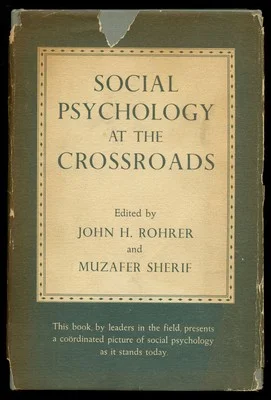
Social Psychology at the Crossroads
 Muzafer Sherif
This 1951 volume collects papers from a 1950 University of Oklahoma conference convened to assess social psychology's disciplinary identity. Edited by John H. Rohrer and Muzafer Sherif, the book's central argument is that social psychology was groping at a crossroads between psychological and sociological approaches, and that productive development required cross-fertilization rather than disciplinary isolation. Of sixteen contributions, only four addressed social psychology proper; the remaining twelve drew on genetics, anthropology, comparative psychology, and industrial sociology, embodying the editors' claim that the field's vitality depended on its engagement with adjacent disciplines.
Key Details
Related Books
View AllSimilar books from the same category, ranked by shared topics and reader engagement.


.webp?alt=media&token=e122db12-881d-4348-827b-bc8f8f60d681)
Key Insights — Read in 10 Minutes
What is the central claim of Social Psychology at the Crossroads, and what does it reject?
The book's organizing thesis, articulated by Sherif in his introduction, is that social psychology in 1950 stood at a crossroads between psychological and sociological approaches and was 'still groping its way' toward a synthesis. This rejects the assumption that social psychology could develop productively within a single disciplinary tradition or that the psychological and sociological variants were simply interchangeable perspectives. The volume embodies its thesis structurally: only four of sixteen chapters addressed social psychology per se, while the rest drew on genetics, anthropology, comparative psychology, phenomenology, and industrial sociology. The editors' point was that social psychology's vitality depended on traffic across disciplinary boundaries, not on policing them.
How did the conference and volume come about, and what was their institutional context?
The book reports a five-day conference held April 6-11, 1950, at the University of Oklahoma, sponsored by that institution. The conference was part of the University of Oklahoma Lectures in Social Psychology series. Harold Guetzkow, reviewing the volume for Psychological Bulletin, noted that the conference and book made social psychology visible in a new geographic center—the American Midwest—rather than the East Coast institutions that had dominated the field. The volume was edited by John H. Rohrer and Muzafer Sherif, both then associated with the University of Oklahoma's interdisciplinary program, and published by Harper & Brothers in 1951.
What was the critical reception of the volume, and what did reviewers identify as its limitations?
Reviews were mixed but generally respectful of the volume's ambition. Guetzkow, writing in Psychological Bulletin, observed that the contributions largely summarized already-published work and contained 'no news of significant, hitherto unreported, advances,' though he found the collection useful as an overview of scattered material. He also noted that the volume suffered from duplication and significant omissions—notably the absence of psychiatrists studying social milieu in hospital settings. Alvin W. Rose in Social Forces and Robert E. L. Faris in the American Sociological Review both reviewed the book in 1951, treating it as a serious statement about the field's direction. The most pointed criticism was that contributors spent little effort specifying how their disciplines should actually influence social psychology's development.
How does this volume relate to Sherif's own theoretical work on social norms and group formation?
The volume extends Sherif's longstanding concern with the social psychological processes through which groups generate norms and regulate members' behavior. His chapter, 'A Preliminary Experimental Study of Inter-Group Relations,' represents one of the earliest published reports from his Robbers Cave research program, which would eventually produce the classic Intergroup Conflict and Cooperation: The Robbers Cave Experiment (1961). The chapter outlines the experimental design for studying how groups form, how norms emerge, and how intergroup relations produce conflict and cooperation—concerns directly continuous with his 1936 book The Psychology of Social Norms. The Crossroads volume thus functions as a bridge between Sherif's pre-war work on norm formation and his post-war turn toward intergroup dynamics.
What does the volume reveal about the relationship between psychological and sociological social psychology in 1950?
The volume is now recognized as a key document in the history of the 'two social psychologies' problem. Stephan and Stephan, writing in 1990, identified this conference as the moment Sherif named the crossroads between sociological social psychology (SSP) and psychological social psychology (PSP), though they noted that 'the metaphor of an overpass might have been more appropriate, since the two disciplines seldom actually met'. The conference brought together representatives of both traditions but, as Guetzkow observed, the sociologists and anthropologists were 'quite unconcerned about differentiating their main focus of interest from the area being claimed by the embryonic social psychologists'. The volume thus documents a moment when disciplinary boundaries were being negotiated rather than settled.
What is a common misconception about the book's title and scope?
The title is sometimes read as announcing a theoretical synthesis or integration of social psychology's competing traditions. In fact, the volume documents the absence of such a synthesis. Sherif's introduction frames social psychology as groping at a crossroads, not arriving at a destination. Guetzkow's review emphasized that the book 'ably achieves its goal of reporting' the conference, but that the contributors made little effort to specify how their various disciplines should influence social psychology's development. The volume is better understood as a diagnostic document—an assessment of a field in transition—than as a programmatic statement of what social psychology should become. Its value lies in the snapshot it provides of disciplinary self-consciousness at mid-century.
Wealthy Psyche is an intellectual archive. We do not host, distribute, or sell book copies — physical or digital. We provide structured knowledge to help you think better, faster.