


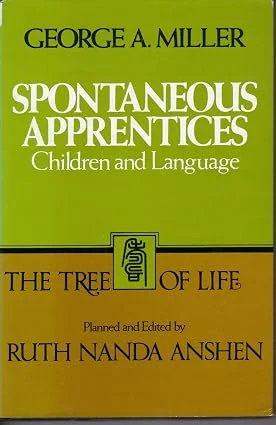
Spontaneous Apprentices: Children and Language
 George A. Miller
This book is Miller's candid account of a research project that failed. From 1972 to 1975, funded by the Grant Foundation, he ran a laboratory study of vocabulary development in three-year-old children, focusing on concepts of color, time, and space. The project yielded little about children's lexical growth and was eventually closed. Miller uses this failure to argue that the public picture of science—a rational march from hypothesis to verified truth—conceals the essential roles of failed experiments, serendipity, and tacit knowledge. The title metaphor frames children as 'spontaneous apprentices' who learn language far more than adults can consciously teach them, and scientists as needing a similar receptivity toward nature.
Key Details
Related Books
View AllSimilar books from the same category, ranked by shared topics and reader engagement.


.webp?alt=media&token=34bd26c3-d0b0-4cd7-a235-153b0182ef19)
Key Insights — Read in 10 Minutes
What is the central argument of Spontaneous Apprentices, and what conception of science does it reject?
The book argues that the standard published account of science—a neat sequence of hypothesis, method, results, and conclusion—is misleading because it omits failed experiments, the retroactive construction of hypotheses, and the role of luck and tacit knowledge. Miller illustrates this through his own failed project: a three-year study of vocabulary development in three-year-olds that produced little of value and was closed when funding ended. Rather than presenting this as a setback, he treats it as representative of how research actually proceeds. The book rejects the view of science as an inevitable march forward from rational insight to established truth, insisting that understanding science requires attending to its confusions, dead ends, and human contingencies.
What was the research project Miller describes, and why did it fail?
From 1972 to 1975, Miller ran a laboratory study funded by the Grant Foundation, observing and recording the speech of about a dozen three-year-old children at play. The goal was to learn how vocabulary develops, particularly concepts of color, time, and space. The project struggled from the outset with unclear theoretical focus. Miller later described the lab as a 'graduate school for myself' in developmental psychology, since that was not his original specialty. The project was closed when funding lapsed. The New York Times review noted that the scientists 'seem to have learned more about themselves than about vocabulary or children.' Miller treats the failure as instructive rather than embarrassing, using it to expose the gap between how science is reported and how it is actually conducted.
How does the book's title metaphor shape its argument about both children and scientists?
The phrase 'spontaneous apprentices' refers to children, who learn language through a freely entered apprenticeship in which they absorb far more than adults can consciously teach. Miller extends the metaphor to scientists, arguing that productive research requires a similar receptivity—an openness to nature that recognizes the importance of the ostensibly insignificant. The Rockefeller University's description of the book notes that this metaphor unifies the volume's two strands: an autobiographical account of research in progress and a philosophical statement about how knowledge actually advances. The child learning words without formal instruction and the scientist learning from unexpected observations are, in Miller's framing, engaged in structurally similar processes of apprenticeship to a domain that exceeds explicit teaching.
What is a common misconception about the book, given Miller's reputation for his work on language and cognition?
Readers familiar with Miller's foundational contributions—particularly his 1956 paper on the 'magical number seven' and his role in the cognitive revolution—might expect Spontaneous Apprentices to be a theoretical treatise on language acquisition or a definitive empirical study of child vocabulary. It is neither. It is a personal, reflective, and at times humorous account of a project that did not work, written for a general audience rather than specialists. The book is as much about scientific practice, institutional constraints, and the psychology of researchers as it is about children. A blogger describing it as 'minor' among Miller's works and 'autobiographical' captures its actual character accurately. It should be read as a contribution to the understanding of science as a human activity, not as a summation of Miller's linguistic research.
What concrete facts about children's vocabulary learning does the book offer, despite the project's failure?
Miller estimated that the average high school graduate has a reading vocabulary of roughly 40,000 words, rising to about 80,000 if proper names and idioms are included. If this vocabulary is acquired over sixteen years, the average child learns approximately 5,000 words per year, or about thirteen words per day. Children with larger vocabularies may learn at twice that rate. Miller also described a two-stage process of word learning: a rapid stage in which children assign new words to broad semantic categories, and a much slower stage in which they work out distinctions among words within those categories. This second stage may never be fully completed, as illustrated by adults who know that 'delphinium' and 'calceolaria' are flower names but cannot identify the plants.
How does the book's treatment of scientific failure relate to Miller's broader intellectual commitments?
Miller's emphasis on failure, serendipity, and tacit knowledge reflects a broader skepticism about overly rationalized accounts of human cognition and scientific practice. As a central figure in the cognitive revolution, he had spent his career studying the mind's actual operations rather than idealized models of them. The same sensibility appears here: just as children learn language through spontaneous, context-rich apprenticeship rather than formal instruction, scientists learn through messy, unplanned encounters with data rather than through the clean logic of published papers. The Rockefeller University catalog description frames the book as arguing that 'the real course of knowledge is not a succession of revolutions but hard work carried on with normal human passions and confusions.' This aligns with Miller's longstanding interest in how minds actually work, as opposed to how they are supposed to work.
Wealthy Psyche is an intellectual archive. We do not host, distribute, or sell book copies — physical or digital. We provide structured knowledge to help you think better, faster.