


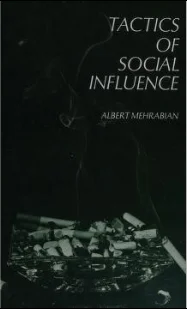
Tactics of Social Influence
 Albert Mehrabian
Mehrabian's 1970 handbook translates behavior modification principles into everyday tactics for changing one's own behavior and influencing others. It argues that people fail to change because they lack simple, applicable rules—and that humanistic resistance to treating social interaction systematically leaves individuals helpless before problems that reward, punishment, stimulus control, and modeling could address. The book presents a primer of applied behavior modification, covering reinforcement, desensitization, forced exposure, and systematic problem analysis, aimed at both psychology students and intelligent laypeople navigating ordinary social and occupational situations.
Key Details
Related Books
View AllSimilar books from the same category, ranked by shared topics and reader engagement.



Key Insights — Read in 10 Minutes
What is the central claim of Tactics of Social Influence, and what obstacle does it identify?
The book argues that people fail to change their own behavior or influence others not because change is inherently mysterious but because they lack guiding principles simple enough to apply in everyday situations. Mehrabian identifies a 'kind of inertia in people's behavior that makes change difficult and distressing' and attributes this partly to humanistic values that discourage approaching personal relationships with the same systematic rigor applied to technical problems . The book counters both the feeling that behavior cannot be categorized by rules and the tendency to treat interpersonal problems as too complex for laypeople. Its method is to present behavior modification as a practical toolkit rather than a professional mystery.
What techniques does the book cover, and which receives the most extensive treatment?
The book covers positive and negative reinforcement, stimulus control, reciprocal inhibition, punishment, modeling, verbal requests for change, rehearsal, forced exposure, and desensitization . Kenneth Kurtz's review in the Journal of Personality Assessment noted that 'the utilization of reward is extensively elaborated, while stimulus control, reciprocal inhibition, and punishment receive secondary attention' . The organizational logic is progressive: chapters move from identifying behavior problems systematically to breaking them into specific components, then to elementary reinforcement principles, then to explicit and implicit reinforcers that communicate respect and liking, and finally to timing and sequencing of interventions.
How did reviewers assess the book's intended audience versus its actual accessibility?
The book addressed three potential audiences: professional psychologists, students in adult education or mental hygiene classes, and intelligent laypeople reading independently. Leonard Ullmann's review in Contemporary Psychology concluded the author 'does well by two of three potential audiences,' amply rewarding professionals with stimulating hypotheses and serving classroom use well, but that 'the intelligent layman reading on his own, will probably not be as well served' . Another reviewer described it as 'short, concise and to the point' with 'no axe to grind,' praising it as a 'primer of behavior modification' for students and intelligent laymen .
What criticism did Kenneth Kurtz raise about the book's relationship to social psychology?
Kurtz noted that the treatment 'includes almost no reference to the vast literature on social influence that has been developed in social psychology' . This omission is striking for a book bearing that title. Mehrabian drew almost exclusively from behavior modification and clinical traditions rather than from the social psychological research on conformity, persuasion, and group dynamics that had accumulated by 1970. The book is therefore better understood as an applied behavior modification primer than as a comprehensive treatment of social influence as the field understood it.
What humanistic objection did Kurtz raise against the book's approach?
Kurtz wrote that 'the humanist will find repugnant the continued treatment of man as an object of manipulation,' and could counter that concrete situations are 'so immensely complex and in such a state of continuous flux that systematic analysis can only provide a distorted and misleading simulacrum of social reality' . This objection targets the book's foundational premise: that social interaction can be reduced to systematic rules applied by a calculating influencer. Mehrabian's framework treats influence as a technical problem solvable through proper application of reinforcement principles, a stance that clashes with views emphasizing human dignity, autonomy, and the irreducibility of social context.
What is the significance of the book's dedication to overcoming 'mystical' views of behavior change?
Mehrabian's opening chapters explicitly attack psychoanalytic assumptions that behavior change requires special personal qualities or prolonged training. He describes psychoanalytic training programs as originally organized around 'vaguely defined experiences' expected to provide 'some very special skills or powers'—the analyst supposedly communicating almost unconsciously with the client and intuiting hidden conflicts . The book positions behavior modification as a democratic alternative: once problems are expressed in terms of specific behaviors, most people can apply the principles effectively with some guidance. This anti-mystification stance aligns with the broader 1970s movement to make psychology practical and accessible.
Show 1 more insights
How does the book's approach compare to the back-cover claim of being 'the first popular approach to dealing with people since Games People Play'?
The comparison is marketing rather than analytical. Eric Berne's Games People Play (1964) offered a transactional analysis framework for understanding recurring social patterns. Mehrabian's book, by contrast, is a behavior modification primer—its emphasis is on operant principles, reinforcement schedules, and systematic problem analysis, not on diagnosing hidden ego states. The publisher's claim positions the book in the popular psychology market, but its actual content is closer to a clinical handbook than to Berne's playful taxonomy. The back cover also frames it as important 'for intelligent laymen who must influence the behavior of other people,' signaling its practical, not theoretical, orientation .
Wealthy Psyche is an intellectual archive. We do not host, distribute, or sell book copies — physical or digital. We provide structured knowledge to help you think better, faster.