


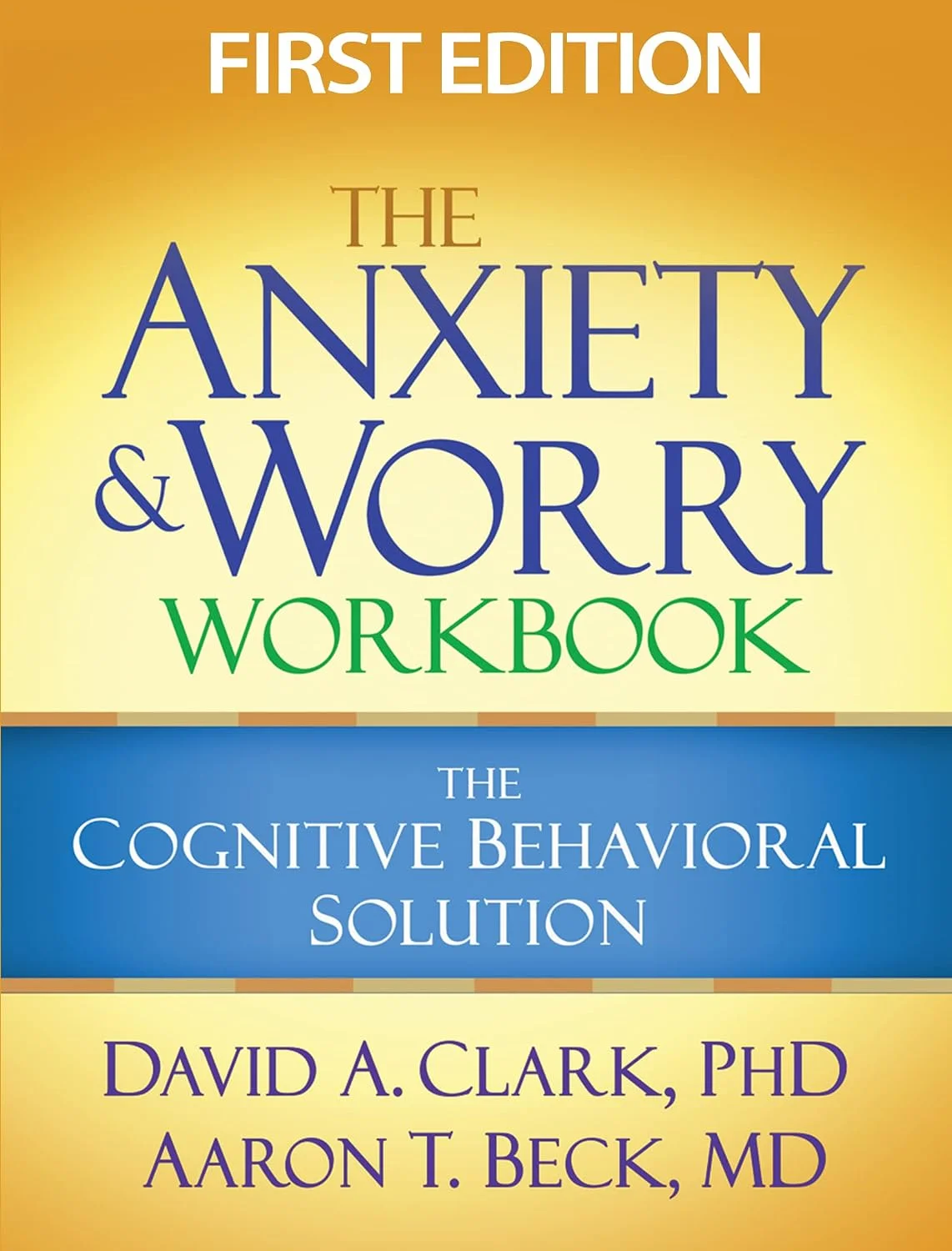
The Anxiety and Worry Workbook: The Cognitive Behavioral Solution
 Aaron Beck
Clark and Beck translate the cognitive model of anxiety into a structured self-help program, arguing that anxiety persists because individuals systematically overestimate threat and underestimate their coping resources. The workbook teaches readers to identify anxiety-triggering thoughts, collect evidence against catastrophic predictions, reduce safety behaviors, and conduct self-guided exposures. Its first eight chapters cover general cognitive and behavioral strategies; the final three apply these tools to panic disorder, social phobia, and generalized anxiety disorder, with worksheets, case examples, and disorder-specific cognitive constructs such as anxiety sensitivity and fear of negative evaluation.
Key Details
Related Books
View AllSimilar books from the same category, ranked by shared topics and reader engagement.


Key Insights — Read in 10 Minutes
What is the central mechanism this workbook teaches for reducing anxiety?
The workbook operationalizes Clark and Beck's risk-resource model of anxiety: anxious individuals systematically overestimate the probability and severity of threat while underestimating their ability to cope. The program teaches readers to identify anxiety-triggering automatic thoughts, collect evidence that contradicts catastrophic predictions, develop alternative appraisals, reduce safety behaviors that maintain fear, and conduct self-guided exposures to feared situations . A review in Cognitive and Behavioral Practice describes the first eight chapters as providing 'meticulous coverage' of these cognitive and behavioral strategies, noting the book's engaging metaphors, extensive worksheets, and numerous case examples make the techniques accessible to self-directed learners .
Which anxiety disorders does the workbook specifically address, and how is the material organized?
The workbook is divided into two main sections. The first eight chapters cover general cognitive therapy strategies applicable across anxiety problems: identifying cognitive distortions, collecting evidence against threatening thoughts, and behavioral techniques for reducing safety behaviors and conducting exposures . The final three chapters provide disorder-specific applications for panic disorder, social phobia, and generalized anxiety disorder . Each condition chapter educates readers about the cognitive constructs particularly relevant to that disorder—anxiety sensitivity in panic disorder, fear of negative evaluation in social phobia, and intolerance of uncertainty in generalized anxiety. This structure allows readers to work through foundational skills before applying them to their specific presentation.
How does this workbook relate to Clark and Beck's professional volume, Cognitive Therapy of Anxiety Disorders?
The workbook is the self-help companion to the 2009 professional text, translating the same cognitive model and therapeutic techniques into accessible language for general readers. The professional volume provides disorder-specific mini-manuals for clinicians; the workbook adapts these protocols into self-directed exercises, worksheets, and case examples that individuals can complete independently . Reviews note that the workbook 'does not strive to break new ground' theoretically but instead 'thoroughly equips the anxious yet self-motivated individual' with the tools developed in the clinical literature . The relationship is one of application: the professional book establishes the evidence base, the workbook operationalizes it for non-clinicians.
What recognition has the workbook received, and what distinguishes the second edition?
The first edition received the Association for Behavioral and Cognitive Therapies Self-Help Book of Merit designation . The second edition, published in 2023, was updated throughout with new evaluation exercises to help readers understand their own anxiety patterns, updated information on panic attacks and social anxiety, additional graphics, and new troubleshooting tools . It also incorporates the concept of 'recovery-oriented cognitive behavioral therapy,' which focuses not only on symptom reduction but on transforming self-perception and increasing stress resilience . The second edition spans 356 pages and includes downloadable worksheets that readers can print as needed .
What are the limitations of a self-help workbook for anxiety, as documented by reviewers?
Reviews acknowledge that the workbook is best suited to 'self-motivated' individuals and that its effectiveness depends on consistent engagement with the exercises . While the book provides extensive worksheets and structured guidance, it cannot replicate the collaborative relationship, individualized conceptualization, and real-time feedback of therapist-delivered CBT. The authors include case examples to illustrate how to apply techniques, but readers with severe symptoms, complex comorbidity, or limited insight may find self-directed work insufficient. Reviews note the workbook is 'particularly suited' to panic, social phobia, and generalized anxiety but does not address specific phobias, obsessive-compulsive disorder, or posttraumatic stress disorder in dedicated chapters .
How has the workbook been disseminated internationally?
The workbook has been translated into multiple languages, reflecting its global reach. A Japanese edition was published in 2024 by Iwasaki Gakujutsu Shuppansha, translated by Tatsuya Hayashi and supervised by Yutaka Ohno . Traditional Chinese editions appeared in Taiwan in 2020 and 2025, published by Gaobao International, with the 2025 edition including a supplementary anxiety self-help practice booklet . Simplified Chinese editions were published by People's Posts and Telecommunications Press in 2019 and 2023 . These translations indicate the workbook's adoption beyond English-speaking clinical contexts, though the fidelity of specific translations has not been the subject of documented scholarly critique.
Wealthy Psyche is an intellectual archive. We do not host, distribute, or sell book copies — physical or digital. We provide structured knowledge to help you think better, faster.