


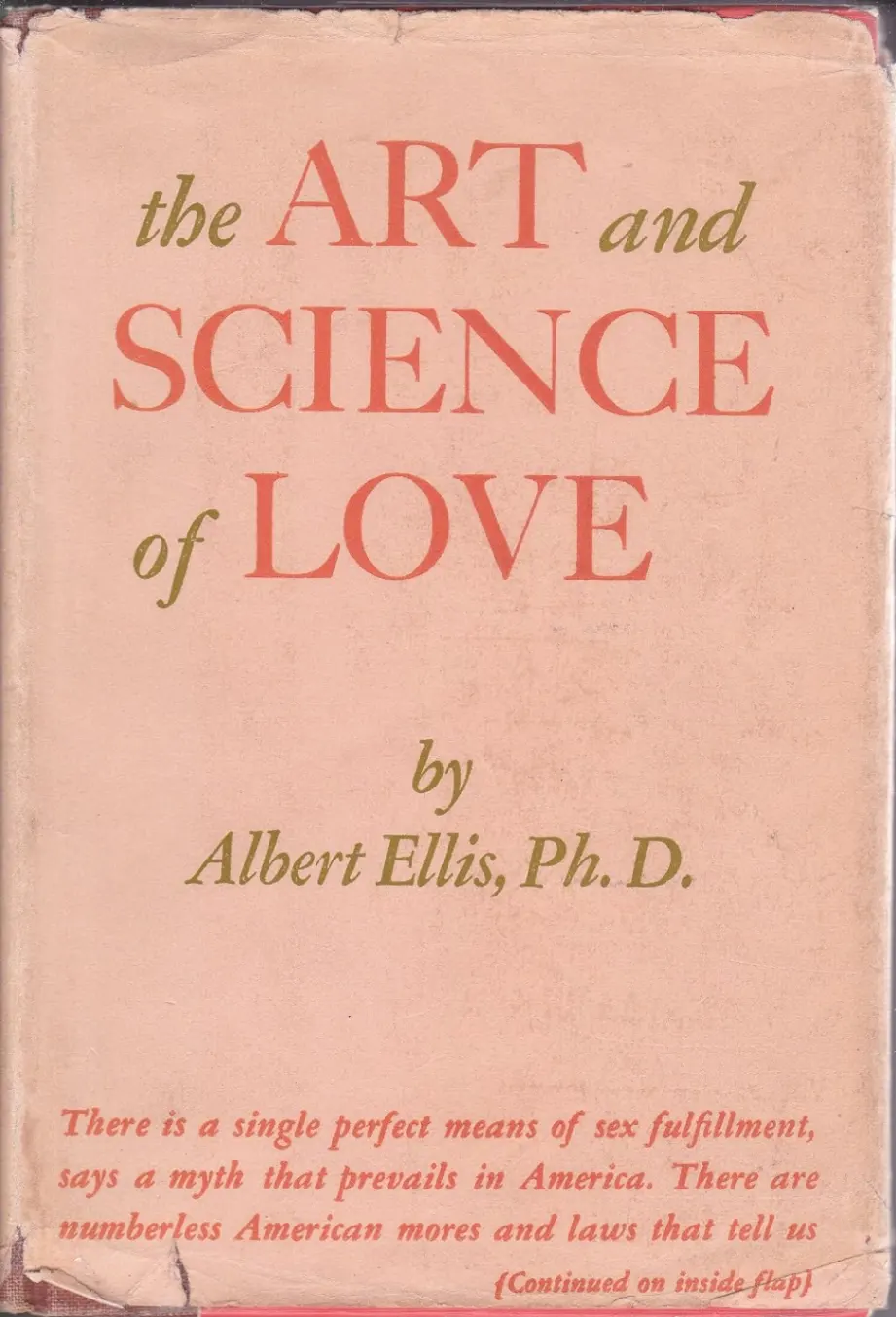
The Art and Science of Love
 Albert Ellis
Ellis applies his rational-emotive framework to sexual and marital fulfillment, arguing that sexual problems stem not from technique deficits but from irrational beliefs—the 'musts' and 'shoulds' that create performance anxiety, guilt, and resentment. The book rejects moralizing approaches to sex and the psychoanalytic focus on deep unconscious processes, offering instead a direct, here-and-now re-education in rational sexual attitudes. Its central mechanism is the same ABC model Ellis developed for emotional disturbance, applied to the bedroom: beliefs about sexual performance, not the performance itself, determine satisfaction.
Key Details
Related Books
View AllSimilar books from the same category, ranked by shared topics and reader engagement.


Key Insights — Read in 10 Minutes
What is the central argument of The Art and Science of Love, and how does it apply Ellis's therapeutic framework?
Ellis argues that sexual satisfaction is determined less by technique than by the attitudes and beliefs individuals bring to sexual experience. His main theme is that sexual intercourse in humans requires both learning and conditioning, and that most sexual problems stem from irrational beliefs—'catastrophizing sentences,' as a contemporary reviewer noted—rather than from deep psychological conflict or inadequate technique . This applies the same ABC model Ellis developed for emotional disturbance: beliefs about sexual performance, not the performance itself, determine emotional and physical response. The book explicitly abandons psychoanalytic interpretation for a direct, here-and-now re-education approach, urging patients to focus attention on the essential pleasures of sexual activity rather than on performance anxieties .
How does the book differ from other marriage manuals of its era?
Ellis distinguishes his book from standard marriage manuals through its psychobiological emphasis and its refusal to moralize. A 1960 review in Marriage and Family Living noted that while the book 'follows the usual approach' in covering anatomy and physiology, it 'differs from others in its strong psychobiological flavour' . Ellis makes readers aware that while sex involves biology, 'the way man defines the various aspects of the experience' most strongly influences satisfaction . He discusses premarital and extramarital relationships frankly, showing both advantages and disadvantages for mature, well-informed individuals . The book also tackles sexual deviations, subfertility, and birth control—topics that many contemporary manuals avoided or treated moralistically.
What did contemporary reviewers identify as the book's major weakness?
A 1960 review in Marriage and Family Living identified a fundamental inconsistency: Ellis 'professes to take a nonmoralizing approach while at the same time he does indeed engage in a good deal of moralizing,' frequently attributing his own moral position to the authority of science . The reviewer, Glenn M. Vernon of Brigham Young University, argued that Ellis fails to recognize that science cannot endorse moral positions—concepts like 'normal,' 'deviant,' 'immature,' and 'desirable' cannot be scientifically determined but only compared against arbitrary standards . This critique remains relevant: Ellis's advocacy of liberalized sexual standards is presented as scientifically grounded when it is, in fact, a moral and philosophical position.
What role did this book play in Ellis's broader career as a sexologist?
The Art and Science of Love is a product of Ellis's early and sustained career as a sexologist, which ran parallel to and predated his development of REBT. By the 1960s, Ellis 'had come to be seen as one of the founders of the American sexual revolution' . He worked with Alfred Kinsey and wrote extensively on human sexuality throughout his career . The book's frank treatment of premarital and extramarital sex, homosexuality, and sexual deviations was consistent with his broader advocacy for liberal sexual attitudes, most famously expressed in Sex Without Guilt (1958). This book thus represents the intersection of Ellis's two professional identities: the sexologist and the rational therapist.
How has the book been translated and received internationally?
The Art and Science of Love has been translated into multiple languages, indicating its international reach. An Italian translation, Arte e scienza dell'amore, was published by Edizioni Mediterranee in 1964, translated by Paolo Silenziario . A French translation, L'art et la science de l'amour, was published in 1967 by the Centre national du livre familial, translated by R. Schiller and L. Germain . These translations suggest the book found audiences beyond English-speaking countries, though the fidelity of specific translations has not been the subject of documented scholarly critique. The Italian edition had at least two printings .
What are the book's documented limitations as a sex manual?
Beyond the moralizing critique, the book has limitations rooted in its era and Ellis's approach. The reviewer for Marriage and Family Living found that 'both art and science are mixed together in such a manner that the unsophisticated reader is unable to distinguish between them' . The book also makes claims that later research complicated—for instance, Ellis asserted in 1960 that 'it is doubtful whether a special vaginal orgasm exists' , a claim that anticipated Masters and Johnson but was not yet supported by their direct laboratory research. A modern reader noted that Ellis later significantly modified some views expressed in the book, particularly regarding homosexuality .
Wealthy Psyche is an intellectual archive. We do not host, distribute, or sell book copies — physical or digital. We provide structured knowledge to help you think better, faster.