


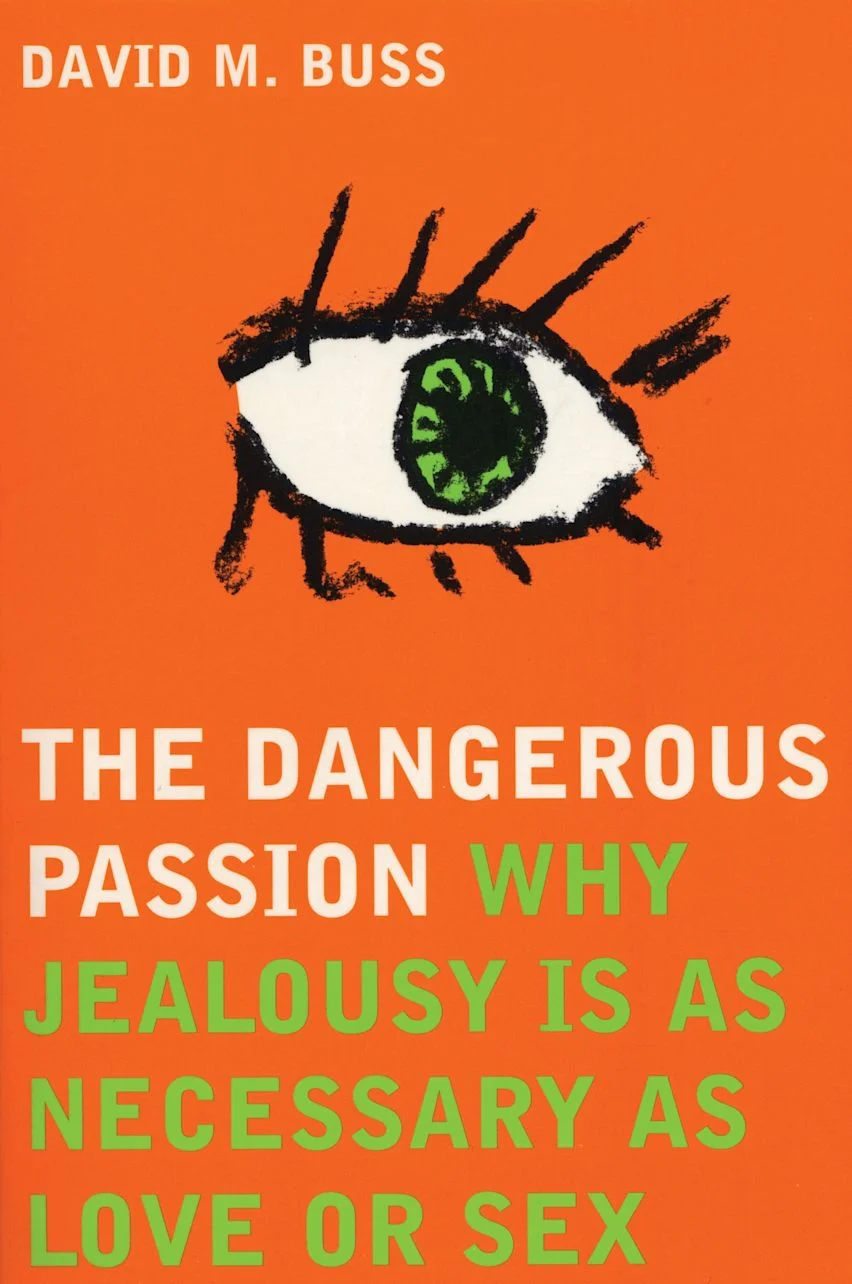
The Dangerous Passion: Why Jealousy Is as Necessary as Love and Sex
.webp?alt=media&token=ead19a6b-0711-40b9-8688-4dd07e665520) David Michael Buss
David Michael BussBuss argues that jealousy is not a neurosis or a cultural artifact but an evolved adaptation—a "hypersensitive defense system" that helped ancestral men guard against cuckoldry and ancestral women guard against the loss of a partner's commitment and resources. Drawing on cross-cultural surveys, this book proposes that men and women possess different jealousy triggers shaped by distinct reproductive threats, and that this dangerous passion, while capable of destroying relationships, also serves as evolutionary glue.
Key Details
Related Books
View AllSimilar books from the same category, ranked by shared topics and reader engagement.


Key Insights — Read in 10 Minutes
What is the central claim of The Dangerous Passion, and what does it reject?
Buss contends that jealousy is an evolved psychological adaptation—a "hypersensitive defense system" that alerted ancestral humans to threats against their reproductive partnerships. The book explicitly rejects the twentieth-century view that jealousy is a neurosis, a sign of immaturity, or a product of capitalism and patriarchy. Instead, Buss argues that jealousy has a crystalline evolutionary logic: men historically faced the risk of cuckoldry and investing in another man's offspring, while women risked losing a partner's emotional commitment and material resources. The dangerous passion is therefore not a character flaw but inherited emotional wisdom, though Buss acknowledges it can become pathological when excessive.
How does Buss's account of jealousy differ from earlier psychological and feminist explanations?
Earlier frameworks—psychodynamic, clinical, and feminist—treated jealousy variously as a symptom of insecurity, a character defect, or a tool of patriarchal control. Buss directly challenges these accounts, arguing that while culture and socialization shape how jealousy is expressed, they cannot explain its cross-cultural regularity or its sex-differentiated triggers. His surveys across multiple nations found that men consistently report greater distress at sexual infidelity, while women report greater distress at emotional infidelity—a pattern he interprets as reflecting distinct ancestral reproductive threats. Critics, including feminist scholars and some evolutionary researchers, have argued that the sex-difference findings are sensitive to methodology and that Buss understates the role of social power in shaping jealousy dynamics.
How has the argument of The Dangerous Passion held up since its publication in 2000?
The book's core sex-difference finding—that men are more distressed by sexual infidelity and women by emotional infidelity—has been replicated in many studies, though the effect sizes vary and some researchers have challenged whether the pattern is as robust as originally claimed. Methodological critiques have focused on whether forced-choice measures exaggerate the difference and whether hypothetical scenarios predict real-world reactions. The broader adaptationist framework has remained influential within evolutionary psychology, but the specific claim that jealousy is a domain-specific adaptation rather than a byproduct of more general threat-detection mechanisms remains debated. Buss's popular writing style also drew criticism from some academics who felt the book prioritized accessibility and provocation over scholarly nuance.
What specific concept did the book introduce, and where does it appear today?
The Dangerous Passion popularized the concept of jealousy as a "hypersensitive defense system"—an evolved mechanism biased toward false positives. Buss reasoned that ancestral humans who failed to detect a partner's infidelity faced catastrophic reproductive costs, while those who falsely suspected infidelity faced relatively minor costs. Natural selection therefore favored a jealousy mechanism calibrated to err on the side of suspicion. This concept has been applied in research on mate-guarding behavior, relationship conflict, domestic violence risk assessment, and even organizational behavior, where vigilance biases have been studied as analogous threat-detection systems. The "Othello Syndrome" chapter also brought clinical attention to pathological jealousy cases where suspicions later proved justified.
How does the book relate to Buss's earlier work, The Evolution of Desire?
The Dangerous Passion extends the framework Buss developed in The Evolution of Desire (1994). While the earlier book focused on mate selection preferences—what men and women look for in partners—The Dangerous Passion shifts to mate retention and the threats that disrupt it. Buss describes jealousy as the emotional system that evolved to protect the partnerships formed through the strategies outlined in the earlier work. The two books form a complementary pair: one on attraction and choice, the other on guarding and maintaining those choices against rivals. Reviewers noted that The Dangerous Passion is written for a broader audience than its predecessor, using more everyday examples and adopting a less academic citation style.
What are the main criticisms of the book's methodology and conclusions?
Critics have raised several methodological concerns. Survey respondents were often university students receiving academic credit, limiting generalizability to broader populations. Hypothetical scenarios about infidelity may not predict actual emotional or behavioral responses. The forced-choice format—asking whether sexual or emotional infidelity is more distressing—may artificially amplify sex differences. Some evolutionary psychologists, including David DeSteno and others, have argued that the sex difference is context-dependent rather than a fixed adaptation. Feminist critics have contended that Buss naturalizes male sexual jealousy and downplays how patriarchal structures shape both the experience and expression of jealousy. Buss has responded that acknowledging an evolutionary origin does not justify harmful behavior.
Wealthy Psyche is an intellectual archive. We do not host, distribute, or sell book copies — physical or digital. We provide structured knowledge to help you think better, faster.