


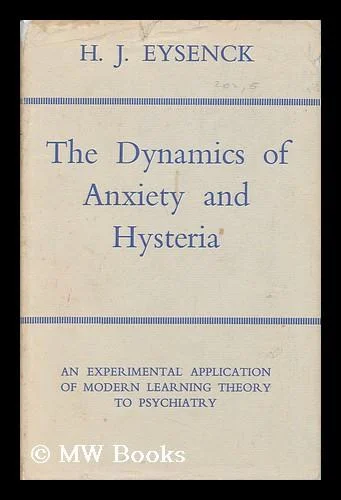
The Dynamics of Anxiety and Hysteria: An Experimental Application of Modern Learning Theory to Psychiatry
 Hans Eysenck
Eysenck applies Pavlovian and Hullian learning theory to the neuroses, arguing that anxiety and hysteria occupy different points on the introversion–extraversion dimension and can be explained by the rise and fall of excitation and inhibition rather than by psychoanalytic conflict. The book's central mechanism is the theory that dysthymics (anxious, obsessional neurotics) are introverted, showing rapid conditioning and slow extinction, while hysterics are extraverted, showing the opposite pattern. It rejects the Freudian monopoly on 'dynamic' psychiatry by grounding causation in laboratory-measurable processes.
Key Details
Related Books
View AllSimilar books from the same category, ranked by shared topics and reader engagement.


Key Insights — Read in 10 Minutes
What is the central theoretical claim linking learning theory to the neuroses in this book?
Eysenck argues that anxiety (dysthymia) and hysteria represent opposite poles of the introversion–extraversion dimension as expressed through conditionability. Dysthymics are introverted: they form conditioned reflexes quickly and strongly, and extinguish them slowly, producing excessive anxiety responses to previously neutral stimuli. Hysterics are extraverted: they condition poorly and extinguish quickly, failing to develop the anxiety responses that would inhibit antisocial or maladaptive behavior . The theory is built on Pavlovian concepts of excitation and inhibition, mediated through Hullian learning theory. Eysenck states his aim is to move 'from nosology to aetiology; from description to causation,' providing empirical foundations for themes previously monopolized by psychoanalysis .
How does the book differentiate dysthymia from hysteria, and what experimental predictions follow?
Dysthymia is Eysenck's term for introverted neurosis—conditions such as anxiety states, obsessional neuroses, and reactive depression. Hysteria is the extraverted neurosis, encompassing conversion and dissociative disorders. The experimental predictions are precise: dysthymics should condition faster, show slower extinction, greater reminiscence, and more work decrement than hysterics . Hysterics, with their more active inhibitory mechanisms, should show the opposite pattern. A reviewer in the British Journal of Medical Psychology noted that Eysenck's approach was characterized by 'fruitful original and consistent' laboratory work, though clinicians might struggle to recognize their patients beneath the 'anonymity of groups such as obsessionals, anxiety states, psychopaths' that made up his experimental samples .
What were the major criticisms of Eysenck's use of learning theory in this book?
R. A. Champion, reviewing in the British Journal of Psychology, identified three fundamental problems. First, Eysenck fails to distinguish consistently between habit strength and excitatory potential in determining performance. Second, he does not adequately account for the role of motivation in learning, and his application of 'relevant drive' is vague and inconsistent. Third, his interpretation of the performance curves displayed by dysthymic, hysteric, and normal subjects is 'arbitrary and questionable' . David Lykken, reviewing in Contemporary Psychology, noted that Eysenck treats five parameters of conditioning as if they were correlated without making clear how they relate, and challenged the empirical basis for predictions about reminiscence and perceptual aftereffects . Lykken subsequently engaged in a published exchange with Eysenck over these issues .
What does the book's subtitle 'An Experimental Application' signal about its method?
The subtitle signals that the book is not a theoretical treatise but a report of laboratory-based research conducted under Eysenck's direction at the Institute of Psychiatry, University of London. It was the fifth book in a series of experimental studies and theoretical work carried out under those auspices . The chapters move from dimensional analysis of anxiety and hysteria, through critical and constructive treatments of personality and learning theory, to perceptual processes, socialization, drugs, and finally psychiatric practice . A reviewer in Mental Health noted that the book 'appeals only to the psychologically sophisticated' and 'may be positively misleading for those who, without much clinical experience, can be bemused by statistics' .
What is the publication history of the book, and why is the first edition year sometimes cited inconsistently?
The Dynamics of Anxiety and Hysteria was first published in 1957 by Routledge & Kegan Paul in London . It has never been published in the United States . The year is sometimes cited as 1958 because reviews appeared that year , and some catalogs list a 1964 edition . The book was reissued by Transaction Publishers with a 1967 listing , and again in Routledge's Psychology Revivals series in 2013 . The original edition runs 311 pages . A Japanese translation was published under the title 不安とヒステリーの力学 .
How does the book relate to Eysenck's earlier dimensional work?
The book is the fifth in Eysenck's series of experimental studies following Dimensions of Personality (1947), The Scientific Study of Personality (1952), The Structure of Human Personality (1953), and The Psychology of Politics (1954) . Where the earlier books were concerned with 'extraction of possible personality factors from clinical data and experimental results,' this volume 'goes further by attempting to apply learning theory of a rather rigid and Pavlovian kind to the explanation of the personality differences he has so far found' . The publisher's description explicitly frames the shift as moving 'beyond classification to a study of dynamics; from nosology to aetiology' . The dimensional framework—introversion–extraversion and neuroticism—is assumed rather than established here.
Wealthy Psyche is an intellectual archive. We do not host, distribute, or sell book copies — physical or digital. We provide structured knowledge to help you think better, faster.