


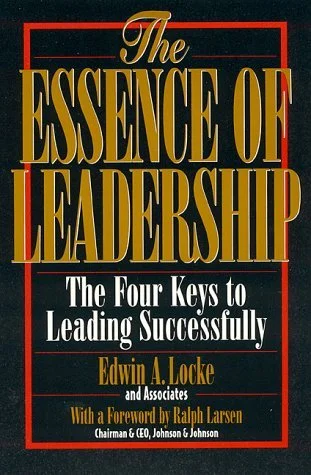
The Essence of Leadership: The Four Keys to Leading Successfully
 Edwin A. Locke
Locke, with Ken Blanchard and others, distills leadership into four core capacities: vision, motivation, credibility, and intellectual breadth. The book's distinctive move is to ground each key in Locke's long-running goal-setting research program, treating leadership as a set of learnable cognitive and motivational tasks rather than a personality trait or a situational fit. Vision supplies direction; motivation converts it into sustained goal commitment; credibility rests on honesty and competence, and intellectual breadth enables leaders to grasp the wider context in which goals are set. The result is a compact, theory-anchored framework that owes more to goal theory and trait research than to contingency models of leadership.
Key Details
Related Books
View AllSimilar books from the same category, ranked by shared topics and reader engagement.



Key Insights — Read in 10 Minutes
What is the central claim of The Essence of Leadership, and what does it reject?
The central claim is that effective leadership can be decomposed into four core keys — vision, motivation, credibility, and intellectual breadth — each of which is learnable and grounded in psychological research rather than innate charisma. Locke rejects the view that leadership is primarily a matter of personality traits, situational contingency, or transformational charisma. Instead, he treats leadership as a set of cognitive and motivational tasks that a person can develop. The framework draws heavily on goal-setting theory, so motivation is understood in terms of specific, challenging goals and commitment rather than inspiration alone. Credibility, meanwhile, is framed as honesty and competence, making trust a product of demonstrated reliability rather than emotional connection.
How does Locke's goal-setting research shape the book's account of leadership?
Locke is best known for goal-setting theory, developed with Gary Latham, which holds that specific, difficult goals produce higher performance than vague 'do your best' instructions when people are committed and receive feedback. The Essence of Leadership applies that logic to leaders: their job includes setting clear direction, securing commitment, and ensuring feedback, which correspond to the vision and motivation keys. This gives the book an unusually precise motivational mechanism compared with leadership books that speak loosely of 'inspiring' followers. It also means the framework is strongest where goals can be specified and measured, and it inherits goal-setting theory's assumptions about conscious purpose as a driver of behavior.
How does the four-keys model differ from transformational and contingency theories of leadership?
Transformational leadership theories, associated with Bernard Bass and others, emphasize charisma, individualized consideration, and intellectual stimulation as leader behaviors that inspire followers beyond transactional exchange. Contingency theories, such as Fiedler's, hold that effectiveness depends on matching leader style to situational favorability. Locke's four-keys model is deliberately more universal and cognitive: it specifies what leaders must accomplish regardless of situation, and it grounds those tasks in goal theory and trait research rather than in follower perception of charisma. This makes the model simpler and more prescriptive, but also less attentive to situational variation. Critics of universal models would argue that it underplays context, while Locke's position is that the keys are necessary even if their expression varies.
What is the role of credibility and intellectual breadth, and why are they often overlooked?
Credibility combines honesty and competence: followers must believe the leader is truthful and capable, or the vision will not be trusted. Intellectual breadth is the leader's grasp of the wider environment — economic, technological, and organizational — that determines whether goals are well chosen. Both keys are easily overlooked because leadership writing tends to focus on vision and motivation, which are more visible and more emotionally appealing. Locke's inclusion of intellectual breadth is notable because it makes knowledge a leadership requirement rather than an optional refinement, and it connects leadership to strategic judgment rather than interpersonal skill alone. The four keys thus balance motivational and cognitive demands.
What are the main limitations or criticisms of the four-keys framework?
The main criticisms concern generality and evidence. The four keys are broad enough that almost any effective leader could be described as possessing them, which raises questions about falsifiability and practical guidance. The framework also leans heavily on goal-setting theory, whose effects depend on commitment, feedback, and task complexity — conditions that leadership contexts do not always satisfy. Compared with contingency and transformational models, it says less about how leaders should adapt to followers' needs or situational constraints. Additionally, the book is coauthored and aimed partly at practitioners, so some claims are asserted rather than empirically tested in the leadership domain. Readers should treat it as a theoretically anchored distillation rather than a comprehensive empirical review.
How does this book compare with Kouzes and Posner's The Leadership Challenge?
Kouzes and Posner's model, built from surveys of followers' reports of exemplary leadership, identifies five practices such as modeling the way, inspiring a shared vision, and encouraging the heart. It is empirically derived from follower perceptions and emphasizes relational and inspirational behaviors. Locke's four keys are theory-driven, anchored in goal-setting and trait research, and comparatively cognitive: vision, motivation, credibility, and intellectual breadth. The two frameworks overlap on vision and credibility but diverge on method and emphasis — Kouzes and Posner describe what followers observe in admired leaders, while Locke specifies what leaders must accomplish psychologically. Reading them together shows the difference between perception-based and theory-based approaches to leadership.
Wealthy Psyche is an intellectual archive. We do not host, distribute, or sell book copies — physical or digital. We provide structured knowledge to help you think better, faster.