


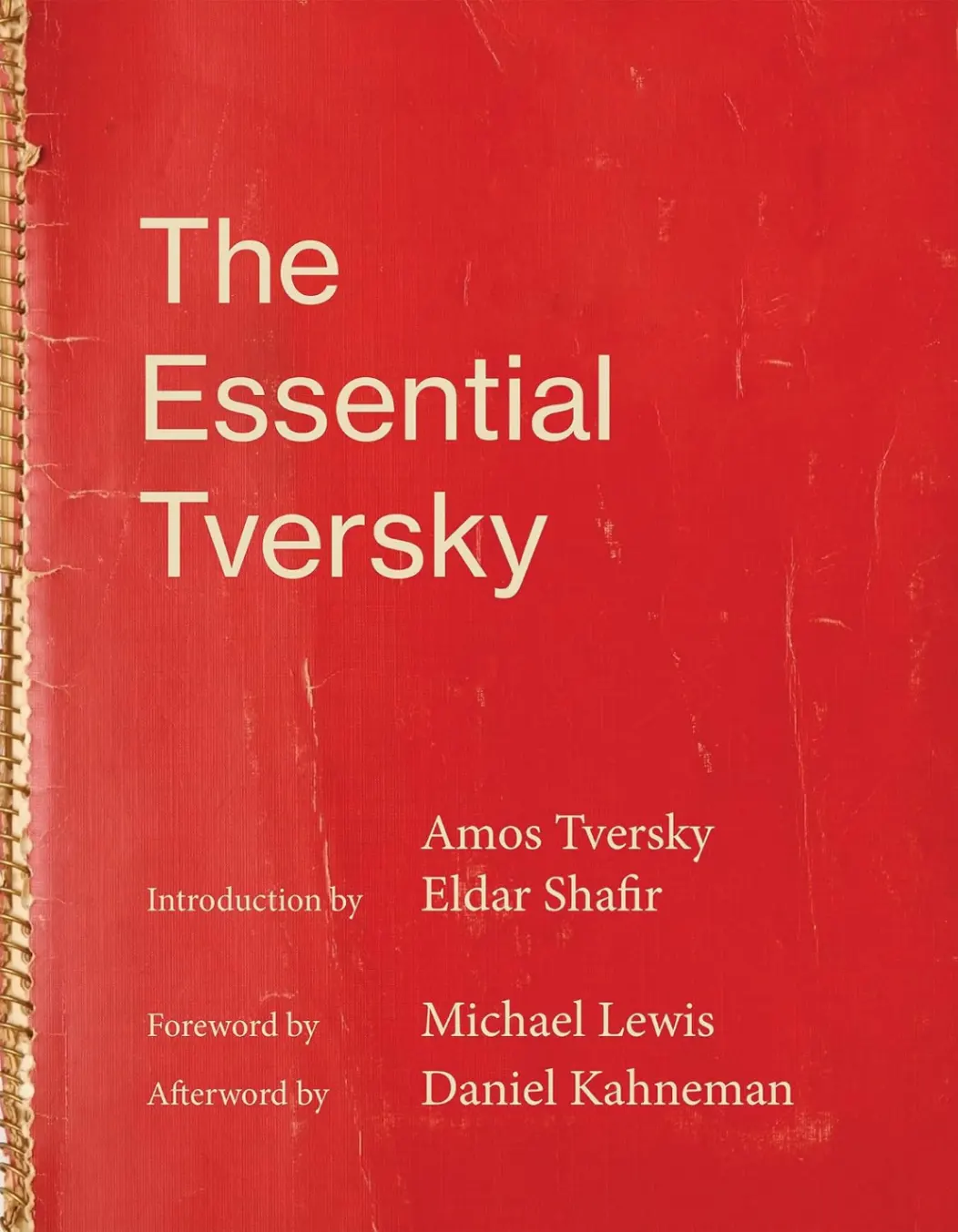
The Essential Tversky
 Amos Tversky
This volume presents fourteen of Amos Tversky's most influential papers, selected and introduced by his student and collaborator Eldar Shafir to make Tversky's work accessible to a broader audience. The collection spans Tversky's core contributions: the heuristics and biases program with Daniel Kahneman, the feature-based contrast model of similarity, prospect theory's challenge to expected utility, and later work on ambiguity aversion and support theory. Rather than a comprehensive archive, The Essential Tversky is a curated introduction built around the papers that most clearly demonstrate Tversky's method of first mastering normative theory, then experimentally documenting its systematic violation.
Key Details
Related Books
View AllSimilar books from the same category, ranked by shared topics and reader engagement.


.webp?alt=media&token=34bd26c3-d0b0-4cd7-a235-153b0182ef19)
Key Insights — Read in 10 Minutes
How does The Essential Tversky differ from the earlier Preference, Belief, and Similarity collection?
The two volumes serve distinct purposes. The 2003 Preference, Belief, and Similarity, edited by Eldar Shafir in collaboration with Tversky before his death, contains forty papers organized into comprehensive sections on Similarity, Judgment, and Preference. The Essential Tversky, published in 2018, distills that larger collection to fourteen papers chosen specifically for accessibility and influence. Shafir's introduction to The Essential Tversky frames it as an introduction for nonspecialists, whereas the earlier volume functions as a more complete scholarly reference. The Essential Tversky also includes a foreword by Michael Lewis and an afterword by Daniel Kahneman, contextualizing Tversky's work for readers who encountered his ideas through popular accounts of behavioral economics.
Which papers are included in The Essential Tversky, and what makes them 'essential'?
The collection includes the foundational 'Judgment under Uncertainty: Heuristics and Biases,' 'Prospect Theory: An Analysis of Decision under Risk,' 'Features of Similarity,' 'Rational Choice and the Framing of Decisions,' 'Belief in the Law of Small Numbers,' 'The Weighing of Evidence and the Determinants of Confidence,' 'Ambiguity Aversion and Comparative Ignorance,' 'Support Theory,' and 'Reason-Based Choice,' among others. The selection criteria prioritize papers that are both influential and readable for nonspecialists. Matthias Lang's review in the Journal of Economics notes that some papers, such as 'Features of Similarity,' may seem less relevant to economics readers, while the prospect theory and ambiguity aversion papers are directly applicable to economic analysis . The result is a volume that captures Tversky's range without the density of the complete scholarly edition.
What role did Daniel Kahneman and Michael Lewis play in this volume?
Both contributed paratext that frames Tversky's legacy for contemporary readers. Michael Lewis, whose bestselling The Undoing Project chronicled the Tversky-Kahneman collaboration, wrote the foreword. Daniel Kahneman, Tversky's most frequent collaborator, contributed the afterword. According to the MIT Press description, Kahneman drew on their joint work in Thinking, Fast and Slow and received the 2002 Nobel Prize in Economics for that collaboration . Lewis's foreword connects Tversky's thinking to Moneyball, his own book on statistical reasoning in baseball. These contributions position The Essential Tversky not merely as a scholarly collection but as a document in the broader popular reception of behavioral economics.
How does the book's treatment of prospect theory relate to the original 1979 paper?
The volume reprints the original 1979 'Prospect Theory: An Analysis of Decision under Risk' alongside later papers that extend and refine the framework. 'Rational Choice and the Framing of Decisions' demonstrates how prospect theory's reference-dependence explains framing effects, while 'Loss Aversion in Riskless Choice' applies loss aversion to the endowment effect. The collection does not include the 1992 'Advances in Prospect Theory,' which introduced cumulative prospect theory and addressed technical limitations of the original model. Readers seeking the full trajectory of prospect theory's development should consult Choices, Values, and Frames. The Essential Tversky presents prospect theory as a coherent framework through its original statement and key applications rather than its complete technical evolution.
What is the 'heuristics and biases' program, and how does this book present it?
The heuristics and biases program, introduced in the 1974 Science paper 'Judgment under Uncertainty: Heuristics and Biases,' proposed that people rely on mental shortcuts—representativeness, availability, and anchoring—that produce systematic errors in probability judgment. The Essential Tversky includes this foundational paper along with extensions: 'Belief in the Law of Small Numbers' shows how representativeness leads to misconceptions about sampling, and 'The Weighing of Evidence and the Determinants of Confidence' examines confidence calibration. The collection presents these papers not as isolated findings but as a coherent research program. However, the volume does not include the substantial body of criticism the program has attracted, notably from Gerd Gigerenzer and the ABC Research Group, who argue that heuristics are ecologically rational rather than sources of bias. Readers should consult The Essential Tversky as an introduction to the program's original claims, not as a comprehensive treatment of its contested legacy.
Why does the collection include 'Features of Similarity' alongside decision-making papers?
'Features of Similarity' (1977) introduced Tversky's contrast model, which proposed that similarity judgments depend on the weighting of common and distinctive features rather than geometric distance in psychological space. Although the paper appears on its surface to address a different topic than prospect theory or heuristics and biases, it reflects Tversky's methodological consistency: in each domain, he challenged a dominant formal model by demonstrating its descriptive inadequacy. The contrast model also influenced later work on categorization and analogy. Matthias Lang's review notes that this paper, while highly cited, 'does not fit any of the other three topics and seems less relevant for economics' . Its inclusion signals that The Essential Tversky aims to represent Tversky's full intellectual range, not merely his most economically consequential contributions.
Show 1 more insights
Is The Essential Tversky suitable for readers without a technical background?
The volume is explicitly designed as an accessible introduction. Shafir's introduction and the inclusion of Lewis's foreword suggest the editors envisioned readers who encountered Tversky's ideas through popular books like Thinking, Fast and Slow or The Undoing Project. However, several papers retain technical content. Prospect theory includes mathematical formalisms for value functions and decision weights; support theory proposes a formal model of subjective probability. The collection sits between a popular introduction and a complete scholarly edition. Readers without quantitative training can follow the conceptual arguments and experimental findings, but full engagement with the theoretical papers requires comfort with formal models. The Essential Tversky is best understood as a bridge from popular accounts to primary literature.
Wealthy Psyche is an intellectual archive. We do not host, distribute, or sell book copies — physical or digital. We provide structured knowledge to help you think better, faster.