


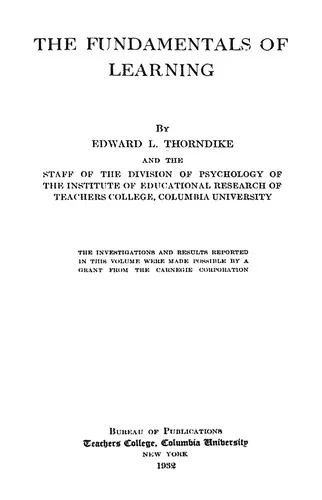
The Fundamentals of Learning
 Edward Lee Thorndike
Thorndike argues that learning is governed primarily by the after-effects of satisfaction, not by the mere frequency or recency of stimulus-response connections. Drawing on over one hundred experiments conducted with his Columbia staff between 1927 and 1930, he presents detailed evidence that repetition without “belongingness” produces no strengthening of bonds, and that punishment does not weaken connections in a manner symmetrical to the strengthening effect of reward. The book documents the experimental basis for his revision of the law of exercise and his truncated law of effect, establishing satisfaction as the central condition of learning.
Key Details
Related Books
View AllSimilar books from the same category, ranked by shared topics and reader engagement.



Key Insights — Read in 10 Minutes
What is the central empirical claim of The Fundamentals of Learning, and how does it revise Thorndike's earlier laws?
The book's central claim is that learning is conditioned primarily by the achievement of satisfactions, not by the frequency or recency of stimulus-response connections. This revises Thorndike's earlier law of exercise, which had held that repetition strengthens bonds. The experiments reported demonstrate that mere repetition of a situation produces no improvement when the element of satisfaction or belongingness is absent. Thorndike concludes that the law of exercise must be practically renounced as an independent law of learning, and that the law of effect—in a truncated form—remains the fundamental principle: reward strengthens connections, but punishment does not weaken them in any comparable way.
What was the experimental evidence that led Thorndike to abandon the law of exercise?
The disproof of the law of exercise came from experiments in which repetition occurred under conditions where the law of effect could not operate. In one type of experiment, subjects repeatedly attempted to draw a line exactly three inches long while blindfolded; no matter how many times they repeated the attempt, no improvement occurred. Practice brought improvement only when subjects were informed after each attempt whether their line was too long or too short—that is, when a satisfying or informative after-effect was present. Thorndike concluded that mere repetition of situations produces no change in the strength of connections, and that the strengthening effect attributed to exercise actually depends on the operation of reward. He estimated that a single occurrence followed by reward strengthens a connection about six times as much as mere occurrence without reward.
What does Thorndike mean by “belongingness,” and what role does it play in his revised theory?
Belongingness is the principle that a connection is more easily learned when the elements involved are perceived as going together, as belonging to one another. Thorndike illustrates this with the example of learning “John is a butcher; Henry is a carpenter”: the association John-butcher is stronger than butcher-Henry, even though the latter items are more contiguous, because subject and predicate belong together in a way that the end of one sentence and the beginning of another do not. Belongingness modifies the operation of both exercise and effect. Repetition strengthens a connection only when belongingness is present; reward strengthens a connection more effectively when the reward belongs to the activity rewarded. The concept was a significant concession to Gestalt psychology and introduced an organizational principle into Thorndike's otherwise mechanical associationism.
How did Thorndike revise the law of effect regarding punishment, and what was the evidence?
Thorndike's revised law of effect holds that reward strengthens connections but that punishment does not weaken them. At the Ninth International Congress of Psychology in 1929, he announced this revision with the words, “I was wrong.” The evidence came from experiments in which human subjects guessed numbers in response to words and were told Right or Wrong after each response. Rewarded responses were repeated significantly more often on subsequent trials, but punished responses were not weakened—they recurred at a rate consistent with chance. Similar results were obtained with chicks in a maze: reward strengthened the tendency to return to the rewarded choice, while punishment did not weaken the tendency to repeat the punished choice. Thorndike concluded that punishment affects learning only indirectly, by inducing the learner to do something incompatible with the punished response.
How did the book's methodology and presentation differ from Thorndike's earlier, more accessible works?
The Fundamentals of Learning is a technical research monograph, not a popular or textbook presentation. It reports 104 experiments conducted between 1927 and 1930, with detailed results presented in 153 tables across 638 pages. A contemporary reviewer noted that the volume “is not easy to read” and “is packed full of evidence” . The book was intended as the detailed empirical basis for the conclusions Thorndike had presented in the briefer and more accessible Human Learning (1931). Reviewers advised readers who cared for conclusions rather than evidence to read Human Learning first and then consult the present volume only for specific experimental details. The work was made possible by a grant from the Carnegie Corporation .
How was the book received by contemporaries, particularly by Gestalt psychologists?
The book was reviewed alongside Wheeler and Perkins's Principles of Mental Development, a Gestalt textbook, in a joint review that highlighted the fundamental opposition between the two approaches. The reviewer described Thorndike as “the father of the reaction-hypothesis” and Wheeler and Perkins as representatives of the Gestalt group . The Gestalt authors argued that “the very essence of learning is NOT REPEATING A PERFORMANCE, BUT MAKING A NEW ONE” and challenged every principle of the connectionist school. The reviewer of the joint notice observed that the Gestalt work offered “the most serious challenge to the teachings of Thorndike and his school that has yet been made” and advised Thorndike's disciples to read it carefully, predicting they would “get a number of shocks” .
Show 1 more insights
What is the relationship between this book and Thorndike's later work on the spread of effect?
The Fundamentals of Learning was followed in 1933 by Thorndike's discovery of the spread of effect, which he offered as additional evidence for the law of effect. The spread of effect is the phenomenon in which a rewarded response strengthens not only that response but also temporally adjacent responses, with the effect diminishing as the distance from the rewarded connection increases. Thorndike used this finding to argue for the automatic, mechanical operation of reward, independent of the learner's awareness or intention. Later researchers, including Tilton, questioned whether the spread of effect was an artifact of the experimental procedure, and the phenomenon became a subject of methodological dispute. The 1932 book does not include the spread-of-effect experiments, which were published in journal articles the following year.
Wealthy Psyche is an intellectual archive. We do not host, distribute, or sell book copies — physical or digital. We provide structured knowledge to help you think better, faster.