


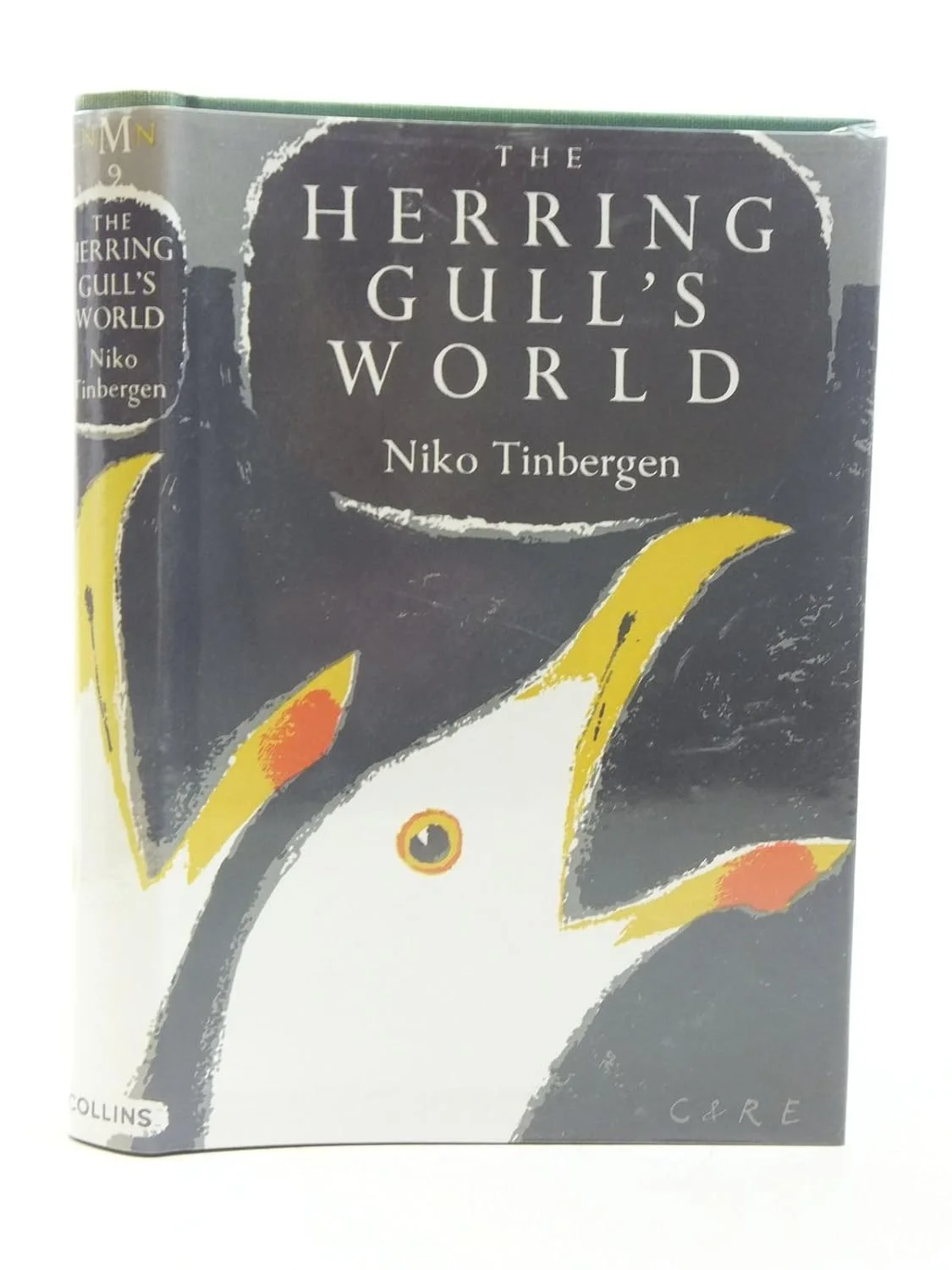
The Herring Gull's World: A Study of the Social Behaviour of Birds
 Niko Tinbergen
Tinbergen argues that the social behavior of the herring gull can only be understood through a combination of sustained field observation and field experiments that isolate the specific stimuli—the red patch on the parent's bill, the shape of the egg, the landmarks around the nest—that release instinctive responses. The book demonstrates that gulls do not recognize their own eggs or chicks as individuals but respond to sign stimuli, and that artificial models with exaggerated features (supernormal stimuli) elicit stronger reactions than natural ones. This established field experimentation as ethology's core method.
Key Details
Related Books
View AllSimilar books from the same category, ranked by shared topics and reader engagement.


Key Insights — Read in 10 Minutes
What is the central argument of The Herring Gull's World, and what methodological commitment does it establish?
Tinbergen argues that the social behavior of the herring gull—fighting, mating, incubating, feeding young—can be analyzed experimentally in the field by presenting artificial stimuli and recording responses. The book's core finding is that gulls respond to specific sign stimuli rather than to whole objects or individual identities: chicks peck at the red patch on the parent's bill, not at the parent as such; incubating gulls retrieve eggs based on shape and size, not ownership. This established field experimentation, rather than laboratory conditioning, as ethology's signature method and demonstrated that innate releasing mechanisms could be studied with the same rigor as morphological traits.
What is the specific experimental finding about herring gull chick pecking that made the book famous?
Tinbergen and his students presented newly hatched chicks with cardboard models of adult gull heads, varying the color, position, and shape of the red patch on the bill. They found that chicks pecked most at models with a red patch, but that a model with a red patch and a white ring inside it—a bull's-eye pattern more contrastive than the natural bill—elicited even more pecks. This was the first clear demonstration of a supernormal stimulus: an artificial sign stimulus that exceeds the natural releaser in effectiveness. The finding suggested that innate perceptual mechanisms respond to specific features like contrast and color, not to the biologically accurate whole object.
What textual and data discrepancies did later researchers find between the original experiments and Tinbergen's published accounts?
Carel ten Cate's 2009 analysis in Animal Behaviour documented that Tinbergen's published descriptions of the chick pecking experiments became progressively detached from the original 1947 data. The original experiment found that chicks pecked more at a black-patched model than at the red-patched one, an outcome Tinbergen attributed to a methodological error—the red model had been presented more frequently than others, causing chicks to lose interest. In later publications, including The Herring Gull's World, he presented corrected data as if it were the original result. Ten Cate's replication confirmed that when all models were presented equally often, red was indeed preferred, validating Tinbergen's intuition while revealing that the published record diverged from what actually happened.
How did the book relate to the collaboration between Tinbergen and Konrad Lorenz?
Tinbergen and Lorenz began their collaboration in 1936, with Lorenz contributing the theoretical framework of innate releasing mechanisms and Tinbergen supplying the experimental rigor to test them in the field. Lorenz's strength lay in synthesizing ethological concepts; Tinbergen's was in designing elegant, simple field experiments. Their partnership was synergistic and foundational for ethology, but their approaches differed. Lorenz tended to defend innate mechanisms against evidence of learning; Tinbergen progressively acknowledged the role of experience and revised his positions. In The Herring Gull's World, Lorenz's theoretical influence is evident in the emphasis on innate sign stimuli, but the book's method is distinctively Tinbergen's: experimental, quantitative, and grounded in sustained naturalistic observation.
What does the book reveal about how herring gulls recognize their own eggs and chicks?
One of the book's most striking findings is that herring gulls do not recognize their own eggs individually. When Tinbergen and his students swapped eggs between nests, the gulls incubated the foreign eggs without hesitation, provided the eggs were three-dimensional and within a certain size range. Similarly, chicks placed back into the wrong nest were adopted by the parents. This led Tinbergen to conclude that gulls rely on generalized sign stimuli—egg-like shape, size, and position—rather than individual recognition. The egg-retrieval experiments showed that gulls would attempt to roll back almost any rounded object placed near the nest rim, even objects quite unlike a real egg, if they fell within the range of stimuli effective for releasing the retrieval response.
How has the book's scientific legacy held up in the decades since its publication?
The book's core demonstrations—supernormal stimuli, sign-stimulus releasing mechanisms, and the value of field experimentation—remain foundational in behavioral biology. Tinbergen's emphasis on testing functional hypotheses through manipulation influenced generations of researchers. However, some of his interpretations have been qualified. Later work showed that gull chicks' pecking preferences are more flexible than the innate-releasing-mechanism model suggested, with experience and development playing larger roles. The specific experimental discrepancies documented by ten Cate have led to calls for greater transparency in how original data are reported. The book is now read both as a classic of ethology and as a case study in the retrospective smoothing of scientific narratives.
Show 1 more insights
What is the relationship between this book and Tinbergen's later formulation of the four questions of behavioral biology?
The Herring Gull's World prefigures the four questions framework that Tinbergen formally articulated in his 1963 paper “On aims and methods of ethology.” The book addresses causation (what stimuli elicit behavior?), ontogeny (how does the chick's pecking develop?), function (what is the survival value of specific behaviors?), and evolution (how do gull displays compare to those of related species?). Tinbergen later insisted that all four questions be given equal attention, arguing that ethology had overemphasized causal questions at the expense of functional and developmental ones. The gull book, with its combination of field experiments, developmental observations, and comparative speculation, exemplifies the integrated approach he would later prescribe for the entire discipline.
Wealthy Psyche is an intellectual archive. We do not host, distribute, or sell book copies — physical or digital. We provide structured knowledge to help you think better, faster.