


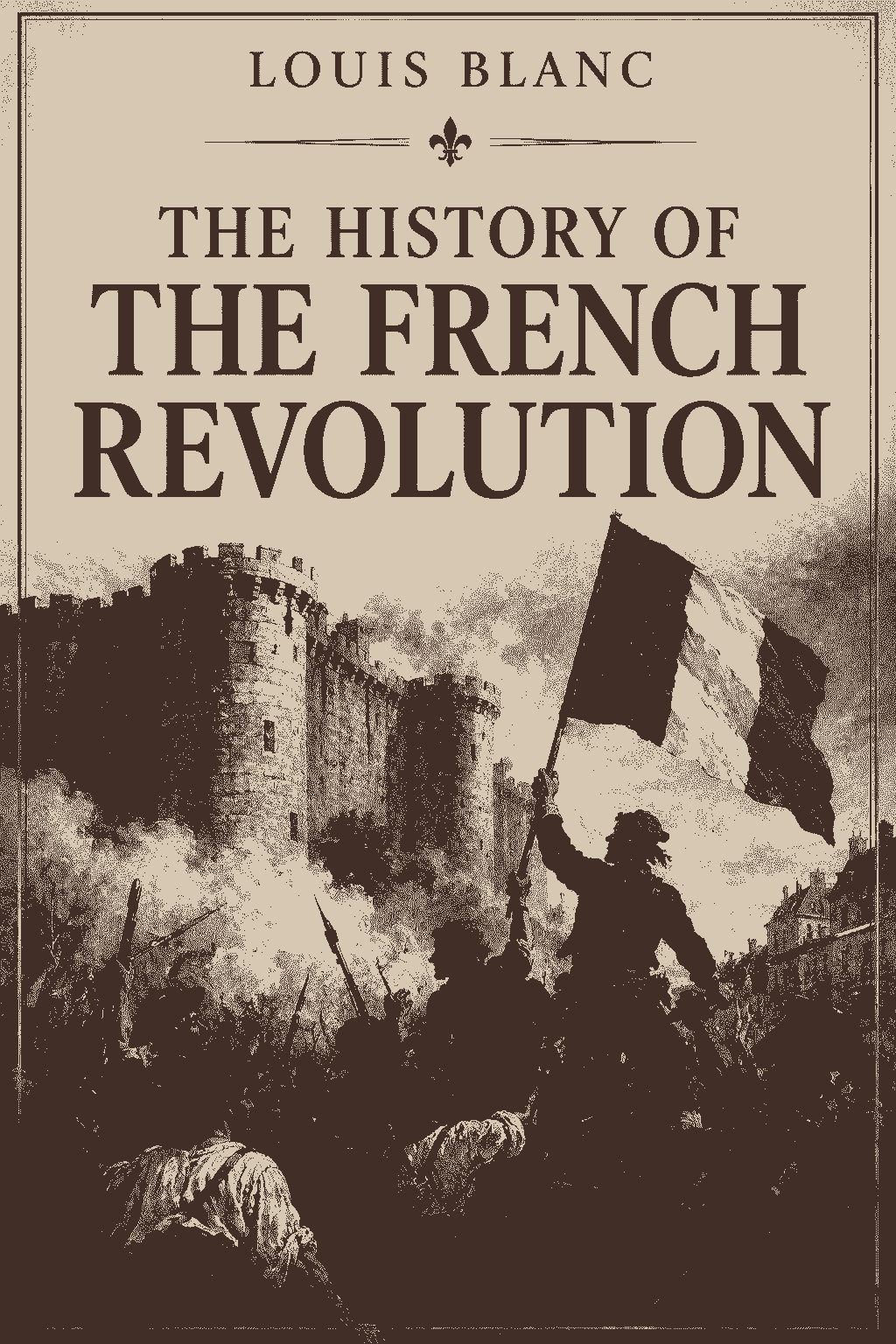
The History of the French Revolution
_-_(MeisterDrucke-924659).jpg?alt=media&token=da0d1cd5-1724-4f38-ba69-3bc18d7a9eb0) Louis Blanc
Louis BlancBlanc's monumental twelve-volume history interprets the French Revolution through a tripartite schema: the principle of authority (Catholicism), the principle of individualism (Protestantism, the Enlightenment, the bourgeoisie), and the principle of fraternity (the Jacobin Mountain, which he identifies with socialism). He argues that 1789 was a bourgeois revolution that established the dominance of individualism, while 1793 represented the defeated attempt to realize fraternity. For Blanc, the Revolution's true meaning lies in its unfinished promise of social solidarity, and its failure under Robespierre explains the subsequent drift toward empire and reaction.
Key Details
Related Books
View AllSimilar books from the same category, ranked by shared topics and reader engagement.


Key Insights — Read in 10 Minutes
What is Blanc's central interpretive framework for understanding the French Revolution?
Blanc organizes the Revolution around three principles: authority, characterized by superstition and inequality; individualism, characterized by individual sovereignty and laissez-faire; and fraternity, characterized by solidarity and social harmony. The Catholic Church embodied authority, the Reformation and Enlightenment embodied individualism, and the Jacobin Mountain announced fraternity. For Blanc, 1789 established bourgeois individualism, while 1793 represented the defeated attempt to realize fraternity—the principle he identified with socialism .
How does Blanc's interpretation differ from Jules Michelet's history of the Revolution?
Blanc wrote his history in critical dialogue with Michelet, often omitting what he borrowed while emphasizing his disagreements. Where Michelet celebrated the Revolution as the triumph of the people and the nation, Blanc focused on class struggle and the failure of fraternity. Blanc's notes contain aggressive critical engagement with Michelet's account, and scholars suggest his book took shape partly as an inventory of Michelet's perceived omissions. Blanc privileged the Jacobin republic and popular movement over the bourgeois revolution of 1789 .
What role does the concept of class struggle play in Blanc's history?
Blanc argues that the Revolution of 1789 succeeded because it served the interests of a class already becoming dominant—the bourgeoisie, whose individualism was destined to establish its empire. The subsequent defeat of fraternity in 1793–94 is explained by the failure of the popular classes to secure their vision against bourgeois consolidation. This class-based reading, anticipating later socialist historiography, distinguishes Blanc from liberal historians who framed the Revolution as a unified national struggle for liberty .
When was The History of the French Revolution written and published?
Blanc began publishing the work in 1847, with the first volumes appearing in Paris from Langlois et Leclercq. The complete twelve-volume work spanned from 1847 to 1862, and much of it was written while Blanc was in exile in England after the failure of the 1848 Revolution. A second edition was published in Paris by Pagnerre from 1864 to 1870, and Cambridge University Press reissued the complete set in 2011 as part of its library collection .
How did Blanc's own political career shape his historical writing?
Blanc was not a detached scholar but a participant in the events he described—he had been a member of the provisional government after the February 1848 Revolution and chaired the Luxembourg Commission on labor. His exile in England after 1848 gave him time to research and write the later volumes. The history reflects his commitments: he wrote as a socialist republican seeking to demonstrate that the Revolution's true promise lay in fraternity, the principle he had tried to realize through the organization of labor .
How was the book received by Marxist critics?
Engels assessed Blanc's historical work highly, and Plekhanov noted that the introduction alone was enough to place Blanc among the first teachers of economic materialism. However, Plekhanov also drew a sharp distinction between Blanc's conception of class struggle and Marx's, arguing that Blanc, like Guizot, could not explain the origin of property relations themselves and thus reverted to idealism despite his attention to economic factors. Later Marxist historians generally treated Blanc as a precursor rather than a fully materialist thinker.
Wealthy Psyche is an intellectual archive. We do not host, distribute, or sell book copies — physical or digital. We provide structured knowledge to help you think better, faster.