


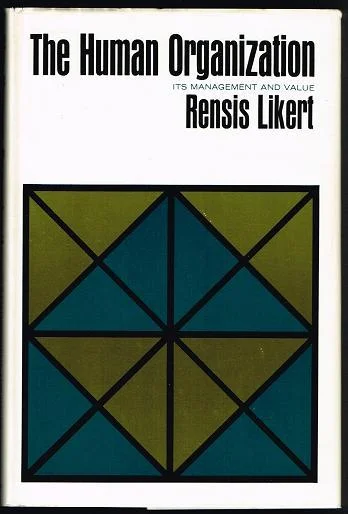
The Human Organization: Its Management and Value
 Rensis Likert
Likert's central argument is that organizations can be arrayed along a continuum of four management systems, and that the participative-group model (System 4) produces superior long-term performance because it builds the human assets of loyalty, motivation, and cooperative group functioning. The book's distinctive mechanism is a three-variable causal framework — causal variables (management style, structure), intervening variables (attitudes, group cohesion), and end-result variables (productivity, profit) — paired with the proposal of 'human asset accounting' to attach dollar values to the human organization. It extends the System 4 theory of New Patterns of Management with new research evidence and a practical diagnostic questionnaire for managers.
Key Details
Related Books
View AllSimilar books from the same category, ranked by shared topics and reader engagement.



Key Insights — Read in 10 Minutes
What is the central claim of The Human Organization, and what does it reject?
The central claim is that System 4 participative-group management produces superior long-term organizational performance by building the human assets of loyalty, motivation, and cooperative group functioning. Likert rejects the assumption that short-term cost economies achieved through hierarchical control are genuinely efficient, arguing that they often destroy human assets that later show up as turnover, apathy, and declining performance. The book extends the System 4 theory of New Patterns of Management (1961) with additional research evidence and a more explicit causal framework: causal variables such as management style affect intervening variables such as group attitudes, which in turn affect end-result variables such as productivity and profit. This three-variable model is the book's distinctive analytical mechanism .
What are the four management systems, and how does System 4 differ from the others?
Likert describes four systems along a continuum: System 1 exploitative-authoritative, where power is concentrated at the top and fear drives compliance; System 2 benevolent-authoritative, where management is paternalistic but still dictatorial; System 3 consultative, where subordinates are consulted but final authority remains with superiors; and System 4 participative-group, where decisions emerge from group processes and communication flows in all directions . System 4 differs structurally through the linking-pin arrangement, in which supervisors belong to overlapping groups, enabling influence to travel upward and laterally as well as downward. Likert argues that only System 4 fully activates the motivational forces that sustain high performance over time, while Systems 1 and 2 may achieve short-term results at the cost of human assets.
What is the causal-intervening-end-result variable framework, and why does it matter?
Likert classifies organizational variables into three categories. Causal variables are independent factors management can control, such as leadership style, organizational structure, and policies. Intervening variables are the internal state of the human organization — group cohesion, attitudes, motivation, and communication — that mediate between causal factors and outcomes. End-result variables are the dependent outcomes such as productivity, costs, and profits . The framework matters because it explains why short-term end-result measures can mislead: a manager may boost production by pressure (a causal variable) while degrading intervening variables, and the damage only appears later in the next manager's tenure. Likert argues that periodic measurement of intervening variables is essential to reveal the true health of the human organization .
What is 'human asset accounting,' and what problem was it meant to solve?
Human asset accounting is Likert's proposal to attach dollar estimates to the value of a firm's human organization and customer goodwill, so that changes in morale, loyalty, and cooperative capacity appear on the balance sheet alongside physical and financial assets . The problem it addressed was managerial myopia: executives who demanded dollar figures for any investment would discount human-relations improvements as intangible. By translating behavioral measures into monetary values, Likert hoped to make the cultivation of human assets a rational economic decision rather than a soft humanitarian gesture. Critics noted that Likert left the actual accounting methodology unspecified, a gap that later human-resource-accounting research attempted to fill .
How was the book received, and what were the main criticisms?
Reception was mixed. The book was widely read and influential, with one 1968 survey reporting that 88 of 302 firms said Likert had influenced their management structure, making him the third most-cited theorist . But reviewers raised methodological and theoretical objections. Harry Triandis, in Administrative Science Quarterly, questioned the accuracy of Likert's conclusions, and others noted that data were gathered from organizational members' perspectives rather than neutral observers . Critics also objected to Likert's eagerness to generalize System 4 to all organizations and his static portrayal of hierarchical management . By the 1970s, with economic recession, participative management fell out of fashion, and one 1976 article declared Likert's theories 'no longer in' .
How does The Human Organization relate to Likert's New Patterns of Management?
The Human Organization extends and reformats the theory introduced in New Patterns of Management (1961). Likert himself described it as presenting the system of management more fully, with additional research findings, and with a sharper focus on the systemic nature of the organization and the motivational forces operating within it . Where New Patterns introduced the four-system typology and linking-pin concept, The Human Organization adds the causal-intervening-end-result variable framework, the human asset accounting proposal, and practical diagnostic questionnaires that managers could use to locate their own organization on the System 1–4 spectrum . It is therefore both a theoretical extension and a more user-friendly application manual, aimed at managers who wanted to assess and change their management style.
Wealthy Psyche is an intellectual archive. We do not host, distribute, or sell book copies — physical or digital. We provide structured knowledge to help you think better, faster.