


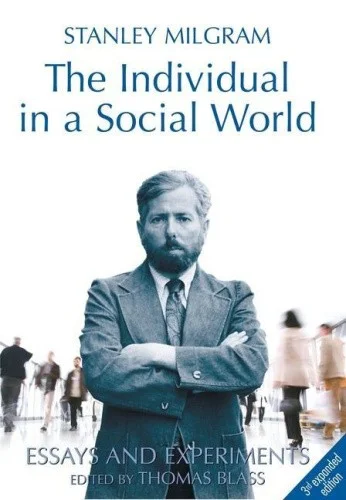
The Individual in a Social World: Essays and Experiments
 Stanley Milgram
Milgram's central argument in this collection is that the individual's behavior is powerfully shaped by situational forces—urban overload, authority structures, group pressure, and social networks—rather than by stable personality traits. The book curates his major papers beyond the obedience studies, including the 'small world' problem (six degrees of separation), mental maps of cities, the lost-letter technique, and the familiar stranger. Milgram positions himself as a commentator on the hidden social architecture that constrains and enables action, using inventive field experiments and accessible prose to make invisible social mechanisms visible.
Key Details
Related Books
View AllSimilar books from the same category, ranked by shared topics and reader engagement.



Key Insights — Read in 10 Minutes
What is the central claim of The Individual in a Social World, and what does it reject?
The collection's governing thesis is that situational and structural forces—urban density, authority hierarchies, group pressure, communication networks—exert more decisive influence on individual behavior than stable personality traits or moral character. Milgram rejects dispositional explanations that locate the causes of action inside the person. His obedience studies serve as the most dramatic demonstration, but the essays on city life, conformity, and the small-world problem extend the same situational logic to everyday contexts. The book's introductions, written by Milgram himself, explicitly frame his diverse research as a unified project: mapping the implicit social architecture that constrains and enables human action.
What specific concept or framework did this collection introduce to a broader readership?
The collection is significant for assembling Milgram's 'small world' experiment, which tested the hypothesis that any two people in the United States are connected by a short chain of acquaintances—popularized later as 'six degrees of separation.' While the original study appeared in the journal Psychology Today in 1967, The Individual in a Social World made the full methodological details and Milgram's own reflections more accessible to students. The book also showcases the 'lost letter technique,' a field method for measuring community attitudes without direct contact, and his work on 'mental maps' of cities, which revealed how urbanites psychologically represent their environments. These frameworks remain cited in network science and environmental psychology.
How does this collection differ from Milgram's Obedience to Authority?
Obedience to Authority is a focused monograph on a single experimental paradigm, with detailed results, variations, and theoretical implications. The Individual in a Social World is a curated collection of diverse essays and experiments spanning urban psychology, conformity, networks, and media influence. It includes the full obedience study but situates it among Milgram's other interests. The collection also contains Milgram's replies to critics of the obedience research, including ethical challenges raised by Diana Baumrind, making it a valuable companion to the 1974 book. Readers seeking the full obedience dataset should consult Obedience to Authority; this collection offers breadth and Milgram's own retrospective framing.
How has the book's argument held up since its publication?
The situationalist framework has proven durable, though with important qualifications. The obedience studies have been subjected to methodological scrutiny, most notably by Jerry Burger's 2009 partial replication, which found comparable compliance rates, and by archival work questioning the experimenter's scripted 'prod' system. The small-world research has been both extended and challenged: later studies confirmed short chains in digital networks, but the original method's completion rates were low. The 'familiar stranger' concept has been applied to urban sociology, while the lost-letter technique remains a standard field method. The book's core insight—that situations matter profoundly—has been reinforced by situationist psychology and behavioral economics, even as personality psychology has clarified that traits and situations interact.
How has this book been misread or oversimplified?
A common misreading treats the collection as primarily a record of the obedience experiments with some 'extras' attached. In fact, the obedience chapters occupy only one of four sections; the book's center of gravity is Milgram's broader inquiry into how social structures—cities, groups, networks—shape individual experience. Another oversimplification reduces his situationalism to a denial of individual agency or moral responsibility. Milgram's position is more nuanced: he documents how ordinary people can be led to harmful acts by situational pressures, but he also includes essays on disobedience and the 'liberating effects of group pressure,' showing that situations can enable resistance as well as compliance. The book's structure, with Milgram's own introductions, resists the caricature of a simple determinism.
How faithful is the standard edition to Milgram's original intent, and what did editors change?
The editorial history is complex. The 1977 first edition was prepared by Milgram himself, who wrote introductions linking the papers. After his death in 1984, John Sabini and Maury Silver produced a 1992 second edition that added posthumously published material. A 2010 third expanded edition, edited by Thomas Blass, incorporated further uncollected essays, including pieces on the Jonestown massacre and 'Network Love.' Each edition preserves Milgram's original papers but adjusts the framing and selection. The 1977 edition best reflects his own curatorial intent; later editions serve as more comprehensive archives. Readers should check which edition they consult, as the table of contents and editorial apparatus differ substantially.
Show 1 more insights
What real-world systems or disciplines use the methods or findings from this book?
The small-world research directly influenced network science and the study of social contagion, informing how epidemiologists model disease spread and how sociologists analyze online social networks. The lost-letter technique has been adapted for measuring prejudice and community attitudes in field settings. Milgram's mental-map studies contributed to environmental psychology and urban planning by showing how subjective representations of space affect navigation and neighborhood attachment. His work on television and antisocial behavior, included in the collection, anticipated media-effects research. The 'familiar stranger' concept has been used in urban design to understand how public space fosters or inhibits recognition and community. The obedience research, of course, remains central to research ethics training and to discussions of authority in organizations and institutions.
Wealthy Psyche is an intellectual archive. We do not host, distribute, or sell book copies — physical or digital. We provide structured knowledge to help you think better, faster.