


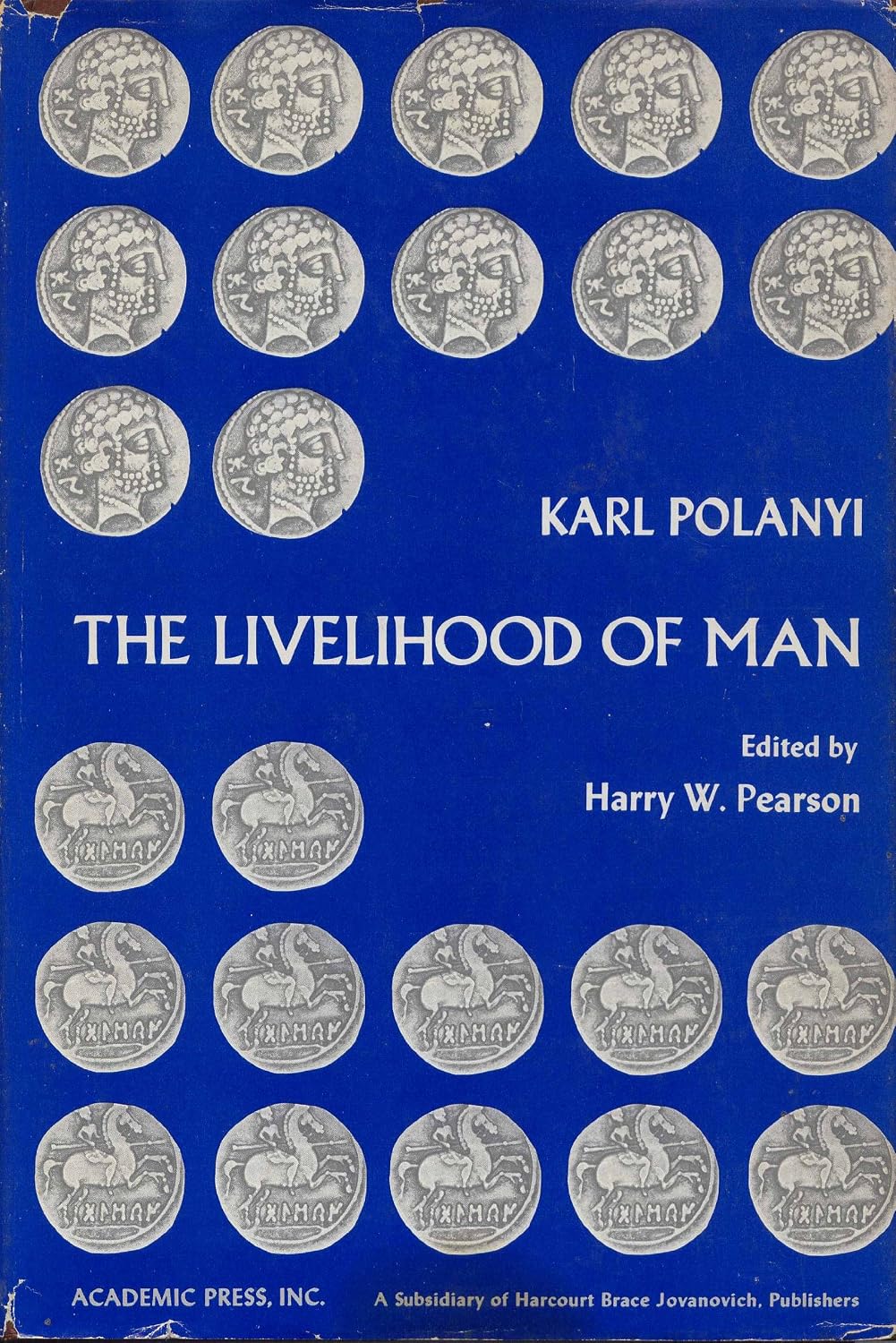
The Livelihood of Man
 Karl Polanyi
Polanyi's final, posthumously published work argues that the 'economistic fallacy'—the habit of equating human economy in general with its market form—has distorted our understanding of economic history. Through studies of ancient Mesopotamia, archaic Greece, and the kingdom of Dahomey, he demonstrates that trade and money long predate price-making markets, and that economic activity was historically embedded in reciprocity, redistribution, and political institutions. The book's distinctive contribution is its extended treatment of ancient Greece, arguing that the Athenian agora was a mechanism of civic redistribution rather than a price-setting market.
Key Details
Related Books
View AllSimilar books from the same category, ranked by shared topics and reader engagement.


Key Insights — Read in 10 Minutes
What is the central argument of The Livelihood of Man?
Polanyi argues that the 'economistic fallacy'—equating human economy in general with its market form—has corrupted our understanding of economic history. The market as a price-setting mechanism is a recent development; trade and money long predate it. Economic activity in archaic societies was embedded in reciprocity, redistribution, and political institutions, not governed by price-making markets . The book's distinctive contribution is its sustained treatment of ancient Greece, arguing that the Athenian agora was a civic redistribution mechanism, not a nascent price-setting market .
What specific concept does Polanyi develop in this book about the ancient Greek economy?
Polanyi argues that the Athenian agora was not a price-setting market but a mechanism of redistribution used by the polis to provision citizens. Prices fluctuated only within traditionally acceptable limits under magistrates' supervision, independent of international trade . He further shows that the Greek genius gave birth to both economic systems—market and centrally planned—as demonstrated by Ptolemaic Egypt's 'most complete system of a marketless, centrally planned economy the world has ever seen' . This Hellenic origin of both systems reveals the real antiquity of the market-versus-plan rivalry.
How does The Livelihood of Man relate to Polanyi's earlier Trade and Market in the Early Empires?
The Livelihood of Man extends and deepens the project begun in Trade and Market in the Early Empires (1957). Where the earlier volume presented empirical case studies of Mesopotamia, Dahomey, and Berber societies, the later book is more systematically theoretical, elaborating the formal/substantive distinction and the principles of reciprocity, redistribution, and exchange . It also adds Polanyi's most sustained historical treatment of ancient Greece, a case only touched on in the earlier volume. The book is thus both a culmination of the Columbia research project and a new departure .
What is the most common misconception about Polanyi's argument in this book?
A common misconception is that Polanyi denied the existence of markets in antiquity. In fact, he explicitly distinguished trade from market and demonstrated that trade existed in many forms without self-regulating markets. Another misreading treats the 'economistic fallacy' as a rejection of all formal economic analysis. Polanyi did not deny that formal analysis is valid for market economies; his argument was that its universal application to all societies is an ethnocentric error . The book's target is the retrojection of market logic onto premarket societies, not the study of markets where they genuinely exist.
How was the book received and what is its relationship to Polanyi's other works?
Published posthumously in 1977, edited by Harry W. Pearson, the book was described in a contemporary review as 'certain to stand alongside M.I. Finley's Ancient Economy and Alfred Zimmern's The Greek Commonwealth' . It remains less widely read than The Great Transformation but is essential for understanding late Polanyi's theoretical achievement. A 2014 Korean study argues it shows 'the achievement of substantive non-market economics' and that civilizations finding balance between individual freedom and communal solidarity flourished . The book was first translated into French in 2011, over thirty years after its English publication .
What role does the 'triad' of trade, money, and market play in the book's argument?
Polanyi's 'catallactic triad' holds that trade, money, and market have separate origins and only converge under capitalism . Trade begins as external exchange between communities; money emerges from multiple uses including payment, store of value, and standard; markets develop later as internal institutions. The convergence of these distinct elements into a single integrated system is historically recent and contingent. This framework allows Polanyi to analyze ancient economies without assuming market integration, and to show that 'trade without market' and 'money without market' were normal conditions for most of human history .
Show 1 more insights
What limitations have scholars identified in Polanyi's analysis?
A 2014 study argues that late Polanyi's substantive economics must encompass not only the social embeddedness of the market but also 'the social embeddedness of property and production modes,' and should reconstruct the dynamics of the double movement in the history of economic civilizations . A French review notes the text's 'disjointed character,' composed from diverse contributions, and its 'somewhat dry style' contrasting with The Great Transformation . Some archaeologists argue Polanyi's influence discouraged recognition of market exchange in Bronze Age economies . The book is nonetheless acknowledged as a foundational work of economic anthropology.
Wealthy Psyche is an intellectual archive. We do not host, distribute, or sell book copies — physical or digital. We provide structured knowledge to help you think better, faster.