


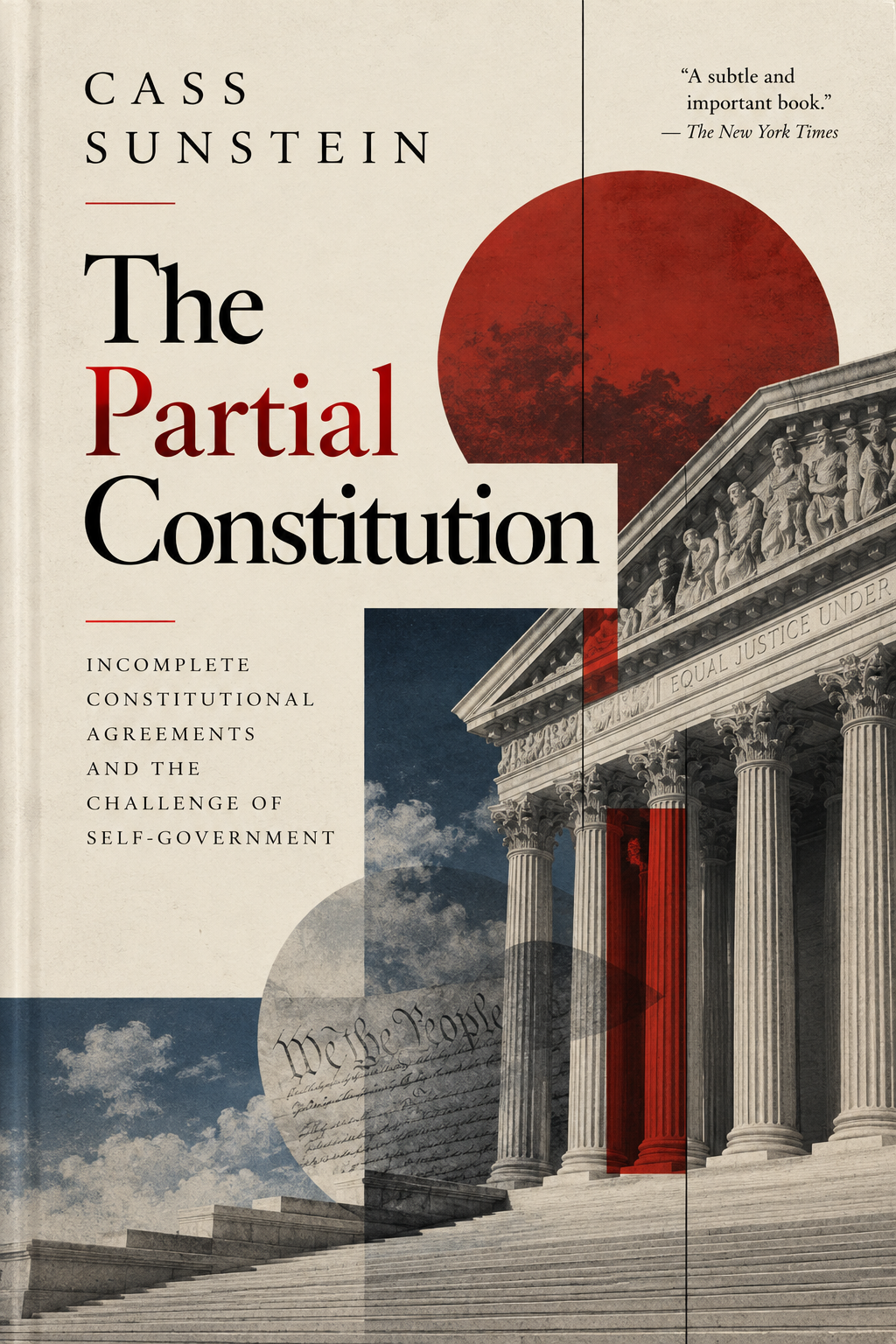
The Partial Constitution
 Cass R. Sunstein
Sunstein's The Partial Constitution argues that American constitutional law is 'partial' in two senses: its meaning has been identified solely with Supreme Court decisions, and it treats the existing distribution of entitlements as a neutral baseline, labeling any departure as partisan. He contends this status quo neutrality produces injustice when the baseline is neither neutral nor just. Against this, Sunstein proposes a deliberative democracy reading of the Constitution, grounded in the New Deal insight that property rights and the status quo are themselves products of government action. He reconceives free speech, equal protection, and privacy as commitments to public deliberation among political equals, rather than mere restraints on state power.
What does Sunstein mean by 'status quo neutrality,' and why does he consider it a bias?
Sunstein argues that contemporary constitutional law treats existing distributions of entitlements as a neutral baseline, so that any government intervention to change them appears partisan or illegitimate [citation:1][citation:3]. But this baseline is not natural: as the New Deal recognized, property rights and market distributions are themselves products of legal rules [citation:12]. Treating them as neutral therefore privileges those who benefit from the current arrangement. Sunstein's critique is not that neutrality is impossible, but that the prevailing conception of neutrality is covertly substantive, favoring the status quo under the guise of impartiality.
Why does Sunstein argue the Constitution's meaning should not be identified solely with Supreme Court decisions?
Sunstein contends that judicial supremacy is a historical departure from the Framers' design, not its fulfillment. The Constitution often served as a catalyst for public deliberation about its general terms and aspirations, and this broader understanding of its role should be revived [citation:1][citation:3]. He challenges the doctrine of judicial supremacy and seeks to replace it with a conception of shared authority among the branches of government and the American people [citation:6]. The courts retain a role in securing the preconditions of deliberative democracy, but they are not the sole or primary interpreters of constitutional meaning.
How does Sunstein's argument about abortion in The Partial Constitution differ from the standard privacy framework?
In an especially striking argument, Sunstein claims that the Equal Protection Clause of the Fourteenth Amendment—not the right to privacy—protects a woman's right to choose abortion [citation:1][citation:3]. He connects this to the Constitution's historic commitment to public deliberation among political equals and argues that restrictions on abortion reflect the sexual and reproductive status quo, which is sometimes a locus of inequality [citation:12]. This reframing shifts the constitutional foundation of reproductive rights from individual privacy to equality and anti-subordination, a move that would later influence his work on the anticaste principle.
What is the most common historical criticism of Sunstein's account of the Framers?
Reviewers in the William and Mary Law Review and Harvard Journal of Law & Public Policy argued that Sunstein's historical claims are constructed from distortions and exaggerations, suggesting that bad history is the homage he pays to originalism [citation:10]. Critics contend that he takes some elements of the Framers' complex philosophy while abandoning others, and that republican theory at the Founding was consistent with natural rights and pluralism, not opposed to them [citation:5][citation:10]. Sunstein's argument that the Framers sought to effectuate a 'deliberative democracy' above all else needs more historical support than he provides.
How did The Partial Constitution influence Sunstein's later work on judicial minimalism?
The Partial Constitution represents Sunstein's fullest exposition of a substantive vision of the Constitution as embodying deliberative democracy [citation:17]. His later work, beginning with One Case at a Time, shifted focus from the substantive commitments of the Constitution to a theory of judicial review, advocating minimalism—narrow rulings that leave fundamental questions open [citation:17]. Critics describe this as an 'incredible shrinking constitutional theory,' arguing that his earlier work was an outstanding grand theory with critical bite, while his minimalism blunts that bite and risks suggesting courts should wither away as vindicators of constitutional rights [citation:7][citation:17].
What role does the New Deal play in Sunstein's account of constitutional history?
Sunstein identifies the New Deal as the moment when the 'outstanding conceptual break' occurred: the recognition that ownership rights and the status quo were products of government, not natural facts anterior to law [citation:12]. This insight is central to his critique of status quo neutrality, because it exposes the Lochner-era conception of neutrality as a substantive choice rather than a neutral baseline. Yet Sunstein is clear that the New Deal project has been realized only partially; his book analyzes contemporary constitutional problems in terms of the continued failure to resist the allure of the status quo baseline [citation:12].
Wealthy Psyche is an intellectual archive. We do not host, distribute, or sell book copies — physical or digital. We provide structured knowledge to help you think better, faster.