


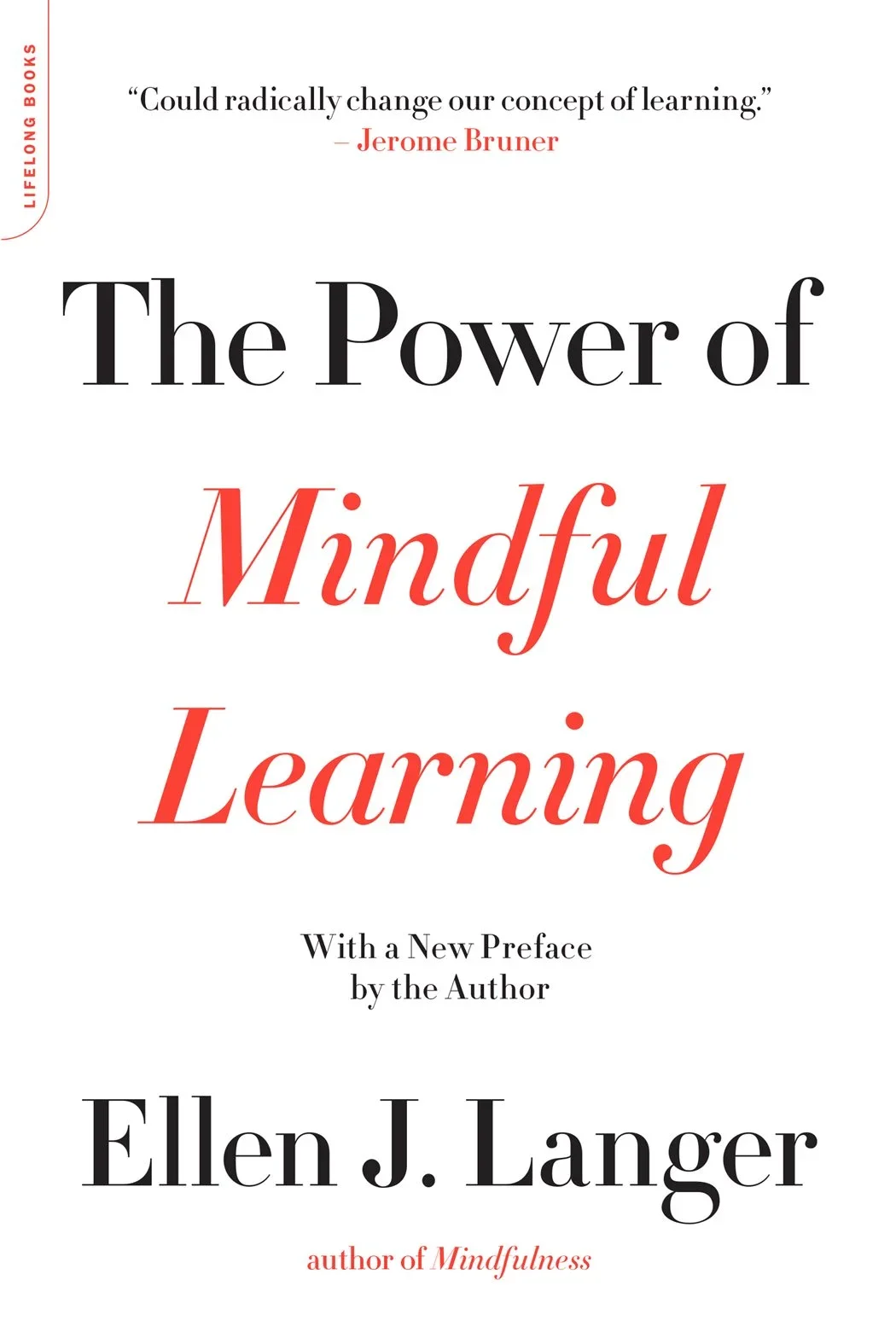
The Power of Mindful Learning
 Ellen Langer
Langer argues that conventional education cultivates mindlessness by teaching facts as absolute, drilling skills through repetition, and forcing rote memorization. She identifies seven myths of learning—including delayed gratification, the basics, and right answers—that undermine flexibility and transfer. In their place, she proposes mindful or conditional learning: approaching information with awareness of context, openness to novelty, and an implicit sense of multiple perspectives. Drawing on her experimental research, Langer shows that conditional instruction improves retention and creative application compared to standard didactic teaching.
Key Details
Related Books
View AllSimilar books from the same category, ranked by shared topics and reader engagement.


.webp?alt=media&token=e122db12-881d-4348-827b-bc8f8f60d681)
Key Insights — Read in 10 Minutes
What is the central claim of The Power of Mindful Learning, and what does it reject?
Langer contends that conventional education unintentionally teaches mindlessness by presenting information as absolute, drilling skills through repetition, and forcing rote memorization. She rejects seven entrenched myths: that practice makes perfect, that delayed gratification is necessary, that the basics must be taught first, that forgetting is failure, that memory inevitably declines, that intelligence is fixed, and that there are unambiguous right answers. In their place, she proposes mindful or conditional learning—approaching material with openness to novelty, sensitivity to context, and awareness of multiple perspectives. Her core experimental demonstration is that students taught conditionally outperform those taught didactically on measures of retention, synthesis, and creative application.
What specific research paradigm did Langer use to demonstrate conditional learning?
Langer and her collaborators compared groups receiving identical content presented either conditionally or absolutely. In one frequently cited study, high school students studying the Kansas-Nebraska Act were either asked to adopt multiple perspectives—their own, the participants', and observers'—or simply told to learn the passage. The perspective-taking group outperformed the control group on recall and essay quality immediately and one week later. In a music study, beginning pianists taught to respond to thoughts and feelings while playing a C major scale were rated more competent and creative than those taught by memorization-through-repetition. These designs isolate instructional framing as the independent variable while holding content constant.
How does Langer's concept of mindful learning differ from Ellen Langer's earlier book Mindfulness?
Mindfulness, published in 1989, introduced Langer's general theory of mindfulness as the active creation of new categories, openness to new information, and implicit awareness of multiple perspectives—with applications ranging from aging to health to decision-making. The Power of Mindful Learning applies that framework specifically to education. It operationalizes mindfulness for the classroom, identifying seven myths of learning and translating the general theory into concrete instructional practices: conditional language, perspective-taking, soft vigilance, and play-oriented engagement. The later book functions as a domain-specific extension rather than a theoretical revision, taking the core mechanism from Mindfulness and demonstrating its consequences for how material is taught, studied, and retained.
What are the main criticisms of Langer's argument about memorization and basic skills?
Reviewers have questioned whether Langer's hard line against memorization and drill is tenable in all domains, particularly medicine and other fields requiring rapid recall of critical information. In a New York Times review, Jacques Steinberg noted being less persuaded by the contention that forgetting and relearning information might improve learning, and predicted strong reactions to the claim that there is no such thing as basic skills . A more sympathetic review in a university senate publication observed that while Langer's experiments are suggestive, some feel small in scope, and suggested the book seemed hastily written compared to her earlier work . The debate centers on whether conditional, perspective-rich instruction can fully substitute for foundational knowledge that must be reliably accessible under time pressure.
How has Langer's argument held up given subsequent research on learning and mindset?
Langer's emphasis on conditional framing and multiple perspectives anticipates findings in cognitive science about desirable difficulties and transfer-appropriate processing, though her experimental designs were modest by contemporary standards. Her critique of fixed intelligence aligns with Carol Dweck's mindset research, published in book form a decade later, which empirically distinguished fixed from growth beliefs about ability. Dweck and Langer coauthored Personal Politics in 1973, so the intellectual lineage runs in both directions. However, the specific claim that memorization is categorically counterproductive has not been broadly adopted; modern learning science supports spaced retrieval practice and some forms of deliberate repetition as effective for durable retention, suggesting Langer's position was more oppositional than the evidence warranted.
Wealthy Psyche is an intellectual archive. We do not host, distribute, or sell book copies — physical or digital. We provide structured knowledge to help you think better, faster.