


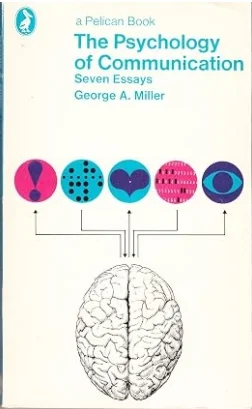
The Psychology of Communication: Seven Essays
 George A. Miller
The unifying argument across these seven essays is that human beings are best understood as information-gathering and information-processing systems—channels with measurable capacities, bottlenecks, and encoding strategies. Miller applies information theory to memory, perception, and language, arguing that our limited channel capacity forces us to "chunk" information into organized units. The essays extend from the classic "The Magical Number Seven" to psycholinguistic arguments about the biological basis of language, framing man as a "miserable component" in communication systems while retaining the unique human gift for recoding information in novel ways.
Key Details
Related Books
View AllSimilar books from the same category, ranked by shared topics and reader engagement.


.webp?alt=media&token=34bd26c3-d0b0-4cd7-a235-153b0182ef19)
Key Insights — Read in 10 Minutes
What is the central claim of The Psychology of Communication, and what does it reject?
Miller's core argument is that the human mind should be modeled as an information-gathering and information-processing system—a communication channel with finite capacity, measurable bandwidth, and characteristic encoding strategies. This framework rejects purely behaviorist accounts of memory and language that treat verbal behavior as a bundle of stimulus-response associations. In "Information and Memory," Miller explicitly argues against a behaviorist account by distinguishing a text's "physical length" (number of symbols) from its "psychological length" (number of ideas and their organization)—a distinction the behaviorist cannot make. The information-processing view instead treats memory as communication from past to future, encoded to resist the noise of the nervous system.
What specific concept did Miller's earlier work introduce that this book extends?
The book's longest and most famous essay, "The Magical Number Seven, Plus or Minus Two," introduced the concept of "chunking"—the observation that immediate memory is limited not by raw information but by the number of organized units or "chunks" a person can hold. Miller showed that while absolute judgment capacity for a single stimulus dimension hovers around seven categories, people can dramatically expand effective capacity by recoding multiple items into single chunks. This volume extends that argument by connecting chunking to psycholinguistic questions of language processing and to broader claims about how humans discover "clever ways to abstract the essential features of our universe" through recoding.
How does the book's information-processing framework relate to Chomsky's linguistics?
The psycholinguistic essays in the latter part of the book grew directly from Miller's collaboration with Noam Chomsky, and a contemporary reviewer noted that "it was largely through the efforts of Noam Chomsky and George A. Miller that psycholinguistics was born as a scientific discipline" around the late 1950s . Miller argues that the central task of this new science is "to describe the psychological processes that go on when people use sentences," not merely to observe verbal behavior. He also invokes Eric Lenneberg's arguments about the biological basis of language to resist the Wittgensteinian "language game" metaphor, which Miller believed could mislead by treating linguistic rules as arbitrary as chess rules.
How has the book's argument about human channel capacity held up since 1967?
The specific number "seven, plus or minus two" has been substantially revised. Later research in the 1970s and 1980s—notably by Nelson Cowan—converged on a working memory capacity closer to four chunks, with the larger seven figure reflecting rehearsal and other strategies that inflate measured performance. Miller himself acknowledged the provisional nature of the number. However, the broader information-processing framework proved remarkably durable: it became foundational to cognitive psychology's core metaphor and to subsequent models of working memory, attention, and language processing. The essay's core insight—that capacity limits are structural and that chunking is the primary workaround—remains central to the field.
What did reviewers identify as the book's most useful contribution to philosophy?
A 1967 review in a philosophy journal praised the book as "a treat to any philosopher" for its handling of problems "that used to be classed as philosophical" with originality, depth, and methodological awareness . The reviewer singled out Miller's demonstration that memory experiments refute a purely behaviorist account—because at higher levels of organization, one cannot disregard the ideas that symbols stand for. The essay "Concerning Psychical Research" was also cited as a model of methodological rigor, with Miller systematically cataloguing flaws in parapsychological claims such as optional stopping, selective sampling, and unverified witness testimony. The reviewer's verdict on the parapsychologist's claim: "fraudulent. An innocent fraud, perhaps, but no less vicious for its good intentions."
What misconceptions about Miller's "Magical Number Seven" does the book itself help correct?
A common misreading treats "seven" as a fixed, universal limit on human memory. But in context, Miller's argument is subtler: he distinguishes between the capacity for absolute judgment on a single sensory dimension (which does hover near seven) and the capacity for immediate memory when material can be chunked (which is not fixed at all, because chunk size varies). The book's later essays make clear that the interesting question is not the number itself but the recoding process—how humans transform information from one form into another to fit through a narrow channel. As Miller puts it, the search to map "a strange, new phenomenon into simpler and more familiar ones" is what we call thinking; success is what we call understanding.
Wealthy Psyche is an intellectual archive. We do not host, distribute, or sell book copies — physical or digital. We provide structured knowledge to help you think better, faster.