


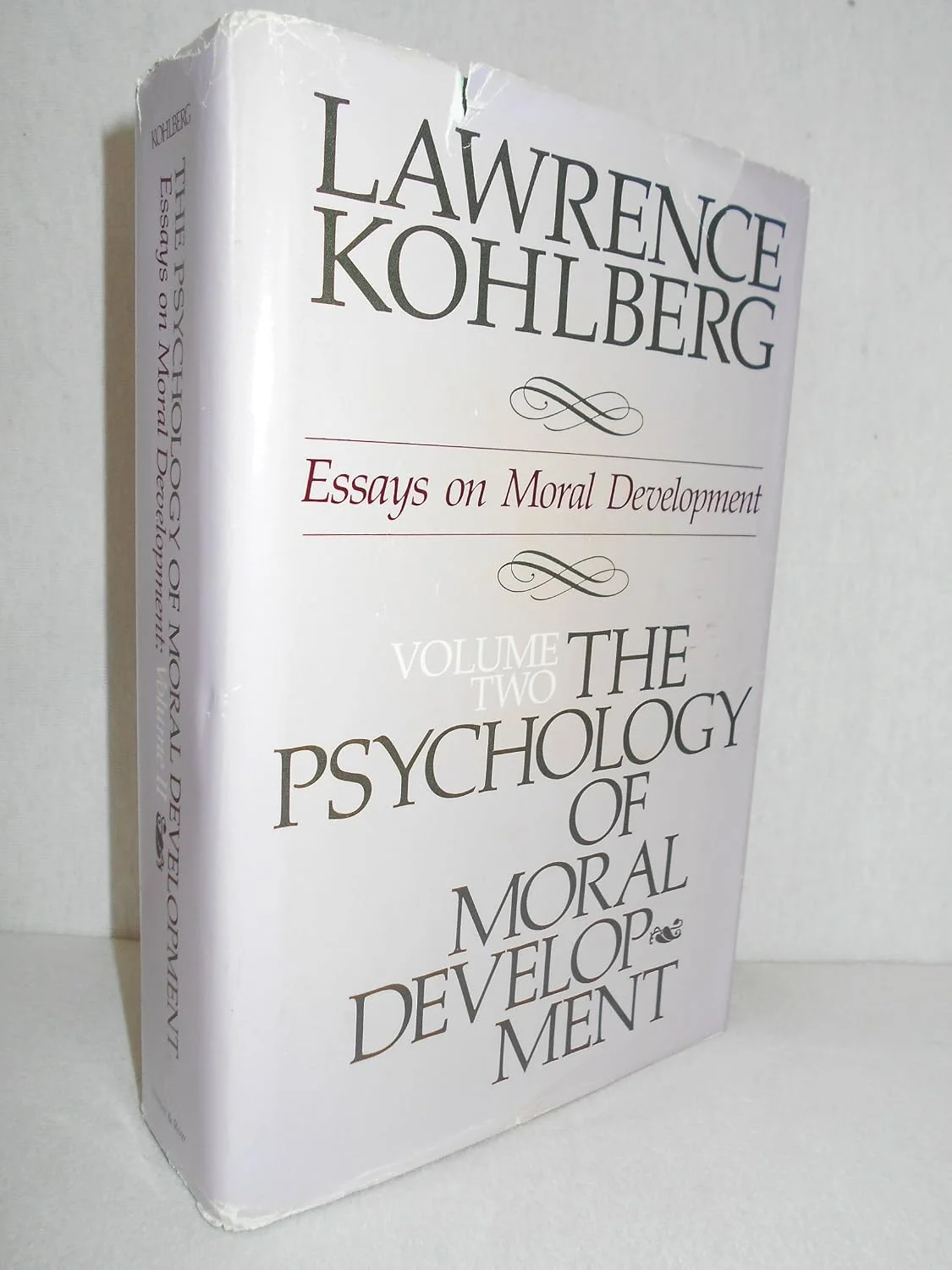
The Psychology of Moral Development: The Nature and Validity of Moral Stages
 Lawrence Kohlberg
The second volume of Kohlberg's Essays on Moral Development presents the empirical culmination of his twenty-year longitudinal research program. It argues that the six-stage sequence of moral judgment is empirically validated, with the revised Standard Issue Scoring system demonstrating that individuals move through stages in invariant order without skipping. Crucially, Kohlberg suspends Stage 6 as an empirically substantiated stage, acknowledging that no longitudinal subject achieved it. The volume also defends the theory against critics including Carol Gilligan, integrates judgment with moral action through research with Daniel Candee, and reports cross-cultural studies from Turkey and Israel supporting universal sequence claims.
Key Details
Related Books
View AllSimilar books from the same category, ranked by shared topics and reader engagement.



Key Insights — Read in 10 Minutes
What is the central empirical claim of this volume, and what specific evidence supports it?
The central claim is that Kohlberg's six-stage sequence is empirically validated by twenty years of longitudinal data. Working with seven boys from his original 1958 sample retested every three to four years, Kohlberg and colleagues constructed the Standard Issue Scoring manual, then validated it on 51 additional subjects. They found no stage skipping and only about 6 percent regression . The revised scoring system demonstrated that individuals move through stages in invariant order. This longitudinal evidence, reported in the volume, was Kohlberg's primary defense of the stage model's empirical validity.
Why did Kohlberg suspend Stage 6, and what does this mean for his theory?
Kohlberg suspended Stage 6 because none of the subjects in his longitudinal research achieved it, leaving insufficient empirical cases for psychometric validation . Stage 6 had been the philosophical crown of his hierarchy—universal ethical principles reasoning. In the 1983 monograph with Levine and Hewer, he acknowledged that claims about Stage 6's single principle and its identity with justice could no longer be empirically supported . Stage 6 was retained as a rational or logical construct but not as a validated psychological stage. This concession was significant: it undercut the claim that Kohlberg's theory had identified the endpoint of moral development.
How does Kohlberg respond to Carol Gilligan's critique in this volume?
Kohlberg argues that Gilligan's charge of gender bias misconstrues the theory's object. The stages describe the structure of justice reasoning—how a person organizes and justifies moral judgments—not the content of specific moral values. He contends that women and men do not differ in their capacity for justice reasoning, attributing observed score differences to educational and occupational opportunities. The detailed reply, presented with Charles Levine and Alexandra Hewer in Part Two, acknowledges Gilligan's care orientation as a legitimate moral domain but insists it operates alongside justice reasoning, not as a replacement for it.
What does the research with Daniel Candee reveal about the relationship between moral judgment and moral action?
The chapter with Daniel Candee addresses the judgment-action gap: why people sometimes act against their moral judgments. Kohlberg and Candee found that moral judgment is necessary but not sufficient for moral action. Factors including willpower, ego strength, and situational pressures mediate the translation of judgment into behavior. Their research on the Heinz dilemma and actual behavior showed that Stage 5 reasoners agreed on action choices for most dilemmas, but agreement was not absolute . The finding supported Kohlberg's claim that judgment has motivational force, while acknowledging that other psychological factors determine whether judgment translates into action.
What cross-cultural evidence does the volume present for universal sequence, and what are its limitations?
The volume includes longitudinal studies conducted in Turkey with Mordecai Nisan and in Israel with John Snarey and Joseph Reimer . These studies reported that subjects moved through the stages in the predicted order, supporting the universal sequence hypothesis. Kohlberg argued that no significant cultural differences existed in the nature, order, or hierarchical structure of moral development . However, the samples were limited, and critics noted that the scoring system itself was developed from American data, potentially embedding cultural assumptions that affected cross-cultural assessment. Later research documented care, community, and divinity-based moral concerns that Kohlberg's justice-centered scheme underweighted.
What was the critical reception of this volume when published, and how did reviewers assess its contribution?
Reviews acknowledged the volume's importance as the definitive empirical statement of Kohlberg's theory but noted its length and density. The Cambridge review listed it as a major publication alongside contemporary works on moral behavior . John Snarey and colleagues later noted that some coworkers did not agree with Kohlberg's decision to stop revising the scoring manual, suggesting internal tensions about whether the bootstrapping process was genuinely complete. The volume was recognized as the essential companion to Volume I: where the first volume made the philosophical case, the second provided the longitudinal evidence and psychometric defense.
Show 1 more insights
How has the stage theory presented in this volume held up since its publication in 1984?
The core claim of invariant sequence has been partially supported but substantially qualified. Subsequent longitudinal research confirmed that moral reasoning develops in a rough developmental order, but stage transitions are less uniform than Kohlberg claimed, and regression occurs more often than his initial findings suggested—some studies found up to 15 percent . Cultural psychology challenged the assumption that justice reasoning is the sole measure of moral maturity. The volume remains foundational as a record of the most ambitious longitudinal study of moral development ever conducted, but its strong claims about universality and invariant sequence are now treated as hypotheses requiring qualification rather than established facts.
Wealthy Psyche is an intellectual archive. We do not host, distribute, or sell book copies — physical or digital. We provide structured knowledge to help you think better, faster.