


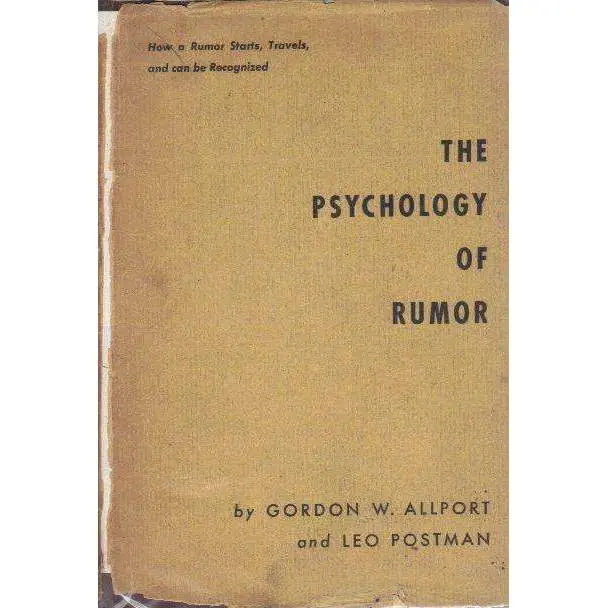
The Psychology of Rumor
 Gordon Willard Allport
Co-authored with Leo Postman, this book argues that rumor is not random chatter but a predictable cognitive and social process. Its central mechanism is the basic law of rumor: the intensity of rumor transmission varies with the importance of the topic to the individuals involved multiplied by the ambiguity of the evidence available. Rumors spread because they relieve emotional tension, justify existing feelings, and make confusing situations meaningful. Through serial reproduction experiments, Allport and Postman show that rumors undergo leveling (omission of detail), sharpening (selective emphasis), and assimilation (distortion toward pre-existing beliefs), providing an experimental basis for understanding collective distortion.
Key Details
Related Books
View AllSimilar books from the same category, ranked by shared topics and reader engagement.



Key Insights — Read in 10 Minutes
What is the central claim of The Psychology of Rumor, and what does it reject?
The book's central claim is that rumor is a systematic phenomenon governed by identifiable psychological laws, not random or inexplicable chatter. Allport and Postman define rumor as a specific proposition for belief passed from person to person without secure standards of evidence, and they propose that its circulation varies with the importance of the topic multiplied by the ambiguity surrounding it . They reject the assumption that rumors are merely pathological or confined to the ignorant; instead, rumors serve normal psychological functions—relieving tension, justifying emotion, and making confusing situations meaningful. A contemporary review noted that the book was the first systematic attempt by psychologists to explain what rumors mean and why they circulate, treating rumor as a dependable index of public mood and an early warning of social disturbance .
What is the "basic law of rumor," and how did critics evaluate it?
The basic law is expressed as R ~ i × a: the amount of rumor in circulation varies with the importance of the subject to the individuals concerned times the ambiguity of the evidence pertaining to the topic . Allport and Postman presented this as a quasi-mathematical law of social transmission. Contemporary critics were skeptical. Robert E. L. Faris, reviewing in the American Journal of Sociology, objected that the use of precise mathematical symbols was pretentious given the ambiguity of the referents, and that nowhere in the volume was there evidence that the amount of rumor varies in the mechanical relationship the formula designated. Faris granted that importance and ambiguity are necessary conditions for rumor spread, but denied that the formula captured a genuine quantitative law .
What did the serial reproduction experiments demonstrate, and what were their methodological limitations?
The experiments adapted Bartlett's serial reproduction paradigm: a subject viewed a picture, described it to a second person, who described it to a third, and so on. Allport and Postman found that roughly seventy percent of details were eliminated across five or six links, with three consistent distortion patterns: leveling (omission of details), sharpening (selective emphasis on striking features), and assimilation (distortion toward pre-existing expectations and stereotypes) . The authors themselves acknowledged that laboratory control came at the cost of oversimplification, sacrificing the spontaneity and naturalness of real rumor situations . Later critics added that serial chains poorly simulate actual rumor transmission, which is typically branching and interactive rather than a one-way relay, and that rumors often grow more elaborate rather than shrinking as they spread .
How does the book relate to Allport's broader work on prejudice and personality?
The Psychology of Rumor is a direct precursor to Allport's later and more famous work on prejudice. The cognitive processes identified here—leveling, sharpening, and especially assimilation—are the same mechanisms that, in The Nature of Prejudice (1954), Allport would argue underlie stereotyping and categorical thinking. The idea that rumors assimilate to pre-existing beliefs and expectations is a specific application of his general insight that perception is shaped by mental categories. A contemporary review of the rumor book noted its emphasis on rumor as an index of public state of mind and a warning of disturbances such as race riots, which never occur without a preliminary barrage of rumors . This practical, socially engaged orientation carries directly into his later anti-prejudice work.
What were the circumstances of the book's production, and how did government interest shape the research?
The book emerged from wartime urgency. In the early 1940s, rumors about World War II spread throughout the United States, and the government worried about their effects on morale and national security. The U.S. government encouraged social scientists to study rumor as a phenomenon that could be understood and controlled . Allport and Postman, both at Harvard, drew on this context; a preliminary version of their argument appeared as an article in Public Opinion Quarterly in 1946, explicitly stating that the study was based in part on their forthcoming book . The book thus belongs to a tradition of applied social psychology in which national crisis drives research agendas, and its practical recommendations for rumor control reflect that origin.
What is a common misreading of the book that persists today?
A persistent misreading treats the serial reproduction experiments as a definitive model of how rumors actually spread in the real world. The experiments demonstrated cognitive distortion under controlled conditions, but Allport and Postman did not claim they captured the full social dynamics of rumor. As later critics have emphasized, the serial chain model rarely applies to natural settings, where transmission is often branching, interactive, and motivated by the transmitter's desire for feedback or social connection . Another misreading reduces the book to the basic law formula, ignoring the richer psychological account of why rumors serve emotional and meaning-making functions. The formula is a heuristic, not a predictive equation, and the book's enduring value lies more in its descriptive account of distortion than in its pseudo-mathematical law.
Wealthy Psyche is an intellectual archive. We do not host, distribute, or sell book copies — physical or digital. We provide structured knowledge to help you think better, faster.