


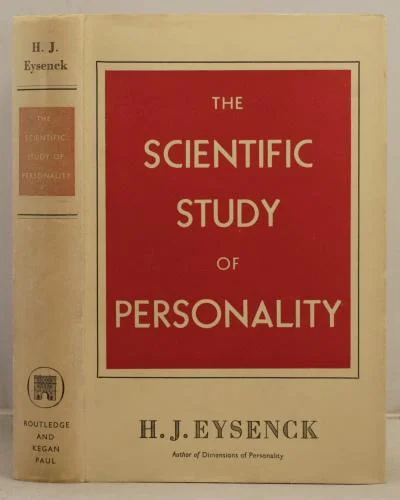
The Scientific Study of Personality
 Hans Eysenck
Eysenck presents the experimental program conducted at the Institute of Psychiatry between 1947 and 1952, arguing that personality can be studied with the rigor of a natural science. The book's central mechanism is the dimensional approach: personality traits are measured operationally through objective tests, and factor analysis reveals three independent dimensions—neuroticism, extraversion–introversion, and psychoticism. It rejects clinical intuition and psychogenic explanations in favor of quantitative measurement, experimental hypothesis testing, and constitutional causation.
Key Details
Related Books
View AllSimilar books from the same category, ranked by shared topics and reader engagement.


Key Insights — Read in 10 Minutes
What is the central methodological innovation of The Scientific Study of Personality?
The book's central innovation is the application of operational definitions and experimental hypothesis testing to personality research. Eysenck adopted the language of the null hypothesis and defined his phenomena operationally, in what a 2016 assessment described as 'the best spirit of behaviorism' . Rather than relying on clinical intuition or projective interpretation, he subjected personality dimensions to the same quantitative scrutiny applied in the exact sciences. The book opens with a discussion of scientific method in personality research, using physics as the model, and argues that dimensional analysis provides the appropriate framework for a cumulative, testable science of personality .
What are the three dimensions of personality Eysenck claims to have identified, and how does psychoticism differ from the other two?
The book reports three relatively independent dimensions: introversion–extraversion, neuroticism, and psychoticism . The first two were carried over from Dimensions of Personality (1947), but psychoticism was a new addition. Eysenck's key claim is that neurosis and psychosis are not mutually exclusive categories but independent dimensions. As the book states, the question 'Is this person psychotic or neurotic?' becomes as unreasonable as asking 'Is this person intelligent or tall?' . A person can score high or low on each dimension independently, and the dimensions can combine in various ways. This reframing of psychiatric classification as dimensional rather than categorical was a major theoretical contribution.
What practical applications does the book present for dimensional analysis?
The final section applies the findings to a range of practical problems. Among the areas investigated are the psychological after-effects of prefrontal leucotomy, the prediction of work efficiency of paroled mental defectives, the selection of students and nurses, and the work adjustment of factory workers . These studies, conducted by Eysenck and his colleagues, were designed to demonstrate that the dimensions of personality had real-world predictive utility beyond the laboratory. A 1953 review noted that the field studies warranted 'examination in considerably more detail than the information actually presented allows,' but acknowledged their value as demonstrations of the dimensional approach's applied potential .
What were the major criticisms of the book's methodology and conclusions?
A 1953 review in the Journal of Consulting Psychology identified two significant weaknesses. First, some experiments seemed to suffer from 'the lack of cross validation on independent groups,' meaning the findings might not generalize beyond the original samples . Second, the reviewer noted that Eysenck's 'statically cross-sectional approach' led almost inevitably to a hereditarian position, and that Eysenck 'generally belittles psychogenic hypotheses based on clinical evidence' . The reviewer expressed hope that Eysenck would someday 'undertake the experimental investigation of learning, and apply his considerable talents to the study of change as well as to the study of status' .
How does the book relate to Eysenck's earlier Dimensions of Personality and his later Structure of Human Personality?
The book is the direct sequel to Dimensions of Personality (1947), reporting experiments conducted at the Institute of Psychiatry during the five years following that earlier work . Where the 1947 book established the two major dimensions, the 1952 volume integrates the findings into a consistent conceptual scheme and adds psychoticism as a third dimension. The Structure of Human Personality (1953) then synthesized evidence from all available assessment methods—ratings, questionnaires, objective tests, projective techniques—to demonstrate the replicability of these dimensions across measurement contexts. Together the three books form a progression: identification (1947), experimental validation (1952), and comprehensive synthesis (1953).
What was the book's reception in the broader scientific community?
Reviews acknowledged the book's methodological rigor while questioning its conclusions. Nature published a brief notice in 1953 listing the book without extensive commentary . The Journal of Consulting Psychology praised Eysenck's 'original and ingenious experiments' and his use of objective tests, recommending that this approach 'deserves wider attention in the United States' . A review in the British Journal of Industrial Medicine noted that Eysenck's criterion analysis was 'an attempt to minimize' the difficulty of comparing conclusions across studies, but observed that 'the answers which the author gives will by no means be universally acceptable' and that many psychologists would not accept his general approach 'without grave reservations' .
Show 1 more insights
What is the book's publication history?
The book was first published in 1952 by Routledge & Kegan Paul in London, running 320 pages with an additional xiii pages of front matter . A Russian translation was published in Moscow in 1999 . Taylor & Francis reissued the book in 2021 as part of its psychology reissue program, with a note that the language and views portrayed reflect the era of original publication . The ISBN of the original edition is 9780710013521 . The book remains available through academic libraries and used book sellers.
Wealthy Psyche is an intellectual archive. We do not host, distribute, or sell book copies — physical or digital. We provide structured knowledge to help you think better, faster.