


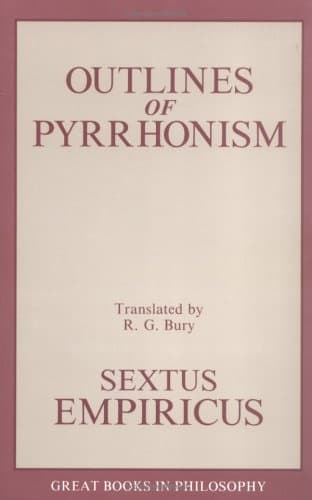
The Skeptic Way: Sextus Empiricus's Outlines of Pyrrhonism

Mates's edition presents Pyrrhonian skepticism as a live philosophical position, not a historical curiosity. The central claim, drawn from Sextus, is that the skeptic follows appearances without dogmatizing, opposing equipollent arguments until suspension of judgment (epochē) follows, bringing tranquility. Mates's distinctive contribution is analytic: he translates Sextus's technical vocabulary with philosophical precision and argues that Pyrrhonism is immune to many standard modern objections to skepticism. The volume combines a new complete translation with a section-by-section commentary aimed at professional philosophers.
Key Insights
✦What distinguishes Mates's edition from the Annas and Barnes translation published two years earlier?
David Glidden's review draws the contrast sharply: the Annas and Barnes version is 'more mellifluous' and opens out to classicists, historians, and general readers, with footnotes citing parallel passages and a focused bibliography. Mates's edition 'is directed toward philosophers alone,' reading Sextus as a contemporary professional philosopher might, employing 'philosophese' and the language of propositions and Fregean intensions . Mates's style is 'plain-spoken,' which Glidden notes has merits when the arguments get technical. The choice depends on the reader's purpose: Annas and Barnes for historical and literary context, Mates for analytic engagement with the arguments as philosophy.
✦Why does Mates argue that Pyrrhonism is immune to standard modern objections to skepticism?
The key is the distinction between Pyrrhonism and modern skepticism. Modern skepticism typically asserts a thesis—that knowledge is impossible, or that we cannot know the external world—which can then be refuted or defended. Mates argues that Pyrrhonism, as Sextus presents it, does not assert any thesis, including the thesis that nothing can be known. The skeptic reports that after opposing equal arguments, suspension follows. Because it is not a dogmatic position, it escapes objections that target dogmatic skepticism. Oxford University Press's description notes that Mates 'discusses specific features of this form of skepticism which make it immune to many of the standard criticisms' . This is the central interpretive claim of his introduction and commentary.
✦What is the significance of Mates's translation of Sextus's technical vocabulary?
Mates gives 'particular attention to explicating a number of quasi-technical terms that occur frequently in the Outlines and have decisive bearing on the philosophical content' . By rendering these terms 'more accurately and uniformly,' he seeks to make the essential features of Pyrrhonism 'more evident to the reader' . Lloyd Gerson's review notes that Mates's translation is 'undoubtedly an improvement over its predecessor, especially in the rendering of technical terms and in the clarification through translation of some obscure argumentative structures' . This matters because Sextus's arguments often turn on subtle terminological distinctions, and a translation that blurs them can make the skeptical strategies appear either trivial or incoherent. Mates's philosophical training allows him to preserve the argumentative force of the Greek.
✦How does Mates's commentary differ from a historical or philological commentary?
Mates's commentary is explicitly philosophical rather than philological. Glidden describes it as 'another hundred pages of narrative, reflecting primarily what Mates finds interesting about certain selected passages,' with his 'own narrative line' dominating both the introductory essay and the commentary . The commentary engages Sextus by comparing passages to Hume or Berkeley, even though those philosophers derived their views from reading Sextus . This approach treats Sextus as a contemporary interlocutor rather than a historical figure to be situated in his Hellenistic context. Glidden warns that 'postmodern Foucaultians, contextualist historians, and Hellenistic scholars might find this approach unhelpful, even irritating,' while 'busy, mainstream American philosophers could find Mates's approach sufficiently sympathetic to actually read some Sextus' .
✦What was the state of Sextus studies in Anglophone philosophy before Mates's edition appeared?
Glidden's review describes a remarkable neglect: 'For decades Sextus was banned in American philosophy departments, as no philosopher at all. He was not taught, he was not read. One highly prominent American philosopher was expressly forbidden to write a dissertation on him' . The only available English translation was Bury's Loeb edition from 1933. Mates had begun pioneering work on Sextus and Hellenistic philosophy nearly half a century before his translation appeared in 1996. The publication of both Mates's edition and Annas and Barnes's translation signaled a reversal: 'Fashion has returned to favor Pyrrhonism in the late twentieth century,' and 'Sextus is now welcome in the Canon' . Mates's edition is thus both a scholarly contribution and a marker of Sextus's rehabilitation in analytic philosophy.
✦Is this edition suitable for readers without a background in philosophy?
It is less suitable than the Annas and Barnes translation for beginners. Glidden notes that Mates's edition is 'directed toward philosophers alone' and reads Sextus through the lens of contemporary analytic philosophy, employing terms like 'propositions' and 'Fregean intensions' that presuppose philosophical training . The commentary assumes familiarity with debates in epistemology and the philosophy of language. That said, the translation itself is clear and plain-spoken, and the introduction is described by Gerson as capable of standing alone as 'a concise and clear exposition of the basic ideas of Pyrrhonian Skepticism' . Determined general readers can profit from it, but they should expect to work harder than they would with Annas and Barnes.
Wealthy Psyche is an intellectual archive. We do not host, distribute, or sell book copies — physical or digital. We provide structured knowledge to help you think better, faster.