


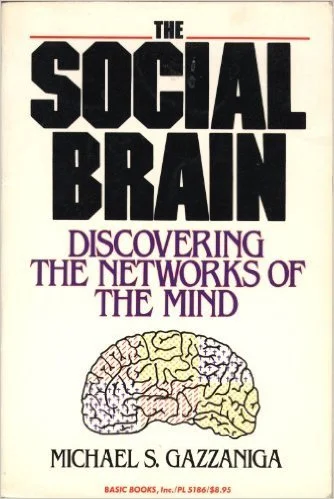
The Social Brain: Discovering the Networks of the Mind
 Michael S. Gazzaniga
Gazzaniga argues that the brain is not a unified processor but a collection of semi-autonomous modules that operate in parallel, each capable of influencing behavior and mood without conscious awareness. The book's central mechanism is the left hemisphere's 'interpreter': a language-based module that observes actions initiated elsewhere and fabricates plausible explanations for them. This confabulatory capacity, Gazzaniga contends, underlies our sense of a coherent self, our belief in free will, and the formation of religious and social beliefs. The book moves from split-brain experiments to speculative claims about culture and consciousness.
Key Details
Related Books
View AllSimilar books from the same category, ranked by shared topics and reader engagement.



Key Insights — Read in 10 Minutes
What is Gazzaniga's central hypothesis in The Social Brain, and what experimental evidence supports it?
Gazzaniga's central hypothesis is that the brain is organized into separate modules that can carry out actions, maintain moods, and perceive the world independently, with a language-based 'interpreter' module in the left hemisphere that constructs explanations for behaviors it did not initiate [citation:4][citation:5]. The evidence comes from split-brain patients: when a command like 'walk' is flashed to the right hemisphere, the patient gets up and walks, but when asked why, the left hemisphere—which never saw the command—readily concocts a false but plausible explanation [citation:4]. This confabulatory capacity is the seed for Gazzaniga's broader argument about consciousness, free will, and belief formation [citation:5].
How does the book distinguish itself from the popular 'left brain/right brain' dichotomy?
Gazzaniga explicitly repudiates the 'left brain/right brain mania' that simplified his research into a dichotomy between analytical left and intuitive right hemispheres [citation:4][citation:5]. A 1985 Nature review praised him for 'wisely' resisting the oversimplification, noting his findings were more subtle: the right hemisphere may draw better, but not because it is a superior visualizer—rather, the left hemisphere's linguistic activity may interfere with its perceptual performance [citation:4]. The book's actual argument is not about two competing types of thinking but about modular organization, where many independent processors contribute to behavior and consciousness without our awareness [citation:2].
What role does the concept of modularity play in the book's argument about belief and society?
Modularity is the foundation for Gazzaniga's speculative extension into belief formation, prejudice, and religion. He argues that because behavior is often initiated by modules outside conscious awareness, and the interpreter then fabricates explanations, we hold beliefs for which we have no objective evidence [citation:4]. The book's final chapters apply this framework to prehistory, the inevitability of religious beliefs, and social behavior [citation:14]. A review noted that Gazzaniga's unique contribution is his emphasis on the 'confabulatory capacity of the interpretative module,' which he links to how humans construct shared beliefs and cultural narratives [citation:2][citation:5].
How have critics assessed the book's structure and argumentative rigor?
Reviews identified significant structural weaknesses. A New York Times review said Gazzaniga 'tried to compress three books into one' and ended up 'doing justice to none of his projects' [citation:17]. A detailed academic review noted that Gazzaniga never defines what a 'module' is, makes unqualified assertions that the nonspecialist cannot distinguish from consensus science, and shifts the meaning of 'Social Brain' between chapters without signaling the change . The same reviewer warned that the book is an 'idiosyncratic account' and that students should beware—it does not represent consensus brain science. The conversational style makes it easy to read but difficult to critically evaluate .
How does The Social Brain relate to Gazzaniga's earlier work with Joseph LeDoux?
The Social Brain extends and revises the framework of The Integrated Mind, co-authored with Joseph LeDoux in 1978. The earlier book presented the technical case for modular mental organization and the role of the corpus callosum in integrating hemispheric processing. The Social Brain moves from the experimental evidence to broader speculation about consciousness, belief, and culture. A Library Journal review described the 1985 book as presenting 'a new and valuable approach to understanding the brain' that debunks misinterpretations of split-brain studies and extends modular theory to prejudice, evolution, and religion [citation:15]. It represents Gazzaniga's turn from technical reporting toward public-facing synthesis.
What does the book claim about free will, and how does that claim follow from the experimental findings?
Gazzaniga argues that our sense of free will arises because the left hemisphere's interpreter constructs narratives that make our actions seem consciously chosen, even when they were initiated by modules outside awareness [citation:4]. In split-brain experiments, the right hemisphere can perform actions the left never intended, and the left then confabulates a reason. Gazzaniga generalizes: because we are unaware of the modular causes of much of our behavior, we attribute agency to a unified self that is actually a post-hoc construction. This is why, he writes, 'we think we have free will, and why we are likely to hold beliefs for which we have no objective evidence' [citation:5]. The claim is speculative but follows directly from the interpreter hypothesis.
Wealthy Psyche is an intellectual archive. We do not host, distribute, or sell book copies — physical or digital. We provide structured knowledge to help you think better, faster.