


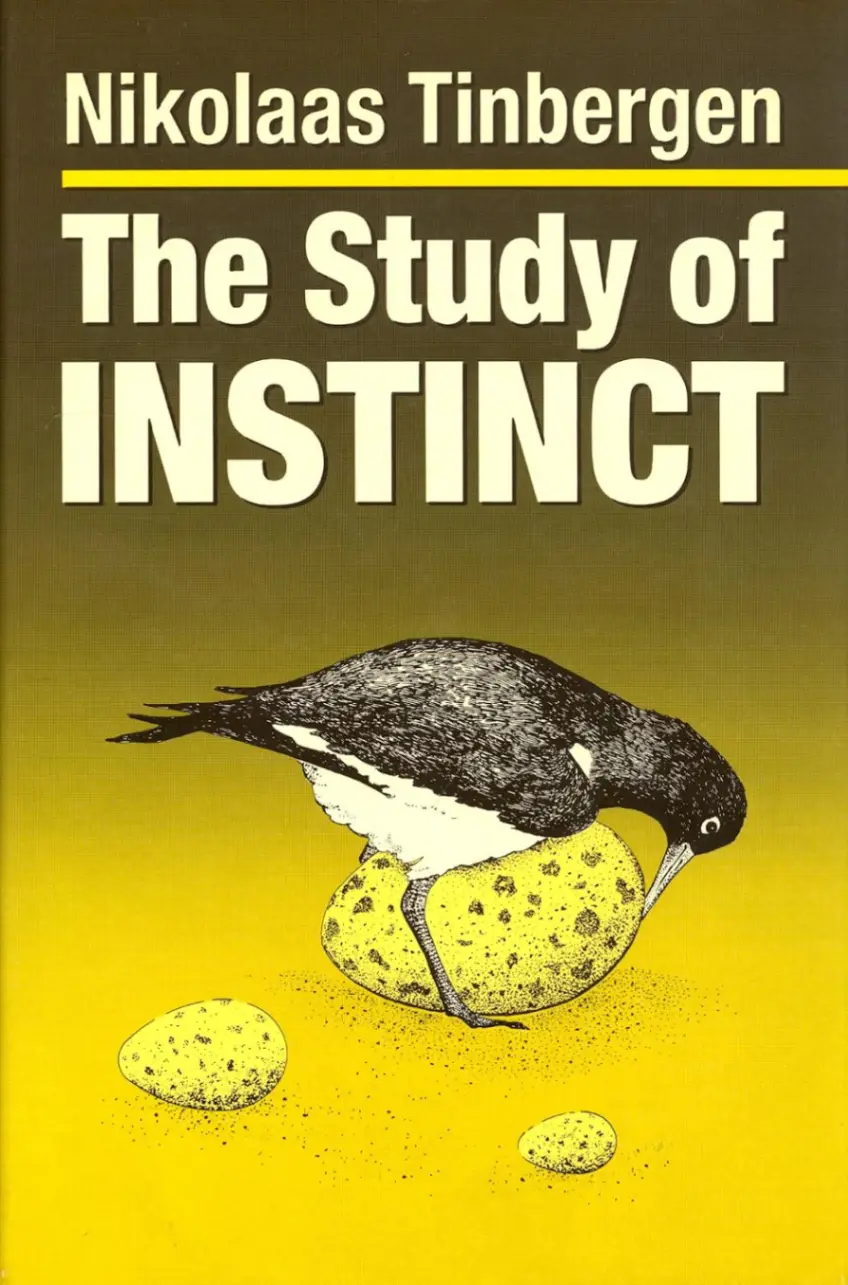
The Study of Instinct
 Niko Tinbergen
Tinbergen argues that instinctive behaviour can be studied with the same rigour as anatomy, by treating species-specific motor patterns as biological structures subject to natural selection. He synthesises ethology's concepts—sign stimuli, innate releasing mechanisms, displacement activities, and the hierarchical organisation of instinct—into a single framework, and insists that causation, survival value, evolution, and ontogeny are separate questions that must not be conflated. The book's central move is methodological: it replaces speculation about animal minds with field and laboratory experiments that isolate the stimuli releasing behaviour.
Key Details
Related Books
View AllSimilar books from the same category, ranked by shared topics and reader engagement.


Key Insights — Read in 10 Minutes
What is the central methodological claim of The Study of Instinct, and what does it reject?
Tinbergen argues that instinctive behaviour is a biological phenomenon that can be studied with the same experimental rigour applied to anatomy and physiology, and that species-specific motor patterns are subject to natural selection. He rejects both the reflex-chain psychology that reduces behaviour to concatenated stimulus-response units and the introspective anthropomorphism that reads human motives into animals. His method is to isolate the specific sign stimuli that release behaviour, then manipulate them experimentally in the field and laboratory. The book's foundational move is to treat behaviour as structure: something with form, homology, and evolutionary history, not merely a sequence of responses to environmental input.
How does the book's treatment of motivation differ from Konrad Lorenz's hydraulic model?
Tinbergen adopts Lorenz's concept of action-specific potential but is more cautious about the hydraulic metaphor and more attentive to hierarchical organisation. He describes a system in which appetitive behaviour—flexible, searching activity—brings the animal into the situation where a consummatory act, the fixed motor pattern, can be released. His hierarchical diagrams depict instinct as layered levels of integration, with higher centres controlling lower ones, making the model easier to relate to neural organisation than Lorenz's reservoir-and-valve analogy. Later critics, including Robert Hinde, noted that Tinbergen's hierarchy still struggled to explain the inertia of excitation that Lorenz's hydraulic model was designed to capture. The two frameworks were complementary rather than identical.
What are the four problems Tinbergen identifies for the study of behaviour, and why does he insist they be kept separate?
Tinbergen distinguishes four questions: causation (what physiological mechanisms and external stimuli produce the behaviour?), survival value (what function does it serve?), evolution (how did it arise phylogenetically?), and ontogeny (how does it develop in the individual?). He insists these are logically independent and must not be conflated, because an answer to one does not answer another. Confusing survival value with causation, for example, leads to the error of assuming that because a behaviour is useful it must be performed for its usefulness. This fourfold framework, later formalised in his 1963 paper “On aims and methods of ethology,” became the organising structure for behavioural biology and is arguably Tinbergen's most enduring contribution.
What specific experimental studies does the book draw on to demonstrate its method?
The book synthesises Tinbergen's own field experiments with studies by Lorenz and other ethologists. Central examples include the three-spined stickleback, where a red underside releases aggression in rival males while a swollen grey belly releases courtship in females; the herring gull chick, which pecks at the red patch on the parent's bill, with artificial models revealing supernormal stimuli; and the grayling butterfly, whose courtship sequence Tinbergen analysed as a chain of mutually released signals. He also discusses displacement activities, such as grooming during conflict, and the role of innate releasing mechanisms in coordinating social behaviour. These studies demonstrated that instinctive behaviour could be dissected experimentally rather than merely described.
How was the book received, and how does its approach relate to Lorenz's later systematisation of ethology?
The Study of Instinct was widely reviewed as the first comprehensive English-language synthesis of ethology and established Tinbergen's international reputation. It drew on German-language research that had been largely inaccessible to Anglophone readers. Lorenz's later The Foundations of Ethology (1978/1981) was a systematic restatement of his own positions rather than a continuation of Tinbergen's, and the two men diverged on key points. Lorenz remained more committed to the hydraulic model and to the primacy of innate structure; Tinbergen became increasingly interested in survival value and in the interaction of innate and learned components, and he was more willing to revise his positions in response to evidence. Their collaboration was foundational, but The Study of Instinct is distinctly Tinbergen's synthesis.
What is the relationship between The Study of Instinct and Tinbergen's later Social Behaviour in Animals?
The Study of Instinct (1951) covers the whole field of animal behaviour—method, motivation, development, and the analysis of instinct—and was addressed to a broad scientific readership. Social Behaviour in Animals (1953) narrows the focus to relations between two or more individuals, applying the same framework specifically to mating, fighting, family life, and group organisation. Tinbergen himself noted the overlap in examples and illustrations between the two books, but reviewers observed that the later volume was more detailed on social phenomena and less concerned with background methodology. Together they form a pair: the first establishes the general principles, the second demonstrates them in the domain of social cooperation.
Wealthy Psyche is an intellectual archive. We do not host, distribute, or sell book copies — physical or digital. We provide structured knowledge to help you think better, faster.