


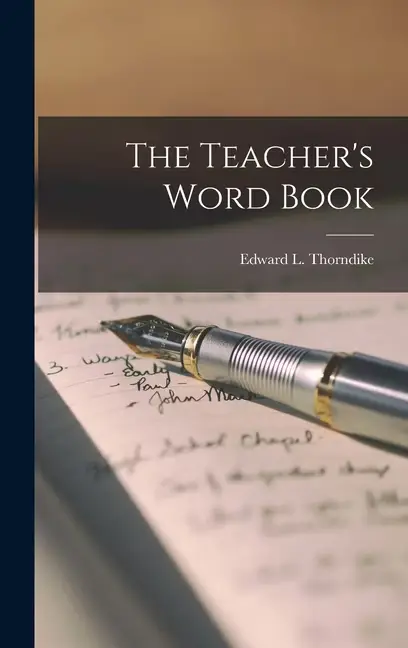
The Teacher's Word Book
 Edward Lee Thorndike
Thorndike argues that vocabulary instruction should be based on the actual frequency with which words occur in the English language, not on tradition or intuition about which words are important. The book presents a ranked list of approximately 10,000 words compiled from an extensive count of words appearing in the Bible, English classics, and elementary school textbooks. Its central claim is that knowing which words are most common allows teachers to sequence instruction efficiently, ensuring that students master the vocabulary they will encounter most often in reading and daily life.
Key Details
Related Books
View AllSimilar books from the same category, ranked by shared topics and reader engagement.



Key Insights — Read in 10 Minutes
What is the central argument of The Teacher's Word Book, and what does it reject?
Thorndike argues that vocabulary instruction should be based on the actual frequency with which words occur in the English language, rather than on tradition, intuition, or the assumption that literary words are inherently more valuable than common ones. The book rejects the practice of selecting vocabulary for instruction on the basis of what teachers or textbook authors happen to consider important. Instead, Thorndike contends that knowing which words are most common allows teachers to sequence instruction efficiently, ensuring that students master the vocabulary they will encounter most often in reading. This empirical approach to vocabulary was a direct application of his conviction that educational practice should be grounded in measurement and the laws of learning.
How was the word list compiled, and what sources were used?
Thorndike and his assistants compiled the list by counting words in a large corpus of texts representing different types of English usage. The sources included the Bible, English classics, elementary school textbooks, and other widely read materials. The total count ran to approximately 4.5 million words, though this figure was later disputed on the grounds that Thorndike claimed 4.5 million words counted but failed to define what he meant by 'word' and how he counted. Words were ranked by frequency, and the resulting list of about 10,000 words was presented with indications of their relative frequency. The book was intended as a practical reference for teachers, not a theoretical treatise, though it rested on a substantial empirical foundation.
What controversy arose over Thorndike's count of words, and how did he respond?
Critics questioned Thorndike's claim to have counted 4.5 million words, noting that he did not clearly define what counted as a 'word' and that the figure seemed implausibly large given the methods available at the time. Thorndike defended the count, arguing that the number referred to the total number of word occurrences in the corpus, not the number of distinct words, and that his definition of a word was consistent with standard linguistic usage. The controversy was significant because it raised questions about the reliability of frequency counts compiled without mechanical aids. Later word frequency counts, such as those by Henry Kučera and W. Nelson Francis, used computer methods and more explicit criteria, and they largely confirmed the general shape of Thorndike's list while revising specific rankings.
What is the relationship between The Teacher's Word Book and Thorndike's broader work in educational psychology?
The Teacher's Word Book is an application of Thorndike's connectionist principles to the practical problem of vocabulary instruction. His educational psychology had argued that learning is specific and that transfer is limited, which implied that students need to be taught the specific words they will actually encounter rather than general principles of vocabulary. The word book provided the empirical basis for deciding which words those are. It also reflected his conviction that educational decisions should be based on measurement rather than tradition. Thorndike later produced expanded editions and related word books, including The Teacher's Word Book of 20,000 Words (1931) and The Teacher's Word Book of 30,000 Words (1944, with Irving Lorge), which extended the approach to a larger corpus.
How was the book received by educators, and what was its impact on reading instruction?
The book was widely adopted and became a standard reference for teachers, textbook authors, and curriculum designers. Its impact on reading instruction was substantial: it provided an empirical basis for selecting vocabulary in basal readers and for grading texts by difficulty. The idea that vocabulary should be sequenced by frequency became a foundational principle in reading education, influencing the development of readability formulas and leveled readers. Some critics argued that frequency alone is an insufficient criterion for vocabulary selection, since some infrequent words are conceptually important and some frequent words are already known. Nonetheless, the book established the principle that vocabulary instruction should be informed by systematic evidence about language use.
How has the book's approach held up in light of subsequent research on vocabulary and reading?
Thorndike's basic insight—that frequency of occurrence is a crucial variable in vocabulary learning and instruction—has been strongly supported by subsequent research. Corpus linguistics has confirmed that a relatively small number of words accounts for a very large proportion of all text, and that frequency is one of the best predictors of word difficulty and acquisition. Contemporary vocabulary research continues to use frequency counts, though with more sophisticated corpora and statistical methods. However, later research has also shown that frequency alone does not determine which words should be taught: factors such as morphological complexity, conceptual difficulty, and importance for academic content also matter. The Teacher's Word Book remains a historical landmark in the empirical study of vocabulary and the first major attempt to apply frequency data to educational practice.
Wealthy Psyche is an intellectual archive. We do not host, distribute, or sell book copies — physical or digital. We provide structured knowledge to help you think better, faster.