


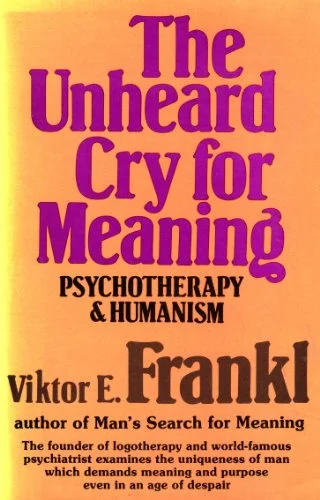
The Unheard Cry for Meaning: Psychotherapy and Humanism
 Viktor Emil Frankl
Frankl's collection of essays written between 1947 and 1977 argues that the human dimension—the will to meaning—has been systematically excluded from both psychoanalysis and behaviorism, producing a psychotherapy that is technically sophisticated but humanly impoverished. The book's distinctive mechanism is a sustained critique of reductionism: Frankl contends that treating meaning-seeking as a derivative of drives or reinforcement schedules misses the specifically human capacity to transcend self-interest and find purpose in work, love, and suffering. He applies logotherapy to contemporary phenomena—sex, morality, literature, athletics—arguing that the existential vacuum of modern life manifests as addiction, depression, and aggression, and that therapy must address the cry for meaning that these symptoms obscure.
Key Details
Related Books
View AllSimilar books from the same category, ranked by shared topics and reader engagement.


Key Insights — Read in 10 Minutes
What is the central claim of The Unheard Cry for Meaning, and what does it reject?
The central claim is that psychotherapy has systematically excluded the human dimension—the will to meaning—and that this exclusion produces a distorted picture of human functioning. Frankl rejects the reductionism of both psychoanalysis and behaviorism, arguing that treating meaning-seeking as a derivative of instinctual drives or reinforcement contingencies misses the specifically human capacity to transcend self-interest. The essays, written between 1947 and 1977, apply logotherapy to contemporary subjects—sex, morality, literature, competitive athletics—to show that the existential vacuum of modern life manifests as addiction, depression, and aggression. The book's title captures its argument: there is a cry for meaning that the dominant psychologies have not heard, and therapy must learn to hear it.
What is the existential vacuum, and how does Frankl connect it to contemporary social problems?
The existential vacuum is the experience of inner emptiness that arises when the will to meaning is frustrated—when a person has the means to live but no reason for living. Frankl argues that as traditional sources of meaning have weakened, individuals are thrown back on the task of finding purpose for themselves, and many respond with substitutes that do not satisfy the underlying need. In this book he connects the vacuum to addiction, depression, and aggression, arguing that these are not merely individual pathologies but symptoms of a cultural condition in which meaning is scarce . The critique extends to affluent society: Frankl cites Ludwig von Bertalanffy's observation that an expanding economy requires manipulating humans into conforming consumers, which deepens the vacuum rather than filling it .
How does this book relate to Man's Search for Meaning?
The Unheard Cry for Meaning extends the project of Man's Search for Meaning by supplying the theoretical and clinical elaboration that the popular book presupposes. A reader review notes that it is a continuation and extension of the 'Introduction to Logotherapy' that comprises the second half of Man's Search for Meaning, more academic and less personal but still full of insight . Where the earlier book is autobiographical and accessible, this collection is addressed to clinicians and scholars, with essays on the critique of pan-determinism, the nature of encounter, and the application of logotherapy to literature and athletics. Readers who know Frankl only through the bestseller will find here the systematic arguments that ground its claims.
What techniques are discussed in the book, and what are they designed to treat?
The final chapter discusses paradoxical intention and dereflection, the two techniques most closely associated with logotherapy. Paradoxical intention asks the patient to do or wish for the very thing they fear—for example, to embrace and heighten anxiety rather than fight it—breaking the circular pattern of anticipatory anxiety that sustains phobic and obsessive symptoms. Dereflection redirects attention away from the symptom toward something meaningful, and is presented as particularly relevant to sexual ailments where hyper-intention and hyper-reflection interfere with natural functioning . These techniques are modest in scope; Frankl does not present them as a comprehensive therapeutic technology but as specific interventions that follow from the logotherapeutic understanding of how meaning-seeking can be blocked by symptom focus.
How was the book received, and what are its main criticisms?
Reception has been respectful but not uniformly enthusiastic. Reader reviews reflect the split: some call it life-changing and recommend it immediately after Man's Search for Meaning, while others find it 'slightly too technical' and note that certain chapters—particularly the critiques of pan-determinism and pure encounter—are difficult to follow because Frankl does not define his terms clearly . The book's extensive use of philosophical and psychological jargon suggests it was not written for a general audience . Elisabeth Kübler-Ross praised its emphasis on helping people find meaning, but scholarly reception has been more measured, noting that the essays were written for different occasions over three decades and vary in accessibility and depth. It is best read as a companion to Frankl's systematic works rather than a standalone introduction.
What is a common misconception about this book?
A common misconception is that The Unheard Cry for Meaning is a self-help book or a sequel to Man's Search for Meaning in the same accessible register. It is a collection of academic essays, many of which engage technical debates in psychotherapy and philosophy, and some chapters assume familiarity with Frankl's terminology and with the positions he is criticizing. Another misconception treats the book as a systematic treatise; it is a gathering of papers written over thirty years for different audiences, and the chapters do not build a single cumulative argument. Readers seeking a clear introduction to logotherapy should begin with Man's Search for Meaning or The Will to Meaning; this volume is for those who want to see Frankl engaging critics and applying his framework to cultural phenomena.
Wealthy Psyche is an intellectual archive. We do not host, distribute, or sell book copies — physical or digital. We provide structured knowledge to help you think better, faster.