


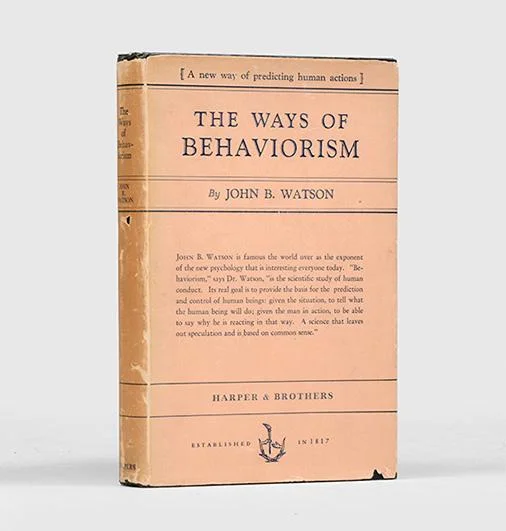
The Ways of Behaviorism
 John B. Watson
Watson argues that behaviorism is not merely a methodological option within psychology but a complete replacement for introspective psychology, which he treats as unscientific because its data cannot be verified by independent observers. The book presents behaviorism as "common sense grown articulate": a science that observes what organisms do, predicts future conduct from present conditions, and ultimately seeks control over behavior. Watson contrasts the behaviorist program with the introspectionist study of consciousness, arguing that terms like sensation, image, and feeling are carryovers from medieval dogma and have no place in a natural science.
Key Details
Related Books
View AllSimilar books from the same category, ranked by shared topics and reader engagement.



Key Insights — Read in 10 Minutes
What is Watson's central argument against introspective psychology in The Ways of Behaviorism?
Watson argues that introspective psychology is not a science because its data cannot be verified. He writes that verification of findings is "forever denied the introspective student of psychology" . Introspectionists claimed to observe consciousness, but no two observers could agree on what they saw, and there was no way to check their reports. Watson contends that behaviorism, by contrast, studies observable conduct—what organisms do—and can therefore make predictions and test them. He dismisses consciousness as a "masquerade for the soul," a carryover from medieval dogma that has no place in a natural science . The behaviorist challenge to introspectionists was straightforward: demonstrate the existence of consciousness as other sciences demonstrate their facts.
How does Watson characterize the relationship between behaviorism and common sense?
Watson describes behaviorism as "just common sense grown articulate" . His point is that behaviorism does not introduce a strange new vocabulary or a mysterious method; it simply observes what people do and attempts to state the conditions under which they will do it. When Watson writes that John Smith will run every time he sees a snake, or that women will scream if wild rats are released in a room, he is making predictions of the sort anyone makes in daily life—but he is doing so systematically and with the aim of developing a science . Behaviorism, on this account, is not a radical departure from ordinary understanding but the refinement of it into a predictive and eventually controllable body of knowledge.
What does Watson mean when he says psychology should aim at prediction and control?
Watson argues that every science passes through stages of observation, prediction, and control, and that psychology should follow the same path. Astronomy can predict eclipses but cannot control them; chemistry and biology are increasingly able to control their phenomena . Watson asks whether psychology can achieve control: can a behaviorist make someone who is not afraid of snakes afraid of them? Can the behaviorist remove a fear that already exists? The answer, for Watson, is yes, through conditioning. This commitment to prediction and control defines the behaviorist program as practical and technological rather than merely descriptive. It also explains Watson's later interest in applying behavioral principles to advertising, child-rearing, and other domains where behavior is deliberately shaped.
How does The Ways of Behaviorism relate to Watson's earlier book Psychology from the Standpoint of a Behaviorist (1919)?
The Ways of Behaviorism (1928) is a shorter, more accessible restatement of the program Watson had systematically presented in Psychology from the Standpoint of a Behaviorist (1919) and popularized in Behaviorism (1925). The 1919 book was a comprehensive textbook covering receptors, effectors, instinct, habit, emotion, and thought. The 1928 book is a defense and clarification rather than a systematic exposition: it focuses on the contrast between behaviorism and introspective psychology, the scientific status of the behaviorist method, and the practical promise of prediction and control. It was published during the period when Watson, having left academia for advertising, was working to promote behaviorism to a broader audience. The book thus belongs to the popular phase of Watson's career, alongside Behaviorism and Psychological Care of Infant and Child.
What was the reception of the book, and how does it fit into the broader trajectory of Watson's influence?
The Ways of Behaviorism was published by Harper & Brothers in 1928, a year that also saw the publication of Psychological Care of Infant and Child . It was reviewed as a clear and forceful restatement of the behaviorist position, though not as a major new contribution to the technical literature. By the late 1920s, Watson's influence was at its peak in terms of public visibility, even as his academic career had ended in 1920 following a divorce scandal. The book contributed to the popular understanding of behaviorism as a commonsense, scientific approach to human conduct. Its emphasis on prediction and control, and its dismissal of consciousness as unscientific, became standard elements of the behaviorist public image. The book remains a useful historical document of Watson's mature rhetoric and his confidence in the behaviorist program.
How does this book differ from Watson's Behaviorism (1925)?
Behaviorism (1925) was Watson's most widely read popular statement, a book aimed at a general audience that made him, in some accounts, the second best-known psychologist of his time after Freud. The Ways of Behaviorism (1928) is a shorter and more focused work, centered on the contrast between the behaviorist and introspectionist approaches and on the scientific status of the behaviorist method. It is less concerned with surveying the full range of psychological topics and more concerned with defending the behaviorist position against the charge that it is not a genuine science. Both books belong to Watson's post-academic career as a popularizer, but The Ways of Behaviorism is more narrowly argumentative and less systematic than Behaviorism.
Show 1 more insights
What does Watson mean by saying behaviorism treats man and animal on the same plane?
Watson argues that the behavior of man and the behavior of animals must be considered on the same plane, because both are studied by the same objective methods and both consist of adjustments to environmental stimuli. This position is stated in the review of his earlier Behavior (1914), which noted that Watson's approach removes the barrier between psychology and the objective sciences . For Watson, the differences between human and animal behavior are differences of complexity and of the presence of language habits, not differences of kind. Humans have speech mechanisms that allow for vastly more elaborate conditioning, but the fundamental principles of stimulus-response connection and habit formation apply across species. This continuity thesis was central to Watson's program and to the later development of comparative and behavioral psychology.
Wealthy Psyche is an intellectual archive. We do not host, distribute, or sell book copies — physical or digital. We provide structured knowledge to help you think better, faster.