


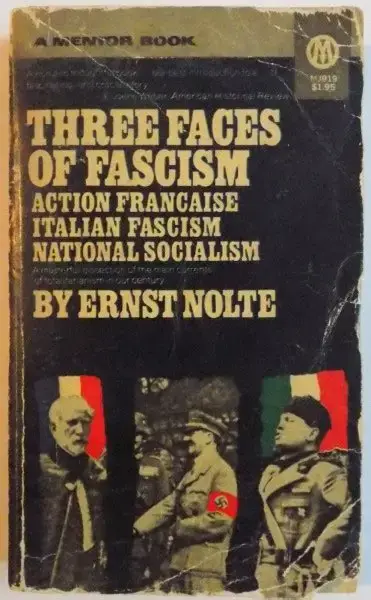
Three Faces of Fascism: Action Française, Italian Fascism, National Socialism
 Ernst Nolte
Nolte's landmark study examines fascism through three movements—Charles Maurras's Action Française, Mussolini's Italian Fascism, and Hitler's National Socialism—arguing they share a common origin in resistance to transcendence. His central definition: fascism is 'anti-Marxism which seeks to destroy the enemy by the evolvement of a radically opposed and yet related ideology and by the use of almost identical and yet typically modified methods.' The book's philosophical framework treats fascism as a metapolitical force opposing the liberal thrust of the nineteenth century, marking the first major attempt to establish fascism as a generic European phenomenon.
Key Details
Related Books
View AllSimilar books from the same category, ranked by shared topics and reader engagement.


Key Insights — Read in 10 Minutes
What is Nolte's central definition of fascism, and what does it reject?
Nolte defines fascism as 'anti-Marxism which seeks to destroy the enemy by the evolvement of a radically opposed and yet related ideology and by the use of almost identical and yet typically modified methods, always within the unyielding framework of national self-assertion and autonomy' [citation:3][citation:14]. This rejects definitions that treat fascism as merely reactionary or incoherent. Nolte emphasizes fascism's ideological kinship with Marxism—it is a 'related' ideology using 'identical' methods—while remaining its mortal enemy. The definition positions fascism as a distinctive political force with its own philosophical foundations, not a mere pathology.
Why did Nolte devote one-third of the book to Action Française, a movement many historians do not consider genuinely fascist?
Nolte regarded Charles Maurras's Action Française as 'the first political grouping of any influence or intellectual status to bear unmistakable Fascist traits' [citation:6]. By including it alongside Italian Fascism and Nazism, he sought to demonstrate fascism's deep intellectual roots in pre-1914 European reaction, before it became a mass political movement. This choice reflects his metapolitical method: fascism is not merely a set of organizations but a philosophical stance against transcendence and liberal modernity. Critics argued this inclusion stretches the fascist category too broadly, treating a politically inconsequential movement as foundational.
What does Nolte mean by fascism as 'resistance to transcendence'?
This is Nolte's metapolitical definition, which he considered the book's core. 'Transcendence' refers to the forces of secularization, democratization, and globalization—modernity's dissolution of closed traditional social systems and its opening toward universal human possibilities [citation:11]. Fascism, in this framework, resists both the practical transcendence of liberal-democratic society and the theoretical transcendence of Marxism. It seeks a refuge from the anomie of modern society. Critics note this definition is highly abstract and obscures the fact that fascism offered its own form of transcendence and an alternative modernity, not merely resistance to change [citation:11].
How does Three Faces of Fascism relate to totalitarianism theory?
Nolte's work emerged when totalitarianism theory was losing explanatory power in the early 1960s [citation:7]. While acknowledging similarities between fascism and communism—both use 'almost identical methods' and glorify violence—he rejected their equation. His fascism is specifically anti-Marxist, a reaction against Bolshevism that paradoxically shares its revolutionary structure. A reviewer noted that if Nolte's characterization is correct, 'the epoch is that of communist and totalitarian dictatorship rather than of fascism,' since the communist revolution begat the first totalitarian trends [citation:3]. Nolte maintained fascism's distinctiveness while recognizing its kinship with its enemy.
What was the critical reception of Three Faces of Fascism when it appeared?
The book met with widespread acclaim across the political spectrum. Klaus Epstein called it 'a work of exceptionally broad range that combines description, comparison and interpretation in an admirable manner' [citation:3]. Leonard Krieger praised it as 'the most perceptive, the most profound, the most knowing and yet critical history of fascism as a European movement that we have had or are likely to get' [citation:3]. The New York Times called it 'brilliant, profound, difficult and exhausting' [citation:6]. A Marxist reviewer acknowledged it as 'an important and useful book' providing a framework notably lacking in both bourgeois and Stalinist accounts [citation:19].
What are the main criticisms of Nolte's approach?
Critics identified several problems. A. James Gregor noted that Nolte's definition, applied literally, could include movements like the South African National Party, and that his suggestion that Hitler's racism was 'a particular and biological form of Marxism' was problematic [citation:14]. The New York Times reviewer warned that professional historians would be 'wary of Nolte's technique of selecting only the historical detail which supports his thesis' [citation:6]. More fundamentally, later scholars questioned Nolte's philosophical framework, noting that fascism offered its own transcendence rather than merely resisting it [citation:11].
Show 1 more insights
How did Nolte's later work relate to Three Faces of Fascism?
Nolte described Three Faces as 'philosophical,' developing the concept of fascism through its three most important forms [citation:3]. It was the first of four volumes in his phenomenology of fascism. The subsequent works—The Crisis of the Liberal System (historical), Theories on Fascism (political science), and Fascism (popular/illustrated)—were not planned from the outset but developed at others' suggestions after the first volume's success [citation:3]. Together they constitute the longest and most detailed attempt to analyze fascism's nature, establishing Nolte as 'the leading western authority on fascism' in the 1960s [citation:7].
Wealthy Psyche is an intellectual archive. We do not host, distribute, or sell book copies — physical or digital. We provide structured knowledge to help you think better, faster.