


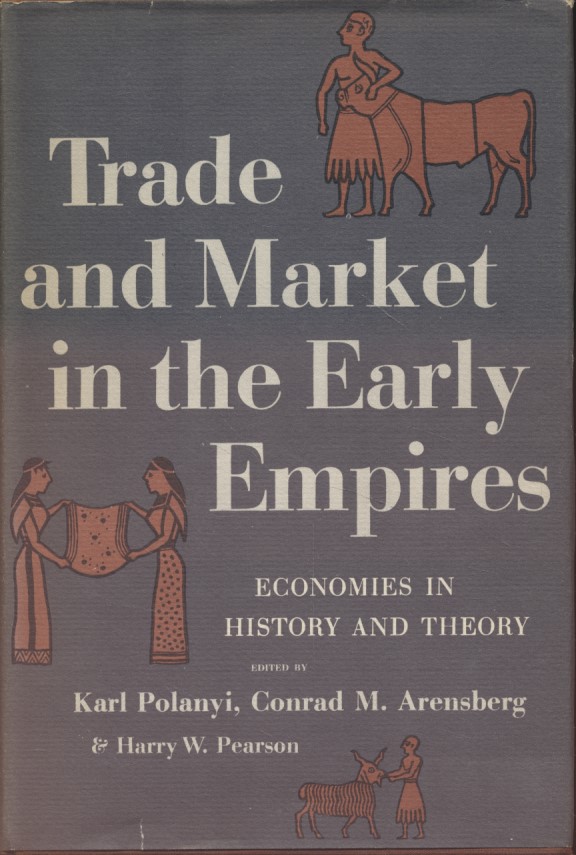
Trade and Market in the Early Empires
 Karl Polanyi
Polanyi and his co-editors argue that the market as a self-regulating institution is a historically recent and socially constructed phenomenon, not a universal feature of human societies. Through empirical studies of Mesopotamia, Aztec and Maya civilizations, Dahomey, India, and Berber societies, the contributors demonstrate that trade can exist without market institutions, and that economic activity in archaic societies was embedded in reciprocity, redistribution, and householding rather than price-making markets. The book is the foundational statement of the substantivist approach in economic anthropology, challenging the application of formal economic theory to premodern economies.
Key Details
Related Books
View AllSimilar books from the same category, ranked by shared topics and reader engagement.


Key Insights — Read in 10 Minutes
What is the central argument of Trade and Market in the Early Empires?
The book argues that the market economy is a historically recent and socially constructed institution, not a natural or universal feature of human societies. Polanyi and his collaborators demonstrate through empirical studies of ancient Mesopotamia, the Aztec and Maya civilizations, Dahomey, India, and Berber societies that trade can and did exist without market institutions. In archaic economies, economic activity was embedded in social relations and organized through reciprocity, redistribution, and householding rather than price-making markets. The substantivist approach this book established challenged the universal application of formal economic theory to premodern societies .
What specific concepts did Polanyi introduce or develop in this book?
The book introduced the substantivist approach to economic anthropology, which defines 'economic' substantively as the process of human interaction with nature and society to meet material needs, rather than formally as rational choice under scarcity . Polanyi developed the concepts of embeddedness and the three forms of integration—reciprocity, redistribution, and exchange (or market)—as principles by which economies are institutionalized . He also argued for distinguishing trade from market, showing that 'trade without market' characterized many ancient economies . These concepts became foundational for economic sociology and heterodox economics.
What was the Interdisciplinary Columbia Project, and how did it produce this book?
The Interdisciplinary Columbia Project was a research program directed by Polanyi at Columbia University, funded initially by the Council for Research in the Social Sciences and later by a Ford Foundation grant . It brought together anthropologists, economists, and historians to test substantivist propositions empirically across a wide range of ancient societies. The project ran from the late 1940s through the mid-1950s, with Polanyi as architect and co-director alongside Conrad M. Arensberg. Trade and Market in the Early Empires, published in 1957, was the collective product of this collaboration, with contributions from scholars including Anne Chapman, who studied Aztec and Maya trade, and Rosemary Arnold, who examined Dahomey .
How does the substantivist approach differ from the formalist approach in economic anthropology?
Formalists argue that the logic of rational choice under scarcity applies universally to all human societies, so modern economic theory can analyze any economy. Substantivists, following Polanyi, counter that this formal definition of 'economic' is historically specific to market societies and cannot account for economies where production and distribution are embedded in kinship, religion, and political institutions . Polanyi argued that the formal meaning of economic is contingent on a market system; outside that system, formal analysis loses most of its relevance . The two approaches clashed in the formalist-substantivist debate of the 1960s, which shaped the development of economic anthropology as a discipline.
What evidence does the book present from ancient societies?
The book presents eight empirical studies covering ancient Mesopotamia, Aztec and Maya civilizations, the kingdom of Dahomey, India, and Berber societies, along with ten theoretical essays . Polanyi's own chapter on 'Trade without Market in the Time of Hammurabi' shows that Mesopotamian commerce operated through administered trade and equivalencies, not price-making markets. Anne Chapman's study of Aztec and Maya 'port of trade' enclaves demonstrates that long-distance exchange occurred outside market institutions . The Berber 'explosive markets' described by Francisco Benet illustrate markets that were arenas of conflict rather than peaceful price-setting mechanisms .
What is the most common misconception about this book's argument?
A common misconception is that Polanyi and his collaborators claimed ancient societies had no markets or trade at all. In fact, the book explicitly distinguishes trade from market institutions and demonstrates that trade existed in many forms without self-regulating markets. Another misreading treats substantivism as a rejection of all economic theory. Polanyi did not deny that formal economic analysis was valid for market economies; his argument was that its universal application to all societies was an ethnocentric error . The book's point is about the historical specificity of market institutions, not the absence of economic activity in antiquity.
Show 1 more insights
How has the book's argument held up since its publication?
The substantivist approach remained dominant in economic anthropology into the 1970s and influenced the development of economic sociology, particularly the concept of embeddedness . However, the formalist-substantivist debate has since been characterized as an obstacle to more sophisticated questions in the field . Some archaeologists argue that Polanyi's influence on Bronze Age Mediterranean scholarship had a 'disastrous effect' by discouraging recognition of market exchange, entrepreneurship, and profit-seeking in ancient economies . The book remains a foundational reference for scholars interested in the historical construction of market economies and alternatives to market fundamentalism .
Wealthy Psyche is an intellectual archive. We do not host, distribute, or sell book copies — physical or digital. We provide structured knowledge to help you think better, faster.