


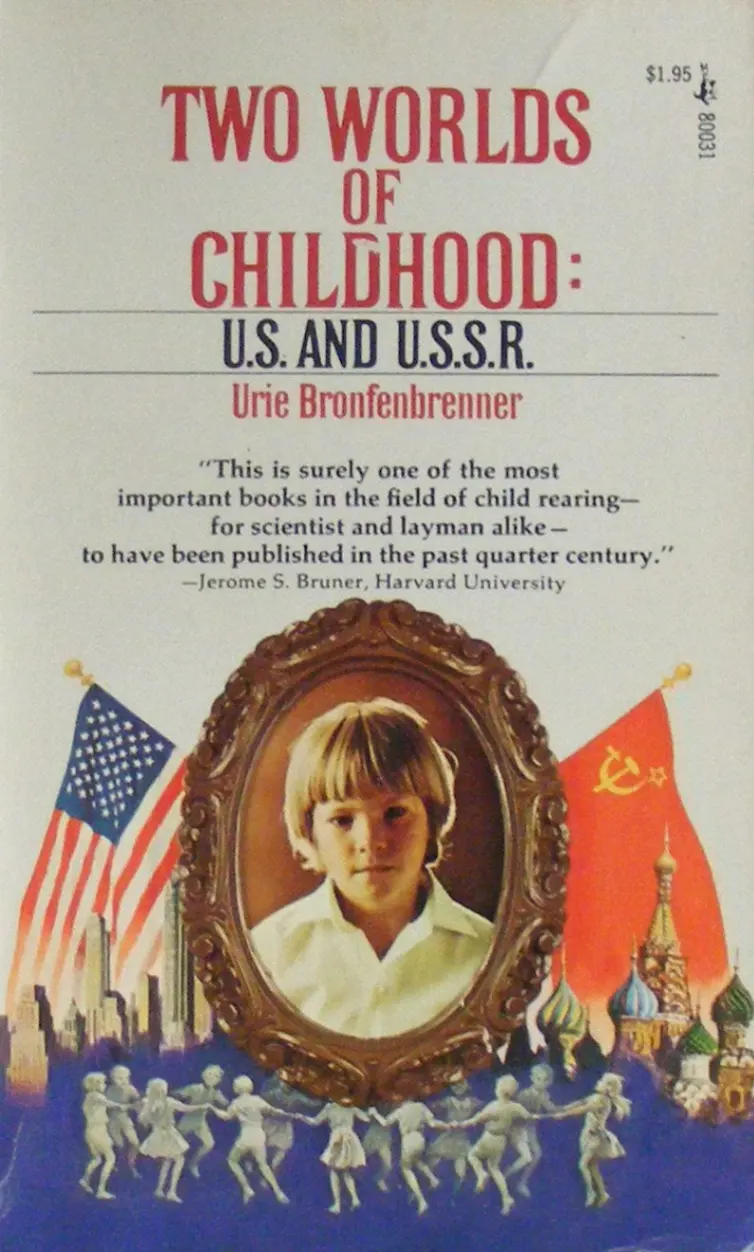
Two Worlds of Childhood: U.S. and U.S.S.R.
 Urie Bronfenbrenner
Bronfenbrenner's comparative study argues that Soviet and American children are raised in radically different developmental ecologies, producing divergent orientations toward adult society. In the Soviet Union, collective upbringing and peer-group accountability deliberately internalize societal expectations, while American children are increasingly raised by age-segregated peer groups and television, in what Bronfenbrenner calls an 'accidental process of development.' The book's central claim is that a society's treatment of its children predicts its future, and that American age segregation and parental withdrawal constitute a cultural crisis requiring institutional, not merely individual, reform.
Key Details
Related Books
View AllSimilar books from the same category, ranked by shared topics and reader engagement.



Key Insights — Read in 10 Minutes
What is Bronfenbrenner's central comparative argument about American and Soviet childhood?
Bronfenbrenner argues that the two societies raise children in fundamentally different developmental ecologies. The Soviet child grows up in an environment that encourages looking beyond immediate gratification to the needs and expectations of society, with peer groups and collective activities deliberately fostering internalization of adult norms. The American child, by contrast, is exposed to a largely accidental process of development, brought up by age-segregated peers in an atmosphere of subtle opposition to adult standards, with television contributing significantly to antisocial potential. The comparison is not neutral description: Bronfenbrenner uses Soviet practices as a mirror to expose what he sees as American neglect.
What does Bronfenbrenner mean by 'age segregation,' and why does he treat it as a crisis?
Bronfenbrenner documents that American children spend roughly twice as much time with peers as with parents, and that housing, social life, and recreation are increasingly organized by age rather than across generations. He argues this segregation is not confined to the young: neighborhoods and social institutions cater to particular life-cycle stages, limiting contact to persons of one's own age and station. The consequence is a vacuum left by parental withdrawal, filled by an age-segregated peer group that is more a product of parental disregard than of the peer group's attractiveness. For Bronfenbrenner, this is not a private family matter but a structural feature of American society that predicts national decline.
How did the book's methodology and data sources shape its argument and its limitations?
Bronfenbrenner drew on multiple visits to the Soviet Union, where he taught at the Institute of Psychology in Moscow, and conducted comparative studies of socialization in both nations. His evidence included observations, interviews, analysis of child-rearing manuals and pedagogical texts, and a study of 766 sixth-grade children on peer versus adult orientation. However, as Robert Sears noted in a contemporaneous review, the American portrait reads like scare-journalism, with the family disintegrating and America going to hell in a motorized wheelbarrow with a color television mounted in front. Sears found the Soviet ethnographic section stronger than the American diagnosis, which he judged cavalier and biased.
What did contemporaneous reviewers identify as the book's central weaknesses?
Robert Sears, reviewing in Contemporary Psychology, distinguished three parts: an ethnographic account of Soviet child-rearing, a diagnosis of American childhood, and a speculative final section on reform. He found the middle section less satisfactory, reading like scare-journalism and presenting a biased portrait of American family life. Leonard Hersher, in a subsequent exchange, argued that Sears failed to address a fundamental alternative explanation: the possibility of genetic differences between American and Soviet children, noting that American children are descendants of freemen and pioneers rather than serfs. Sears's reply dismissed this hypothesis as resting on unproven assumptions about the comparability of historical suppression. The methodological critique—that Bronfenbrenner's American diagnosis was shaped by polemical intent—remained the most persistent objection.
How does this book relate to Bronfenbrenner's later, more famous ecological systems theory?
Two Worlds of Childhood is the empirical and polemical precursor to the formal theory Bronfenbrenner published in The Ecology of Human Development (1979). The comparative study made visible the extra-familial systems—peer groups, schools, media, community institutions—that shape development, which he later theorized as the microsystem, mesosystem, exosystem, and macrosystem. As one scholarly source notes, Bronfenbrenner later drew on the experiences of researching this book to propose his comprehensive framework. The 1970 study's emphasis on how societies organize childhood through institutional arrangements, rather than through individual parental choices, directly anticipates the ecological model's insistence that development cannot be understood apart from the embedded contexts in which it occurs.
What specific reforms did Bronfenbrenner propose, and how did he frame their feasibility?
Bronfenbrenner's reforms were institutional rather than individual: flexible work schedules allowing parents time with children, part-time rather than all-or-none employment for mothers of young children, community centers where people of all ages participate in shared recreation and learning, and business policies that treat family time as a legitimate benefit. He explicitly rejected blaming parents, arguing that parents do only what society tells them to do and that the requirements of work and community life make good parenting impossible without structural change. A review noted that his reforms required little sacrifice on the part of adults and were not so sweeping as to demand total social reorganization—only a revaluation of priorities.
Show 1 more insights
How has the book's argument about American childhood held up in light of subsequent research on media, peers, and family time?
Subsequent research has complicated Bronfenbrenner's diagnosis while validating some of its concerns. The finding that American children spend more time with peers than parents has been repeatedly confirmed, though later studies show peer influence is not uniformly oppositional and that parent-child relationships remain central across development. Bronfenbrenner's worry about television's antisocial effects was based on then-current research on aggressive modeling; contemporary media effects research is more nuanced, emphasizing content, context, and individual differences. His broader claim—that societal arrangements shape developmental ecologies—has been absorbed into mainstream developmental science, even as the specific 1970 diagnosis of American neglect now reads as a historically situated polemic rather than a neutral empirical finding.
Wealthy Psyche is an intellectual archive. We do not host, distribute, or sell book copies — physical or digital. We provide structured knowledge to help you think better, faster.