


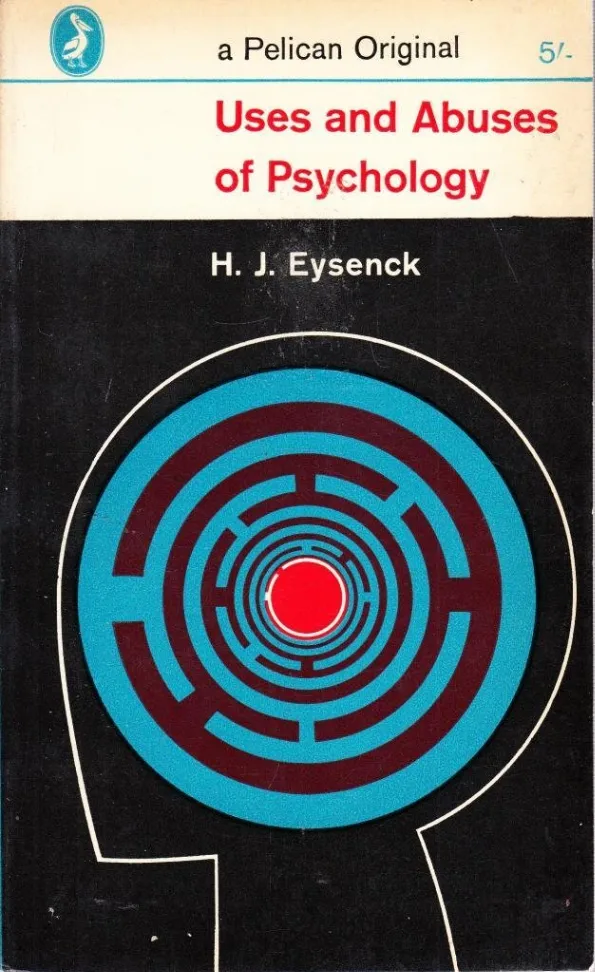
Uses and Abuses of Psychology
 Hans Eysenck
Eysenck's first book for general readers argues that psychology has accumulated genuine scientific knowledge that is routinely ignored or distorted in public life, while pseudo-psychological claims—vocational guidance, projective testing, psychoanalysis, opinion polls, and race science—are presented as established fact without adequate evidence. The book's central mechanism is the demand that all psychological claims meet strict evidentiary standards: demonstration rather than assertion, replication rather than anecdote. Each chapter applies this criterion to a different applied domain, showing where psychology is used well and where it is abused.
Key Details
Related Books
View AllSimilar books from the same category, ranked by shared topics and reader engagement.


Key Insights — Read in 10 Minutes
What is the book's central distinction between the 'uses' and 'abuses' of psychology?
Eysenck distinguishes between psychological knowledge that has been established through rigorous research and is therefore genuinely useful, and psychological claims that are widely applied but lack adequate evidence. The 'uses' include areas where psychology has demonstrable findings—the effects of propaganda, the measurement of attitudes, the validity of certain selection methods. The 'abuses' include vocational guidance, projective techniques like the Rorschach and TAT, psychoanalysis, opinion polling, and claims about racial differences in intelligence . The book's method is consistent: for each topic, Eysenck reviews the available evidence and asks whether the practice rests on demonstrated fact or on unexamined assumption. The book was one of the first to apply this critical standard across the whole range of applied psychology.
How does the book treat psychoanalysis, and what is the basis of Eysenck's critique?
The book devotes a chapter to 'The Abuse of Psychology: Psychoanalysis' and subjects Freudian theory to the same evidentiary scrutiny applied elsewhere . Eysenck's critique rests on the unfalsifiability of psychoanalytic propositions and the poor outcomes reported in follow-up studies of psychoanalytic treatment. He argues that psychoanalysis was widely accepted not because it had demonstrated efficacy, but because it offered a comprehensive system that appeared to explain everything. This chapter previews the more extended attack Eysenck would develop in Fact and Fiction in Psychology (1965) and Decline and Fall of the Freudian Empire (1985). It also established his reputation as one of the most persistent critics of psychoanalysis in the postwar period.
What does the book say about vocational guidance and occupational selection?
Eysenck applies his evidentiary standard to the practices of vocational guidance and personnel selection. He examines the validity of interviews, references, graphology, and various tests used to predict occupational success. His argument is that many selection procedures have little demonstrated validity, while others—particularly certain ability and aptitude tests—have substantial predictive power that is often ignored in favor of intuitive judgment . The book argues that vocational guidance in particular rests on weak empirical foundations, with counselors often relying on impressionistic assessments rather than validated instruments. This chapter reflects Eysenck's broader commitment to replacing professional intuition with demonstrated measurement.
How does the book address the measurement of attitudes and public opinion?
The book includes chapters on 'The Measurement of Attitudes' and 'The Analysis of Public Opinion,' examining the methods and limitations of polling and attitude research . Eysenck had developed the methodology of attitude measurement in his own work, and the book explains the advantages and disadvantages of Likert scales, Thurstone scales, Guttman scales, and other techniques . He is critical of how polling results are interpreted and reported, arguing that the underlying measurement is often more fragile than public presentation suggests. The book thus combines methodological exposition with critique, showing what can and cannot be inferred from attitude data. This dual function—teaching method while warning against misuse—characterizes the book as a whole.
What is the relationship between this book and Eysenck's later popular works?
Uses and Abuses of Psychology was Eysenck's first popular book and established the formula he would follow in Sense and Nonsense in Psychology (1956) and Fact and Fiction in Psychology (1965), forming a loosely connected trilogy for Penguin . All three share the same purpose: demystifying psychology and applying scientific standards to widely held beliefs. The later books focus more narrowly on specific debates—fact and fiction contrasts laboratory evidence with psychoanalytic theory—while Uses and Abuses surveys the entire field of applied psychology. Eysenck later described the trilogy as his attempt to 'set the record straight' about what psychology actually knows and how it is commonly misrepresented.
How was the book received at the time of its publication?
The book reached a large popular audience as a Pelican paperback and helped establish Eysenck as a public intellectual. It was widely reviewed and discussed, and its critical stance toward psychoanalysis and projective testing generated controversy in professional circles. A Google Books description notes that the book covers 'a very wide field, ranging from the effects of propaganda to the measurement of attitudes, and from vocational guidance to the misuse of psychology by psychoanalysts' . The book's combination of accessibility, methodological rigor, and controversial conclusions made it a model for later popular science writing by psychologists. It remains a significant document of mid-twentieth-century debates about the scientific status of psychology.
Show 1 more insights
What is the book's publication history?
Uses and Abuses of Psychology was first published in 1953 by Penguin Books in Harmondsworth as a Pelican paperback . The original edition runs 318 pages and has been reprinted numerous times. It was translated into multiple languages, including German (1955), Japanese, and Spanish . Penguin reissued the book in later decades, and used copies remain widely available. The book is often cited alongside the other volumes in Eysenck's Penguin trilogy as an exemplar of postwar popular science that combined technical exposition with polemical critique.
Wealthy Psyche is an intellectual archive. We do not host, distribute, or sell book copies — physical or digital. We provide structured knowledge to help you think better, faster.