


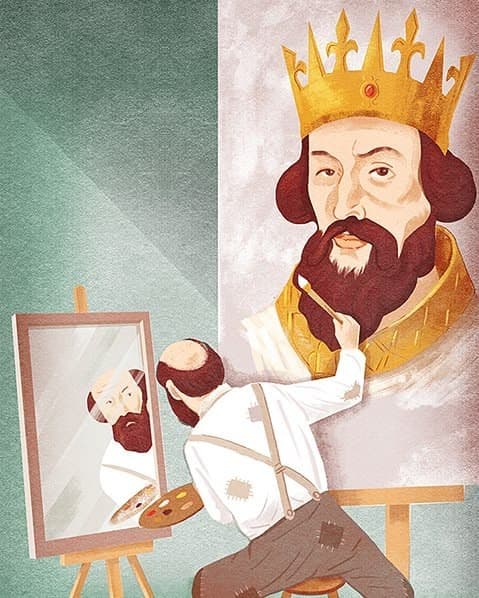
The question itself is a trap. Immediately upon asking it, a subtle division is born: there is the "I" who wants to overcome, and there is the "ego" that must be vanquished. That very "I" is the ego. So who is going to overcome what? This is not a clever word game. It is the central existential riddle that Advaita Vedanta places before any seeker who arrives with a sincere desire to be free. The effort to destroy the ego is like a knife trying to cut its own blade—the one that holds the knife is the very thing it seeks to remove.
And yet, the question persists because suffering feels real. The sense of being a separate, vulnerable, striving self—the ahamkara—brings with it an unmistakable ache. Relationships become battlefields of insecurity, work becomes a stage for proving worth, and quiet moments alone are often filled with a gnawing sense of lack. No wonder the ego is painted as the enemy. But what if this enemy is a phantom? What if the entire project of overcoming it is an elaborate avoidance of looking directly at who is actually there?
This exploration will not offer steps. It will not provide a technique to kill the ego. Instead, it will use the lens of Advaita Vedanta to investigate the very nature of the seeker. It will examine the psychology of spiritual ambition, the identity games we play in relationships and digital spaces, and the final, unsettling recognition that the freedom we seek is not from the ego but from the need to overcome it.
The Phantom That Cannot Be Fought
The Sanskrit term ahamkara is often translated as ego, but its literal meaning is more precise: the "I-maker." It is not a noun, not a solid entity lodged somewhere in the psyche. It is a verb—an ongoing activity of identification. The I-maker is the mental movement that attaches the sense of self to a thought, a feeling, a body, a story. When you think "I am angry," the anger is a passing physiological state, but the I-maker claims it as identity. When you think "I am a failure," the I-maker weaves a single event into a permanent self-definition.
Because the ego is a process and not a thing, you cannot locate it and remove it like a tumor. Any attempt to fight it simply fuels the activity of the I-maker. The one fighting is the I-maker itself, now strengthened by the righteous mission of self-improvement. This is why Advaita does not prescribe ego-killing techniques. Instead, it asks you to look for the ego. Where is it? What is its substance? Under the light of sustained attention, the process begins to stutter. The ghost cannot survive being seen for what it is—a habitual contraction, not a fact.
The Search For The Self That Supposedly Has An Ego
Ramana Maharshi compressed the entire teaching into a simple investigation: ask "Who am I?" and refuse every answer the mind offers. I am the body? That is a perception. I am the thoughts? They come and go. I am the doer? Find that doer. This inquiry is not a psychological exercise to build a better self-concept; it is a scalpel aimed at the very root of the I-maker. Each time the mind says "I am this," the inquiry responds with silence, not with another identity. The gap that appears between two thoughts—that is where the phantom dissolves. It doesn't leave a void. It leaves what was always present: pure, self-luminous awareness.
The ego is like a shadow. It has no independent existence. It appears when there is light and a form to cast it, but you cannot fight a shadow. You simply turn the light on yourself, and the shadow disappears.
The Exhaustion Of Striving: When Spiritual Ambition Becomes The Ego's Fuel
Perhaps the most overlooked twist is how the desire to overcome the ego becomes the ego's most sophisticated disguise. A person reads the scriptures, hears about self-realization, and a new ambition ignites: to become enlightened, to transcend the self, to be permanently free. The I-maker swiftly shifts its identification from worldly success to spiritual attainment. Now the identity is "spiritual seeker," and the ego hides behind a mask of humility and discipline. This is not a minor pitfall; it is the central tragedy of spiritual life. The ego will co-opt the highest teachings to perpetuate itself.
Observe what happens in meditation. You sit to quiet the mind, and suddenly a thought appears: "I'm getting better at this." That's the I-maker, celebrating its progress. Or, "My mind is so restless, I'll never succeed." That's the I-maker, solidifying itself through failure. Both are the same movement of self-definition. The genuine meditative state, according to Advaita, is not one of achieving stillness but of recognizing that stillness is already the background of all movement. The one who strives to be still is already the noise.
The Disappointment That Frees
Many seekers eventually hit a wall of exhaustion. They have tried every practice, renounced every pleasure, disciplined every thought, and yet the ego remains—perhaps subtler, but intact. This moment of despair, if fully allowed, can be a doorway. The exhaustion is of the striver, not of awareness. When the striver collapses, not out of resignation but out of the sheer impossibility of its project, a new seeing dawns. You cannot overcome the ego because you are not the ego. You are that which is aware of the ego, of the striving, of the exhaustion. That awareness has never been touched by any of it. To rest there is not an overcoming but a homecoming.
Stage | Ego Activity | Underlying Assumption | Advaita's Pointer |
|---|---|---|---|
Worldly ambition | I must succeed, be admired, accumulate | I am my achievements | Who succeeds? To whom does the success belong? |
Spiritual ambition | I must overcome ego, attain enlightenment | I am the one who will become free | Who is bound? Find that one. |
Hopelessness | I cannot do this, I am a failure | I am the failure | Even this "I am a failure" is a thought. To whom does it arise? |
Recognition | Effort ceases; the seeker is seen through | No "I" to claim any state | Silence—not as absence, but as the ever-present reality |
Self-Inquiry: The Question That Unravels The Questioner
Self-inquiry is not about finding an answer. It is about living a question so intensely that the question and the questioner are consumed together. "Who am I?" is not a mantra to be repeated mechanically. It is a living curiosity directed toward the immediate sense of "I." When you feel hurt, you ask, "Who is hurt?" Not to get a verbal reply, but to turn attention back toward the source of the feeling. The energy that was flowing outward into the story of the insult now flows inward toward the one who claims to be insulted.
In that turning, something peculiar happens. The apparent solidity of the "I" dissolves. It becomes clear that the "I" is just a word referencing a constantly shifting bundle of sensations, memories, and reactions. There is no permanent core. The psychological self that seemed to need protection, improvement, and transcendence is a conceptual overlay. To see this is not to become a blank nothing. It is to discover that what you truly are—the awareness that registers the bundle—is already whole, already free.
The Direct Path And The Witnessing Awareness
Advaita does not ask you to cultivate a witness; it reveals that you are already the witness. The witness is not a super-ego observing from a distance. It is the light of knowing in which all phenomena appear and disappear. A thought arises—the witness is there, unchanged. The thought subsides—the witness remains. This is not a practice but an observation. Notice right now: the sounds in the room come and go, the sensations in the body shift, the mind comments. But the fact of being aware is constant. That constancy is what you are. The ego is the intermittent thought that claims ownership of this awareness, saying "I hear, I feel, I think." Without that claim, the hearing, feeling, and thinking happen—but no one is burdened by them.
The Social Ego: An Identity Held Together By Others' Gazes
The ego is not a private construction; it is co-created. From childhood, you learn who you are through the eyes of others. Approval shapes you into a pleasing self; disapproval scars you into a defensive one. The adult identity is a matrix of roles—parent, professional, friend, lover—each one a performance tuned to an audience. The terror of losing reputation is the terror of the social ego facing dissolution. If no one reflects you back, do you still exist?
Social media has magnified this dynamic to an unprecedented intensity. The curated profile is a digital ahamkara, a meticulously crafted "I" designed for public consumption. Every like is a small reassurance that the self is real; every ignored post a miniature death. The ego as a process becomes visible here: it is the gap between the image you project and the anxiety that nobody will believe it. Advaita's question cuts through this charade: when you turn off the screen and sit in the dark, who is there? Before the performance begins, before you put on the face for the world, who or what is aware of that urge to perform? That presence needs no validation. The social ego survives on feedback; awareness simply is.
The Exhausting Project Of Being Liked
At work, the ego shapes you into the competent one who never falters. In friendship, into the generous one who is always available. In love, into the partner who meets every expectation. The exhaustion of modern life is not just physical overwork; it is the relentless maintenance of these separate selves. And when any of these roles is threatened—a mistake at work, a friend's disappointment, a lover's withdrawal—the ego experiences it as annihilation. This is why so much of our suffering is social. Yet if you inquire deeply, you see that the one who is threatened is a character in a play. The awareness that witnesses the rise and fall of social fortunes is untouched. You can lose every role and still be the silent presence that you are. That discovery, not as a thought but as a lived certainty, is the end of the social ego's tyranny.
The ego is a collection of borrowed voices. Your fear of being seen is the fear of those voices falling silent. But silence is not empty—it is full of what you originally are.
Relationships As Mirrors That Cannot Lie
Intimate relationships are the ego's favorite battleground. Why? Because they promise the one thing the ego craves but cannot supply: unconditional wholeness. The romantic partner is unconsciously appointed as the savior from loneliness. When they fail—as they must, because no person can complete you—the ego erupts in blame. "You don't see me, you don't appreciate me, you make me feel small." Every accusation is a confession: I still believe I am this vulnerable self that needs outside support.
Advaita does not suggest you ignore relational pain or pretend to be above it. It invites you to use the pain as a direct path inward. When your partner's words trigger you, instead of immediately defending, pause and ask, "Who is triggered? What in me is hurting?" The hurt is a contraction of the I-maker around a vulnerable image. By looking directly at that contraction without trying to fix it, you rob it of its power. The contraction dissolves into the awareness that holds it. The relationship then stops being a stage for mutual ego-reinforcement and becomes a sacred space of truth. You no longer demand that the other person hold your identity together. And from that freedom, a different kind of love becomes possible.
The End Of The Blame Cycle
Consider the common dynamic: you feel unloved, so you criticize your partner. They withdraw, which confirms your belief that you are unloved. This cycle is the I-maker's self-fulfilling prophecy. To interrupt it, you don't need to change the other person; you need to see that the "you" who feels unloved is a thought. Underneath that thought is a raw sensation in the body—tightness, heat, emptiness. Stay with that sensation without naming it. The story "I am unloved" feeds on the naming. Without the story, the sensation is just energy. The ego has no foothold. The cycle breaks not because you become a better person, but because you see there is no person there to be hurt.
Failure, Success, And The Narrative Thread
The ego spins its sense of continuity largely through the twin poles of success and failure. When you succeed, the I-maker swells: "I did it, I am worthy." When you fail, the I-maker contracts: "I'm worthless, I'm a fraud." Notice that both states rely on the same identification with outcome. The ego is equally present in pride and in shame. This is why neither worldly success nor failure can touch the root of suffering. A successful person with a strong ego may still be haunted by the fear of losing it all; a failed person with a strong ego is consumed by regret. Both are slaves to a storyline.
Advaita offers a radically different relationship to action. In the Bhagavad Gita, Krishna tells Arjuna to act with full attention but without attachment to the fruits. This is often misunderstood as a call to indifference. It is actually a pointer to identity. When you know yourself as the awareness that is prior to action, you can engage fully in the world without the ego's desperate need for a particular outcome. Failure does not diminish you because you are not the doer. Success does not exalt you for the same reason. Life becomes a flowing, responsive movement rather than a ceaseless campaign to secure a self.
The Liberation In Losing Everything
Some of the most profound awakenings follow catastrophic loss—bankruptcy, divorce, public humiliation. Why? Because the external structures that propped up the ego suddenly vanish. The identity of "successful person" or "loving spouse" collapses. In that collapse, there is a terrifying but fertile gap. If you do not rush to rebuild a new identity, you might discover that what remains when all identities are stripped away is not nothingness but a spacious, peaceful presence. That is the Self. The tragedy becomes a grace because it finally exposed the lie that you were ever the fragile, constructed self you thought you were.
Phenomenon | Ego's Interpretation | Direct Experience (without the story) |
|---|---|---|
Failure at work | I am a failure; my life is ruined | A situation unfolded differently than expected; thoughts and sensations of disappointment arise |
Romantic rejection | I am unlovable; I will be alone forever | A particular relationship ended; physical sensations of longing and a silent witnessing presence remain |
Public praise | I am special; I must maintain this | Words are heard; a pleasant feeling arises; the background awareness is unchanged |
Aging and illness | I am my body; I am decaying | The body changes; the sense "I am" remains untouched, timeless |
The Guru And The Ego's Last Defense
When the seeker's ego has been cornered by self-inquiry, it often makes a final maneuver: it attaches itself to a teacher. This is not the healthy receptivity of a student, but a subtle substitution. The ego thinks, "If I can't be the enlightened one myself, I will be the closest disciple, the most devoted, the one who really understands." The guru is then used as a new identity prop. The danger is that a certain kind of guru will encourage this, enjoying the adulation and creating a spiritual hierarchy that keeps the disciple's ego intact in a new, "holy" form.
An authentic Advaitic teacher, however, systematically dismantles this. Ramana Maharshi would often ignore questions about the universe or advanced states, and simply return to the one question: "Who is asking?" The true guru functions as a mirror that refuses to reflect the disciple's ego back to them. Every attempt to get validation is met with silence or a pointer that throws the disciple back onto their own investigation. The relationship ultimately points beyond itself—the external guru's final success is to reveal the inner guru, the Self, and disappear. If a teacher needs you, it's not the teaching. If the teaching needs no one, it's the truth.
When The Disciple Becomes The Teaching
There is a saying: after enlightenment, the disciple no longer sees the guru as a person, but as the formless reality itself, which is their own true nature. This is not deification; it is the collapse of the distance between teacher and taught. The ego's last trick is to keep even non-duality as a concept to be mastered. The guru's uncompromising love is to burn that concept too. Then you are left without a teacher, without a teaching, without a self to be taught. Only life, lived in its raw immediacy, with no one separate from it.
The Illusion Of The "Overcomer"
There is a stage where a seeker begins to feel a certain expansiveness, a detachment from the old dramas, a cessation of inner chatter. A subtle pride may arise: "I have overcome the ego. I am more aware than others." This is the ego's resurrection at a higher octave. The spiritual ego is often more tenacious than the worldly one because it is harder to detect. It wears the robes of humility and speaks the language of non-duality. It compares its non-comparison favorably to others' comparison. The only antidote is relentless honesty. Whenever you catch yourself feeling superior or separate because of your spiritual insight, pause. That very feeling is the I-maker. Inquire into it. It will dissolve, often with a laugh at the sheer absurdity.
The freedom Advaita points to is not a state of permanent ego-death where you walk around in a trance. It is the recognition that the ego was never alive in the first place, except as a passing shadow. To have "overcome" it implies there was a real enemy and a real victory. But from the standpoint of the Self, there is no battle, no victor, and no vanquished. There is only the one reality appearing as the play of seeking and finding.
Surrender Without A Surrenderer
Many traditions speak of surrendering the ego to the divine. But who is to surrender? If you attempt to surrender, the doer is still active, now with the intention to give up. True surrender in Advaita is not an act of the ego; it is a recognition. It is the clear seeing that there is no separate agent at all. The entire show—thoughts, actions, the sense of control—arises and subsides in awareness. You are not the one surrendering; you are the space in which the illusion of control is surrendered. This is why the path of knowledge and the path of devotion converge at their peak. The devotee says, "Not my will, but Thine." The jnani says, "There is no 'my' separate from the whole." Both dissolve the imagined border.
What is left is a life that unfolds without a center. Decisions happen, but there is no decision-maker agonizing over them. Emotions pass through, but there is no one clinging to pleasant ones or pushing away painful ones. The body ages, circumstances change, but the underlying peace is unshakable because it is not dependent on circumstances. This is not a remote ideal; it is the natural state, obscured only by the habit of claiming ownership.
Living Without An Ego: Non-Identification, Not Annihilation
The phrase "living without an ego" can conjure images of a robot or a blank, passive personality. That is a misunderstanding born of taking the ego as a real entity. When the I-making process is seen through, life continues in full vividness. Thoughts arise but are not believed to be a self. Desires arise but are not converted into "my needs." The personality remains—its quirks, talents, and preferences—but it is known as a temporary expression, like a wave on the ocean. The wave does not need to be destroyed for the ocean to be recognized. It simply ceases to be mistaken for a separate entity.
In practical terms, this might look like: someone criticizes you at work, and the old pattern of defensiveness arises, but it is seen immediately as a conditioned reaction. There is no second layer of "I should not be reacting, I'm supposed to be egoless." The reaction is there, it is felt, and it passes. The criticizer is seen not as an enemy but as a fellow expression of the one consciousness. This is not a saintly achievement; it is the natural functioning of a mind that has stopped tying itself in knots. The freedom is not from the world but from the imaginary self that was always at odds with the world.
Closing Reflection
So, how do you overcome the ego? You don't. You look for it, and you fail to find it. In that failure, something infinitely more valuable reveals itself: the Self, which was never hidden, never bound, never in need of overcoming anything. The search was always the only problem. The seeker was the only veil. And when that is seen, not as a philosophical conclusion but as the living truth of this very moment, the question dissolves, and with it, all questions. What remains is the simplicity of being—not a better you, but the end of the need for a "you" at all.