


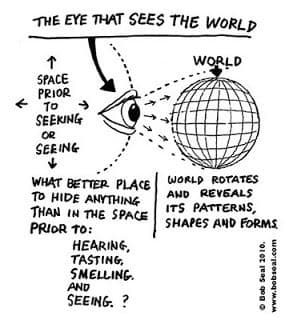
The very phrase "practice Advaita in daily life" contains a hidden fissure, a subtle assumption that spirituality and ordinary existence occupy different rooms. One goes to the meditation cushion to enter a sacred space; then one returns to the kitchen, the office, the traffic jam, and hopes to carry some residue of that peace. This framing—a separate practice compartment and a separate life compartment—is precisely the duality that Advaita Vedanta invites us to see through. The non-dual understanding is not a state to be imported into daily life; daily life is already the unbroken expression of the one reality. The question, then, is not "How do I practice Advaita?" but "What if the very act of seeking to practice keeps the seeker alive, and life appears divided?"
This exploration does not offer a checklist. It does not promise a "10-step program for non-dual living." Instead, it probes the ways we unconsciously hold life at a distance from the truth we seek, and how the everyday—the mundane, the frustrating, the heartbreaking—becomes the precise field where the self can unravel. The examples will come from the lived texture of work, relationships, digital identity, failure, and loneliness. The aim is not to believe something new but to look differently, to shift the axis of attention so that the division between "practice" and "life" dissolves, leaving only the seamless reality that was always already there.
The Great Undoing: Why "How" Is Part of the Problem
When we ask "how to practice," we are already within the logic of the ego—the doer who wants a method to achieve a future result. Advaita points out that the doer itself is a mental construct, a thought that says "I am the author of actions." The search for a practice can become yet another project of the doer, strengthening the very sense of separate self it aims to transcend. This is the first paradox: the most effective "practice" is to see through the one who seeks a practice. But that seeing is not a technique; it is an ongoing inquiry that can happen in the midst of chopping vegetables.
So the entry point is not an action but a shift of curiosity. What is this "I" that wants to practice? Where is it located? Can it be found as an entity, or is it a habit of thought? Throughout the day, whenever the mind generates the feeling "I need to be more spiritual" or "I should be practicing," that very feeling can become an invitation to look: "Who is it that needs to practice?" In that looking, the gap between the practitioner and the goal collapses. The inquiry itself is the practice, and it requires no special setting.
False Assumptions About Spiritual Practice
Several common assumptions subtly reinforce duality: that practice requires silence and solitude, that it involves a special state of mind, that it must be scheduled, that it will make us immune to anger or grief. These assumptions keep the truth compartmentalized. Advaita Vedanta suggests that all experience—from meditative stillness to a heated argument—is the expression of the same non-dual awareness. The challenge is not to escape the argument but to notice the awareness that is present in the midst of it, uncontracted and silent, even as the voice rises. This noticing is not a tool to suppress anger; it is simply the recognition that the anger is made of awareness, not separate from it.
You are not trying to bring awareness into daily life. Daily life is already awareness. The effort is only to stop imagining that you are a separate person who must achieve this.
The Witness Is Not a Spectator
A common misunderstanding of the witness attitude (sakshi bhava) is that it requires a cold, detached observation, as if one were watching a movie of one's own life. But this subtle position reifies a spectator who stands apart from the spectacle, preserving a last bastion of duality. The witness is not an entity behind the eyes; it is the impersonal, open space of awareness in which all experience unfolds. When practiced correctly, the witness does not distance you from life—it dissolves the boundary between you and life.
In daily activity, try this: while washing dishes, feel the warmth of the water and the movement of the hands. Notice that there is not a "you" doing the washing, but simply washing happening. The sensations, the sounds, the thoughts—they all arise within a silent, seamless field. The "I" that usually claims ownership is a late arrival, a commentary that says "I am washing." Without that commentary, what remains? Only the vibrant, undivided happening. This is not a special attainment; it is the ordinary truth when the overlay of personal ownership is seen through. The key is to notice the ownership thought itself as part of the field, not its source.
The Office As Vedanta: Ambition and the Non-Doer
Work is one of the most charged arenas of identity. Ambitions, deadlines, hierarchies—all conspire to keep the ego tightly wound. The non-dual perspective does not require abandoning ambition; it requires inquiring into the one who is ambitious. When you feel the surge of drive to achieve a promotion, ask, "Who wants to succeed?" The immediate answer will be a sensation and a story. The story says, "I will be more respected, more secure, more valuable." All this points to a self that feels lacking. But is that lack real, or is it a narrative superimposed on the already-full awareness?
Notice what happens when you receive a critical email. The body tightens, thoughts spiral. Conventionally, one might practice mindfulness: observe the tightness, label "anger." This can bring some relief. But the Advaitic eye goes further: it sees that the one who seems to be attacked is a thought-image. The email, the critic, the criticized—all arise in the same awareness. The suffering is not caused by the email but by the belief that "I am this image that has been threatened." In the moment of recognition, the image remains but is no longer mistaken for the self. Action—such as drafting a response—flows from a clearer, less personal ground.
Comparison Table: Dualistic vs. Non-Dual Approach to Work Stress
Situation | Dualistic (Ego-Based) Reaction | Non-Dual (Advaitic) Inquiry |
|---|---|---|
Colleague takes credit for your idea | Resentment, inner narrative of injustice, urge to prove ownership | Who is the "I" that has been robbed? Is there a self that owns a thought? Observe the play of forms. |
Imposter syndrome before a presentation | Fear of exposure, tightening, stories of inadequacy | Notice the "I" that claims inadequacy. Can inadequacy be found in awareness itself? Rest as the presence that hosts the fear. |
Missed promotion | Sense of personal failure, comparison, dejection | Who fails? The career self is a story. Awareness does not hold a résumé. The disappointment is felt fully, without a victim center. |
This table is not a prescription for how to "fix" these reactions but a pointer to the direction of questioning that unravels the sufferer. The reactions may still arise; the difference is the absence of a solid self to whom they happen.
Relationships: The Mirror That Has No Frame
Intimate relationships are a ceaseless dance of projection. The partner becomes a screen on which we project our unowned desires, wounds, and expectations. The Advaitic lens reveals that the "other" is not a separate entity but an appearance arising in the same consciousness that is aware of these words. This is not a sentimental "we are all one"; it is a direct perception available in the midst of conflict.
When a loved one says something hurtful, the mind instantly constructs a victim-self and a perpetrator-other. In that moment, turn attention inward. Feel the contraction in the chest, the heat of the story. Ask, "Who is hurt?" The sensation is real, but the entity that claims ownership of it is a mirage. The partner's words, the tone, the memory of past hurts—all are phenomena passing through awareness. The awareness itself remains unscathed. From that seeing, the compulsion to retaliate or defend weakens. Communication may still happen, but it arises from a space of curiosity rather than injury. This is not a psychological trick; it is the natural response when the separate self is seen to be absent.
Table: The Koshas in Relationship Inquiry
Kosha (Sheath) | How It Manifests in Conflict | Non-Dual Investigation |
|---|---|---|
Annamaya (Physical) | Tight jaw, rapid heartbeat, tears | Notice these sensations are objects in awareness. Awareness does not have a heartbeat. |
Pranamaya (Vital) | Energy drain, restlessness | Allow the energy to flow; the "I" claiming it is an afterthought. |
Manomaya (Mental) | Replaying the argument, justifications | Watch the mental movie without buying a ticket. Who is the audience? |
Vijnanamaya (Intellectual) | "I know better," "I am right" | The knower is a thought. What knows the thought? Rest as that. |
Anandamaya (Bliss) | Craving the return of peace | Peace is not a sheath; it is the nature of the witness. Don't seek it, simply be it. |
This mapping does not need to be memorized. It is a gentle tool that can be used in the heat of the moment to dis-identify from the layers, revealing the ever-present freedom behind them.
The Digital Self: Avatars of Maya
Scrolling through a social media feed, the "I" fragments into a thousand comparisons. The curated lives of others can ignite a persistent sense of lack, as if one's own life is a dull draft compared to a shiny final publication. This digital identity—the profile, the follower count, the likes—is an especially vivid demonstration of Maya. It feels solid, it demands maintenance, yet it is a stream of pixels and code, empty of independent self-nature.
Advaita's invitation is not to delete the apps (though one might choose to) but to see through the identification. When the urge to check notifications arises, pause. Before opening the screen, feel the raw sensation of wanting. Ask, "Who wants to check? What will this 'I' gain?" The feeling of incompleteness is real as sensation, but the promised completion—"after one more like I'll feel enough"—is a phantom. That phantom is the ego's fuel. In the pause, you may notice that the awareness in which the desire appears is already complete. The notification then loses its existential grip. The digital persona is seen as a costume, not the wearer.
The Body as a Doorway to the Formless
In daily life, the body is the anchor of the sense of self. Pain, pleasure, fatigue—all are tagged with "mine." Yet the body is also the most immediate portal to the non-dual. Every bodily sensation is a direct manifestation of consciousness. Instead of thinking "I have a body," inquire: from the perspective of pure sensation, can you find a boundary where "body" ends and "world" begins? The air touches the skin, food becomes flesh, the felt interior is a continuous field of tingling, pressure, and warmth. The concept "my body" is an overlay on that seamless field.
Try this during a mundane activity like walking. Feel the feet meeting the ground. There is pressure, movement, the sound of steps. Is there an "I" walking, or is walking simply happening in awareness? The thought "I am walking" may appear, but it is just another arising. When the thought is not believed, what remains is the raw, alive, undivided experience of walking. The body is no longer a possession; it is a shape-shifting expression of the one energy. Even pain, when approached without the narrative of "my pain," can shift from being a personal affliction to an intense, impersonal sensation—not pleasant, but no longer a prison.
The Inquiry That Walks With You
Self-inquiry is often associated with seated meditation, but its power multiplies when woven into the flow of the day. The question "Who am I?" can become a steady, wordless hum beneath all activities. It does not require a formal sitting; it requires a turning of attention away from the content of experience and toward the fact of experiencing itself. While waiting for a bus, instead of filling the gap with the phone, rest in the simple sense of being present. If a thought arises about the bus being late, ask, "Who is impatient?" The answer is not a word but the immediate recognition of the emptiness of the "I."
This ongoing inquiry is not a strain. It is more like a gentle curiosity that gradually undermines the default assumption of being a separate person. At first, it may feel like a thread that breaks often. But with time, the thread thickens into a continuous backdrop of awareness. The chaos of the mind does not need to stop; it is simply no longer mistaken for a self. The inquiry then becomes effortless—the natural, silent abidance of awareness in itself.
Silence and the Noise of the World
A deep-rooted belief is that silence means the absence of noise, and that spiritual depth requires external quiet. Advaita turns this inside out: silence is not the cessation of sound but the presence of awareness itself, which is inherently silent regardless of what arises. The honking horn, the crying baby, the bustling café—all are ripples on the surface of this profound silence. The practice, then, is not to flee noise but to listen to it from the background of silence.
Experiment: in a noisy environment, instead of trying to block out the sound, allow it completely. Notice that the awareness of the noise is itself noiseless. The sound comes and goes, but the awareness of sound does not come and go. Rest in that awareness. Soon, noise is no longer an interruption; it is the silence expressing itself as sound. This is not a metaphor; it is a palpable shift in perception. And it can happen right in the middle of an open-plan office or a crowded subway.
Silence is not the absence of something. It is the presence of everything, seen from the place that never moves.
Failure and the Self That Never Was
Failure—whether professional, relational, or personal—is often the crack through which the non-dual understanding can enter. When we fail, the ego's carefully constructed self-image crumbles. There is a raw, undigested sensation of loss. The mind scrambles to rebuild: "I am a failure," or "I will overcome this failure." Both are stories. The Advaitic inquiry meets failure without the story: there is just the rawness, the aliveness of the moment, and the awareness that contains it. Who is it that failed? Look for that entity. You will find thoughts, sensations, memories, but no central essence.
This is not to minimize the pain but to reveal that the pain is not proof of a separate self. The pain is an experience, and the experiencer is the very same awareness, not an owner. When this is seen, the energy that was tied up in "What does this failure say about me?" is freed. Actions to remedy the situation may arise, but they spring from clarity rather than compensation. The self that feared failure is seen as a ghost; the ghost cannot be harmed.
Eating, Sleeping, Breathing Brahman
The most fundamental activities of life—eating, sleeping, breathing—are often overlooked as spiritual dead zones. Yet they are the perfect ground for non-dual living because they are so immediate and pre-verbal. While eating, if the mind is quiet, there is simply taste, texture, warmth. The "I" that enjoys or dislikes is a commentator. Rest as the tasting itself. The one who tastes is not separate from the taste; they are one indivisible moment.
Sleep, too, offers a daily lesson. In deep sleep, the ego disappears entirely, yet you continue to exist. Where is the practice then? Advaita points to deep sleep as a natural dissolution of the mind. The one who wakes up and says "I slept well" is the same awareness that was present in sleep, though without objects. That awareness is the true self. The practice is to recognize that the same awareness is the substratum of waking and dreaming as well. Then sleep is no longer a break from practice; it is a nightly immersion in the formless, a reminder that the waking self is just another appearance.
The Death of the Practitioner
Eventually, the practice of Advaita leads to a paradox: the practitioner must die for the practice to be complete. As long as there is someone "doing" Advaita, there is still a subtle duality. This is not a call for passivity but for radical insight: the seeking energy itself is the final veil. How does one "practice" this death? Not by doing something dramatic, but by continuously questioning the seeker until the questioner dissolves. The question "Who practices?" becomes a razor's edge that severs the ego's head.
In daily life, this may manifest as a growing sense of ordinariness. The extraordinary mystical experiences that may have once been sought are seen as just more states. What remains is a simple, unshakeable ordinariness: washing dishes, answering emails, laughing with a friend, all without the backdrop of a personal "I" orchestrating them. The practice becomes life itself, and life becomes the practice—not as a chore but as the natural, spontaneous functioning of the non-dual truth. There is nobody left to ask "how."
Closing Reflection: The Ordinary as the Absolute
To practice Advaita in daily life is to stop practicing and start being. It is to recognize that the ordinary is already the absolute wearing different masks. The hum of the refrigerator, the ache in the lower back, the anxiety before a meeting, the joy of a child's laughter—all of it is the one Brahman vibrating. There is nowhere to go and nothing to become, because what you essentially are is already the unlimited awareness in which the entire play unfolds. The only "practice" is to keep looking, with gentle persistence, until the looker falls away. Then the divided world reveals its secret: it was never divided. And the question "how to practice?" is answered by the silent, luminous presence that you are—prior to all questions, prior to all answers.