


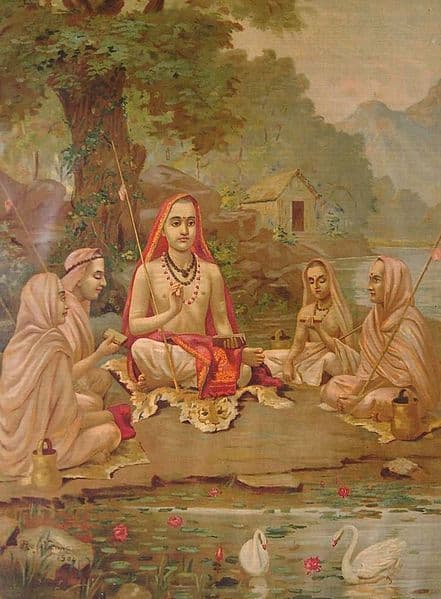
The question arrives with an unspoken demand: choose a box. We inherit categories that sort human endeavours into tidy bins—religion is faith, ritual, and theology; philosophy is reason, argument, and concepts. A tradition that refuses the division creates a quiet unease. Advaita Vedanta, with its insistence on non-duality and the direct inquiry into the nature of the self, unsettles both the religious and the secular mind. It points to a truth that is not a belief to be adopted or a theory to be debated, but a lived realisation. To ask whether it is a religion or a philosophy is to apply a measuring stick that it already questions. This exploration does not aim to settle the label. It aims to show that the very act of labelling may be the first veil over the reality that Advaita seeks to uncover.
1. The Framework of the Question: What Do We Mean by Religion and Philosophy?
Before examining Advaita Vedanta, it is necessary to hold the terms themselves up to the light. What is a religion? Typically, it is a system of belief in a transcendent power, expressed through worship, ritual, moral codes, and often a revealed scripture. It orients the adherent toward salvation, defined in various ways, and builds a communal identity. A philosophy, in the Western academic sense, is a rational investigation into the nature of existence, knowledge, and ethics. It relies on logic, argument, and conceptual analysis. The former is associated with faith; the latter with reason. This division is already a product of a particular European history. It does not travel well into the landscape of Indian thought, where the line between lived spiritual practice and rigorous inquiry was never drawn so starkly.
When we ask "Is Advaita Vedanta a religion or philosophy?", we assume these are the only two options and that they are mutually exclusive. But what if the tradition is something that makes the distinction irrelevant? Advaita involves scriptural study (the Upanishads), but treats them not as commandments but as a means of knowledge—a mirror to see the self. It involves a rigorous dialectic, but aims to silence the mind's chatter rather than to build a system. It uses the language of "God" (Ishvara) at one level, but ultimately dissolves the worshipper-worshipped duality. The question, then, may be less about Advaita and more about our own need to classify what challenges our fundamental assumptions.
2. Advaita as a Radical Epistemology: The Pramana Model
At its core, Advaita Vedanta is a path of knowledge (jnana). This knowledge is not an accumulation of facts. It is the immediate recognition of one's true nature as non-dual consciousness. To enable this recognition, Advaita employs a sophisticated epistemological framework: the pramanas, or valid means of knowledge. Perception, inference, and scriptural testimony (shruti) are accepted as valid, but each has its domain. What makes Advaita unique is its claim that the ultimate reality, Brahman, cannot be known by perception or inference, which depend on subject-object duality. It can only be indicated by the words of the Upanishads, which serve not to provide new information but to remove the ignorance that veils the self-evident.
"The scriptures do not reveal Brahman as an object. They simply negate the superimpositions upon it, and the self-luminous reality shines forth."
This is a far cry from religious dogma. A dogma demands belief in propositions that must be accepted without evidence. Advaita's relationship to scripture is more like a scientist's relationship to a theoretical model—it is a tool for investigation, to be discarded once the direct experience dawns. Adi Shankara, the great systematiser of Advaita, argued extensively using logic and debate, refuting opposing schools not by appeal to authority but by demonstrating contradictions in their positions. His method was philosophical in the strictest sense. Yet his goal was not to win an argument but to point the listener beyond the need for argument altogether. This fusion of intellectual rigour and existential purpose defies the modern separation of philosophy from spirituality.
3. The Absence of a Required Theology: Is Brahman a God?
One of the defining features of a religion is a theology—a discourse about God or gods, their nature, and their relationship to the world. Advaita Vedanta speaks of Brahman, but Brahman is not a god in the theistic sense. It is not a being among beings, not a creator standing outside creation. Brahman is the formless, timeless, spaceless reality that is the substratum of everything, identical with the innermost self (Atman). The statement "Tat Tvam Asi" (That Thou Art) collapses the distance between the devotee and the divine. If the self and the ultimate are one, the relational worship of a deity becomes a preliminary step, not the final truth.
Advaita does accommodate devotion (bhakti) at the empirical level. A practitioner may worship a personal form of God (Ishvara). But the philosophy makes clear that this duality is a concession to the mind still identified with the body. In the ultimate non-dual reality, there is no worshipper, no worshipped, and no act of worship. This hierarchical view of truth—relative and absolute—sets Advaita apart from most theistic religions. A Christian, Muslim, or Vaishnava Hindu might find this problematic because it relativises the personal God. For a philosopher, it reads more like a metaphysical monism akin to Parmenides or Plotinus, yet with a practical path of self-inquiry that is profoundly experiential.
4. The Role of Ritual and Community: Where Religion Fades
Religions are typically woven into the fabric of community life through rituals, festivals, and ethical commandments. Advaita Vedanta, as a path of knowledge, is essentially an individual quest. It does not prescribe a set of rituals for salvation. The rituals of the Vedas (karma kanda) are seen as preparatory, useful for purifying the mind but incapable of granting liberation. The seeker must eventually go beyond ritual and engage in shravana (listening), manana (reflection), and nididhyasana (deep meditation) on the truth. There is no required congregational worship, no intercessor between the individual and the truth.
This does not mean Advaita has no social dimension. Teachers and monastic orders (mathas) established by Shankara continue to exist. But the heart of the teaching is a solitary recognition. You can sit in a temple, chant hymns, and lead a morally upright life, but if the ignorance of the self remains, you are not liberated. Conversely, a realized sage needs no temple. This places Advaita in tension with organized religion, which often emphasizes communal identity and ritual observance as central. The Advaita seeker might appear to the religious as an iconoclast, and to the philosopher as a kind of existential practitioner, whose laboratory is their own consciousness.
5. The Method: Self-Inquiry vs. Belief
Religions ask for faith. Philosophy asks for argument. Advaita asks for direct seeing. The method of atma vichara, self-inquiry, is neither blind belief nor dry speculation. It is an experimental turning of attention upon itself. "Who am I?" is not a question to be answered with a formula. It is a scalpel to dissect the layers of identification—body, mind, memory, social role—until the irreducible awareness remains. This process does not demand belief in Brahman. It demands only that you look, with honesty and persistence, at your own experience.
This resembles phenomenology more than theology. The great Western phenomenologists like Husserl and Heidegger sought to describe the structures of experience without presuppositions. Advaita similarly asks: what is that which is present in all experience, without which no experience would be possible? The answer is not an object of experience but the very light of awareness. This is a philosophical investigation, but it is also the core of a spiritual path. The distinction between the two breaks down when the investigation ceases to be an intellectual exercise and becomes a matter of existential urgency—when the questioner realises that their own peace depends on the answer.
6. The Psychological Texture: How the Label Affects the Seeker
Whether one calls Advaita a religion or a philosophy can shape the entire approach to it. If it is a religion, the mind seeks to believe, to belong, to defend. The ego becomes a "non-dualist," a subtle identity that can be just as rigid as any other. One might argue about the nature of maya with the same heat as a theologian arguing about predestination. The teaching, meant to dissolve the ego, instead gets co-opted to reinforce it. This is a known pitfall. Shankara himself warned against mere intellectual gymnastics without direct experience.
If it is a philosophy, the danger is the opposite. One can become a collector of concepts, a connoisseur of metaphysical nuance, who can brilliantly expound the three orders of reality yet never spend a quiet hour asking "Who is the one who knows this?" The teaching remains an object, and the subject remains untouched. The lived transformation—the surrender of the separate self—is postponed indefinitely. Advaita, properly understood, is neither a badge of identity nor a topic for a seminar. It is a fire that consumes the one who approaches it sincerely. The label "religion" might bring a heart-opening devotion; the label "philosophy" might bring a clarifying sharpness. Both are useful as entry points, and both must be left at the door.
7. Advaita and Science: A Surprising Kinship
One aspect that complicates the religion-philosophy binary is Advaita's resonance with the scientific spirit of inquiry—not in content, but in attitude. Science proceeds by observation, hypothesis, and verification. It rejects unexamined authority. Advaita, especially in its modern expressions taught by figures like Swami Vivekananda, has been presented as a "science of the self." It invites the seeker to experiment: turn your attention inward, observe the mind, test whether the identification with the body is a fact or an assumption. The Upanishads themselves are filled with the language of investigation and discovery.
Dimension | Science | Advaita Vedanta |
|---|---|---|
Goal | Understanding the objective world | Realising the nature of the subject |
Method | Empirical observation, experiment, peer review | Self-inquiry, scriptural pointer, direct experience |
Authority | Evidence, not persons | The self-evident truth, not persons; scripture as pointer |
Result | Theories, technology, predictability | Liberation from suffering, inner peace |
Spirit | Open inquiry, willingness to discard false theories | Open inquiry, willingness to discard false identifications |
Of course, Advaita is not a materialist science. It affirms a transcendent reality that science cannot touch. But its emphasis on direct verification and its de-emphasis on blind faith align it more with a rigorous philosophical inquiry than with a religion of revelation. The seeker is not told, "Believe because the book says so." They are told, "Enquire until you know for yourself." That is a profoundly different epistemological mood.
8. The Paradox of Non-Duality: Why Systems Cannot Contain It
Religions and philosophies are both systems of thought. They provide a structure, a set of concepts that explain the world. Advaita Vedanta, at its core, is a non-system. It uses concepts to dismantle concepts. The central claim of non-duality is that reality is indivisible, beyond all distinctions, including the distinction between "religion" and "philosophy." When the self is realised to be the whole, there is no separate knower to classify anything. The classification is part of the dream. The waking up from the dream is not a philosophical insight or a religious experience; it is the collapse of the experiencer who would claim either.
This is why many teachers, from Ramana Maharshi to Nisargadatta Maharaj, have spoken in ways that seem to dismiss both philosophy and religion. They point directly to the fact of awareness, refusing to be drawn into metaphysical debates. Their words have the flavour of an existential urgency that is neither academic nor devotional, but something more akin to a lover pleading with the beloved to recognise their own beauty. To ask them "Is this a religion or a philosophy?" would be like asking a drowning man whether the rope thrown to him is made of cotton or silk. The question loses meaning when the need is immediate.
"The seeker is he who is in search of himself. Give up all questions except one: 'Who am I?' After all, the only fact you are sure of is that you are."
9. The Historical Context: A Tradition Within a Religion
Historically, Advaita Vedanta arose within the larger framework of Hinduism, which is itself a complex of religions, philosophies, and cultural practices. It accepts the Veda as a valid means of knowledge and respects the traditional guru-disciple lineage. This places it firmly within the religious landscape of India. Yet within that landscape, it has always been a minority path, often criticised by theistic schools for its seeming dismissal of a personal God. It was one of the six orthodox darshanas, which translates as "viewpoints" or "philosophies." So the tradition itself did not feel the need to distinguish sharply between religion and philosophy—the word darshana encompasses both.
Modern Western attempts to study Advaita often try to extract a "philosophy" from its ritual and cultural trappings. This can be illuminating but also distorting. The living tradition includes chanting, meditation, service, and devotion, even among the most staunchly non-dual teachers. The heart is not excluded for the sake of the head. The complete Advaita sadhaka may have a personal relationship with a deity or guru, while intellectually understanding that the relationship is ultimately a play of maya. This integrated approach challenges the modern segregation of faculties into "rational" and "religious." The whole human being is engaged, not just the reasoning mind.
10. Advaita as Therapy: The Psychological Dimension
A modern seeker, disillusioned with organised religion but not satisfied by academic philosophy, might come to Advaita looking for healing. They suffer from anxiety, a sense of inadequacy, a feeling of being an isolated self in a hostile world. Advaita offers a direct investigation into that very self. It functions, in a way, as a radical form of therapy. The inquiry "Who is the one who is anxious?" can, when sustained, dissolve the anxiety at its root, not by removing the trigger, but by revealing that the anxious self is a phantom. This is a psychological transformation with philosophical rigour. It feels less like adopting a new belief and more like deconstructing a painful illusion.
This therapeutic dimension blurs the boundary further. Psychology is a science, but it also deals with the human subject and the search for well-being. Advaita Vedanta does not pathologise or analyse childhood. It goes straight to the identity that holds the whole structure. It says: you are not the wounded child, not the successful adult, not the story at all. This can be profoundly liberating. But it is not psychotherapy in the clinical sense, because it aims beyond the improvement of the ego to its dissolution. Yet it can bring about a degree of peace and resilience that no therapy can, because it removes the ground on which trauma stands.
11. Ethical Implications: Freedom Without Commandments
Religions typically provide a moral code, a set of commandments or precepts. Philosophy can debate the foundations of ethics. Advaita Vedanta does not prescribe a specific moral code for liberation. Instead, it holds that right action flows naturally from self-knowledge. When the ego is seen as an appearance, selfishness—the root of what we call immorality—loses its foothold. The realised sage does not need a rule that says "do not steal," because the sage sees no other to steal from. Compassion is not a duty but the spontaneous expression of unity. This is an ethical vision that is deeply philosophical in its grounding (it resembles the virtue ethics of Plato or the Stoics in some ways), but it is lived as a spiritual reality.
The absence of a codified moral law can be unsettling. A seeker might ask, "If I am Brahman, can I do whatever I want?" The tradition answers that the one who asks that question is still identified with the ego and its desires. When the truth is known, the question does not arise, because the doer has dissolved. In the meantime, the preparatory stages of Advaita include ethical disciplines (yama and niyama), such as non-violence and truthfulness, which are taken from the larger yogic tradition. So while Advaita is not a religion of law, it is deeply ethical in its outcome. The ethical life is the expression of wisdom, not a precondition to be met by an anxious ego.
12. The Living Paradox: Being a Non-Religious Religion and a Non-Philosophical Philosophy
Ultimately, Advaita Vedanta occupies a space that our modern categories cannot easily map. It is a religion without a required deity, a philosophy without mere abstraction, a science of the interior, a therapy for the root of suffering. To call it a religion is to risk importing connotations of dogma and ritualism that are alien to its core. To call it a philosophy is to risk reducing it to an intellectual exercise, ignoring the heart's yearning and the existential demand. Perhaps the most honest answer is that it is both and neither—a unique vehicle calibrated to dismantle the very self that seeks definitions.
Facet | Religious Aspect | Philosophical Aspect |
|---|---|---|
Goal | Liberation (moksha) from suffering | Knowledge of ultimate reality |
Method | Devotion, guru's grace, scriptural study | Inquiry, dialectic, logic, self-inquiry |
Cosmology | Maya, Ishvara as creator (relative level) | Non-dual monism, levels of reality |
Community | Monastic orders, satsang, pilgrimage | Teacher-student transmission, debate |
Ultimate Truth | Atman is Brahman; non-duality | Consciousness is the sole reality |
The person who comes to Advaita seeking a religion will find a theology that deconstructs itself. The one seeking a philosophy will find concepts that point beyond themselves. The only way to resolve the paradox is to live it. To inquire, to meditate, to let the question burn until the questioner is consumed. Then the labels fall away, and what remains is the simple, luminous presence that was always there. The world still appears, but it is no longer a problem to be classified. It is a mystery to be lived.
Closing Reflection: Beyond the Need to Label
The impulse to classify Advaita Vedanta as a religion or a philosophy is itself a symptom of the very duality it seeks to overcome. We want a secure place to stand, a reference point from which to relate to it. But the teaching gently refuses to give us that place. It asks us to step into the unknown, to question the questioner, to see that the one who wants a label is itself the final label to be dropped. In that dropping, the ancient words come alive not as a system, but as the direct taste of being. Religion and philosophy are both noble human endeavours, but the truth of who you are precedes them both. It is the silence before the question, the awareness behind the seeking, the heart that beats in every inquiry. When that is known, the question "Is it a religion or a philosophy?" becomes a faint echo from a dream that has already dissolved.
Frequently Asked Questions
Does Advaita Vedanta require belief in God?
Advaita Vedanta ultimately points to the non-dual reality, Brahman, which is not a personal God but the formless substratum of all existence, identical with the self. At the empirical level, a practitioner may worship a personal deity (Ishvara) as a helpful aid, but the final truth transcends the worshipper-worshipped distinction.
Is Advaita Vedanta a branch of Hinduism?
Historically and culturally, Advaita Vedanta is one of the schools of orthodox Hindu philosophy, accepting the authority of the Vedas. However, its non-dual core and direct inquiry method give it a universal appeal that can be practiced independently of Hindu cultural forms.
Can an atheist practice Advaita Vedanta?
Yes, to a significant extent. Advaita’s emphasis on self-inquiry and direct experience does not require belief in a deity. Many modern teachers have presented it as a rational investigation into the nature of consciousness. The concepts of Brahman and Atman can be understood as the impersonal awareness rather than a theological entity.
How does Advaita Vedanta differ from Western philosophy?
While Western philosophy primarily aims at conceptual understanding through rational argument, Advaita uses reason and scripture as pointers to a direct, non-conceptual realisation. The goal is not to build a philosophical system but to bring about a permanent transformation of identity and the end of suffering.
Are there rituals in Advaita Vedanta?
Advaita itself does not prescribe ritual as a means to liberation. Rituals are acknowledged as preparatory for purifying the mind, but the path of knowledge (jnana yoga) emphasises listening, reflection, and meditation on the non-dual truth. Many monastics and lay practitioners, however, may engage in simple rituals of worship as part of their cultural context.
Is guru-worship a religious aspect of Advaita?
The guru is revered as the embodiment of the teaching and a living pointer to the Self. While devotion to the guru can appear religious, Advaita clarifies that the outer guru points to the inner guru, which is one’s own true self. The relationship is ultimately non-dual; the guru is not worshipped as an external deity but as the reflection of one’s own reality.
Can Advaita Vedanta be studied academically as a philosophy?
Absolutely. Advaita’s rigorous logic, epistemology, and metaphysics have been studied as a philosophy in universities worldwide. However, without the existential component of self-inquiry, it can become a mere intellectual exercise. The tradition itself holds that intellectual understanding alone is insufficient for liberation.