


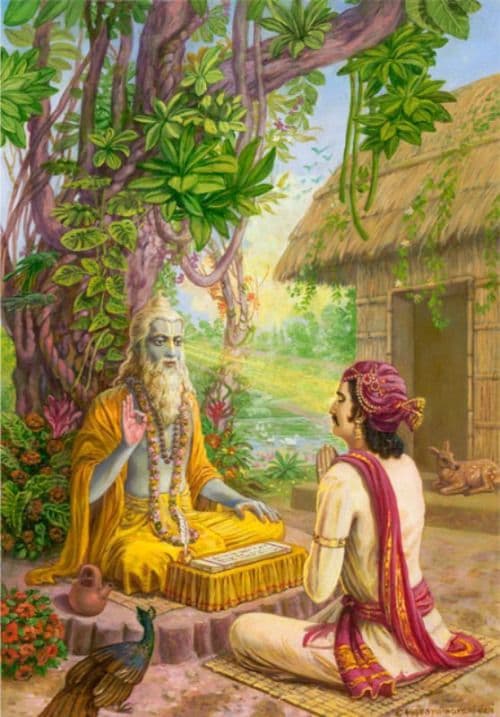
The question arrives already wrapped in paradox. If reality is non-dual, if the self you seek is the self you already are, why would you need anyone to point that out? The very search for a guru seems to confirm the existence of a separate seeker who lacks something. And yet, the Advaita tradition places enormous weight on the guru—not as an optional accessory but as the living, breathing catalyst without which the whole enterprise of self-knowledge remains a theory. So the role of the guru is not what it first appears to be. It is not about filling an emptiness. It is about demolishing the illusion that any filling was ever necessary.
This exploration does not aim to provide a doctrine. Instead, it investigates the psychological and existential architecture of the guru–disciple encounter. What actually happens when one mind sits before another and something fundamental shifts? How can an external figure, made of flesh and speech, trigger an internal dissolution of all boundaries? And why does the same figure so often become a trap—a new object of attachment, a substitute father, a spiritual brand? By looking closely at the role of the guru in Advaita Vedanta, we uncover less about authority and more about the strange mechanics of self-deception and recognition.
The Guru As A Function, Not A Person
When the tradition speaks of the guru, it rarely refers to a biographical individual. The guru is a principle, a function. That function is avidya-nivritti—the removal of ignorance. A person may embody that function, but the moment the disciple mistakes the person for the function, the entire teaching collapses into idolatry. The guru’s words, presence, and silence all serve one purpose: to undo the false identification with the body-mind complex. The guru does not give you something new. The guru takes away something false. And for that, personality is irrelevant.
This is deeply unsettling. A seeker arrives hoping for a relationship, for guidance, for someone who finally understands. What they encounter instead is a mirror that reflects only their own projections. The guru, as a function, is uninterested in confirming the seeker’s narrative. The pain this causes is the beginning of real inquiry. Why are you disappointed? Because you wanted the guru to see you as special. And in that wanting, the entire ego-structure stands exposed.
When The Person Overshadows The Principle
Spiritual communities often collapse because the function is forgotten and the person is worshipped. The guru’s charisma, brilliance, or even fallibility becomes the focus. This is not a modern problem; the Upanishads caution against mistaking the teacher for the teaching. A true guru points away from themselves. The moment they become the destination, something has gone wrong. This does not mean the guru cannot have a personality. It means the disciple must remain vigilant: am I following a living pointer, or am I escaping my own life into someone else’s shadow?
Consider how similar this is to romantic infatuation. You project perfection onto another, only to crash when they fail to live up to it. The guru–disciple relationship carries that same psychological charge, but the purpose is to work through the projection, not to enshrine it. The guru as function knowingly allows your idealizations to arise—and then lets them shatter against the hard fact of their ordinary humanity. That shattering is a teaching no scripture can deliver.
The Threefold Method And The Guru’s Indispensable Voice
Advaita Vedanta maps the path of knowledge through three stages: shravana (listening to the truth), manana (reflecting upon it), and nididhyasana (deep, unbroken contemplation). The guru is classically considered essential for the first stage. Why can’t you just read the texts? Because the ear hears what the eye cannot see. A living voice carries a certain destabilizing authority—it calls into question the very consciousness that is listening. The guru’s words are not mere information. They are a presence that reorganizes your attention from the inside.
When you read, you interpret. When you listen to a teacher who embodies non-dual awareness, the words are accompanied by a quality of silence that undermines your interpretive habit. This is not mystical. It is psychological. You cannot project the same defenses onto a living presence that you can onto a page. The guru’s voice breaks through the mental commentary just enough for a glimpse to occur. That glimpse is what later fuels manana and nididhyasana.
Shravana: More Than Hearing
Shravana is not passive reception. It is a form of acute, receptive attention where the mind temporarily suspends its need to agree or disagree. The guru’s statements—Tat Tvam Asi, “That Thou Art”—land not as philosophy but as a direct challenge to identity. A teacher utters those words and something in the listener’s chest tightens. That tension is the ego sensing its own unreality. The role of the guru here is to hold a space so unwavering that the listener cannot escape into abstraction.
Imagine a moment when someone told you a truth about yourself you had been avoiding. Your immediate reaction was likely resistance, maybe anger. The guru’s shravana works similarly but on the most fundamental level: you are not who you think you are. That is an unbearable statement to the mind that has spent decades building a self-image. The guru’s role is to deliver it not as an accusation but as an invitation—an opening you can fall into once the defenses exhaust themselves.
Manana And The Disappearance Of The Teacher
In manana, the disciple grapples with the teaching intellectually. The guru may still be physically present, but the real work happens in solitude. This stage reveals that the guru’s words were never the source of truth; they were only the trigger. Reflection becomes a conversation with one’s own doubts. Paradoxically, the more deeply you engage in manana, the less you need the external guru. You begin to find the same uncompromising voice within your own inquiry. The external guru then recedes—not because they have been rejected, but because the function has been internalized.
This is a crucial point often missed: the external guru’s ultimate success is their own redundancy. Any teacher who trains you to depend on them forever has not taught Advaita. They have created a spiritual dependency. The true guru will deliberately frustrate your attempts to cling, pushing you back onto your own investigation again and again.
Initiation As Recognition, Not Transfer
The word diksha is often translated as initiation, but its root suggests a kind of vision—making visible what was already there. When a guru initiates a disciple, nothing new is given. The ceremony, the mantra, the silent glance: these are all structures designed to bypass the disciple’s conceptual mind and allow a direct recognition of what has always been present. The guru does not transfer enlightenment like a package. They simply remove the last veil that makes you think it could be transferred.
This understanding dismantles the fantasy of spiritual magic. Many seekers secretly hope the guru will do something to them—touch their forehead, whisper a sound, change their energy. But if you are already the Self, what could possibly be added? The initiation is a moment of profound undoing. It can be dramatic or entirely quiet. Its power lies not in the guru’s mystical ability, but in the disciple’s readiness to stop pretending to be a separate self. The guru’s presence acts as permission for that stopping.
The Look That Ends The Search
Stories abound of Ramana Maharshi’s silent gaze triggering awakening. What actually happened? A person sat before him, full of existential terror, and in that silent meeting, the very question “Who am I?” devoured the questioner. The guru’s look held no answer. It held the absence of answers so completely that the mind had nowhere to go. That is initiation. It is not the transmission of an object; it is the collapse of the subject–object split. The guru, by refusing to be a separate entity, invites the disciple into the same non-separation.
The initiation that matters is not the one the guru performs. It is the one the ego undergoes when it realizes it cannot survive this presence.
The Mirroring Function: How The Guru Reflects The Seeker’s Mind
One of the most uncomfortable aspects of a genuine guru–disciple relationship is that the guru relentlessly shows you your own face. Every judgment you have about the teacher, every disappointment, every surge of devotion—all of it is a reflection of your unexamined inner world. The guru remains empty, like a clear mirror. If you see anger, that anger is yours. If you see unconditional love, that capacity is yours. The guru does not manipulate these reflections; the mind does. The guru simply refuses to be what you need them to be, and that refusal becomes the most direct teaching.
In ordinary relationships, we collude with each other’s self-images. The guru does not collude. This can feel cruel. A disciple projects wisdom, and the guru acts foolishly. The disciple projects holiness, and the guru smokes a cigarette. These are not random provocations; they are precise dismantlings of the disciple’s tendency to look outward for completion. The mirror never changes; it only reveals what you bring.
Transference And Its Transformative Potential
Psychology describes transference—the redirection of feelings from past relationships onto a present figure. In the guru–disciple dynamic, transference is not an obstacle; it is the very substance of the work. You will likely see your father in the guru, or your first betrayer, or the loving presence you never had. That charged material rises to the surface with unusual intensity because the guru refuses to play along. Instead of fulfilling your expectations, they sit in the fire of your projections until the projections burn away. The guru’s role is to be the unmoved witness, allowing you to exhaust your own emotional patterns without giving them new objects to cling to.
This process is far more transformative than pleasant satsangs. It is psychologically grueling. Yet without this mirroring, spirituality becomes another bypass—a way to feel transcendent while leaving the core ego intact. The guru’s uncompromising reflection ensures that you cannot bypass. You must face what you are, or leave.
Silence As The Ultimate Teaching
Advaita’s most iconic image of the guru is Dakshinamurti, the young teacher who taught the greatest sages through silence alone. If words could convey the Self, silence would be unnecessary. But language belongs to duality—subject, object, and the relation between them. The Self is not a relation. So at some point, every word must be abandoned. The guru’s silence is not an absence of speech; it is the presence of that which speech cannot capture. In that silence, the disciple’s mental chatter stands out in stark relief, and for a moment, it can be seen for what it is: noise.
This is why many describe the greatest teachings as happening outside the discourse—in the walk to the car, the shared cup of tea, the unplanned moment of stillness. The structured teaching creates the container; the silence dissolves the container. The guru who knows when to stop speaking knows that the real transmission is not in the words but in the gap between them.
The Limits Of Verbal Transmission
Words in Advaita are only lakshana—pointers. They indicate but never become what they point to. The danger is that the disciple collects pointers, becomes a scholar of the menu, and never tastes the meal. The guru’s role is to burn the menu. This can happen through a sudden shout, a paradoxical statement, or an extended period of deliberate silence. The method matters less than the effect: a rupture in the conceptual continuity. When the mind stops, even for an instant, the guru’s job is done.
Moment | Medium | What Happens |
|---|---|---|
Word | Scriptural statement, direct instruction | The intellect receives a framework; doubt is ignited |
Silence | Presence without speech | The conceptual mind confronts its own limits; the pointer dissolves |
Recognition | Non-dual immediacy | The distinction between teacher and taught collapses; only the Self remains |
When the guru becomes truly silent, you can no longer find them. And in that disappearance, you find yourself.
The Inner Guru: The External Teacher As Prelude To Self-Recognition
Advaita Vedanta does not see the external guru as the final authority. The external guru is the wake-up call. Once you are awake, the inner guru—the antaryamin, the indwelling witness—takes over. The entire process of shravana, manana, and nididhyasana leads to the point where you hear the teaching not from outside but from the very core of your being. The external voice was always just an echo of this inner silence. The tragedy is when disciples cling to the echo and never listen to the source.
The shift from external to internal guidance is rarely a linear progression. There are stages where the disciple experiences profound insight and then falls back into confusion, rushing to the guru for reassurance. A wise teacher will not provide the reassurance in the form the disciple wants. They will say, “Who is it that is confused?” and throw you back onto your own investigation. This seems harsh, but it is the ultimate respect. The guru treats you not as a dependent child but as the Self you already are.
When The External Guru Blocks The Inner
A guru who encourages dependency does profound harm. If you cannot make a decision without consulting the teacher, if your sense of worth depends on their approval, then the external guru has become an obstacle rather than a door. The inner guru is not a voice that gives instructions; it is the silent awareness in which all instructions arise and dissolve. The external guru’s role is to introduce you to that silence, not to replace it with their own personality. When the relationship begins to feel like a substitute for your own direct knowing, it is time to ask whether the teacher is serving the teaching or serving their own position.
Aspect | External Guru | Inner Guru |
|---|---|---|
Form | Embodied person, words, presence | Formless awareness, the Self |
Function | Points, dismantles, mirrors | Is the knowing itself |
Relationship | Teacher–student, can involve projection | No relationship; non-dual |
Duration | Temporary, until recognition | Eternal, ever-present |
Potential Trap | Dependency, idealization | Can be ignored or conceptualized |
The Shadow Of The Guru–Disciple Bond: Attachment, Idealization, And Spiritual Dependency
Every intimate spiritual relationship carries a shadow. The very intensity that fosters breakthrough also fosters psychological entanglement. The disciple may unconsciously transfer unmet childhood needs onto the guru, mistaking the safety of the teaching container for the love they never received. The guru, if unexamined, may enjoy the adulation and begin to believe in their own specialness. The result is a closed loop of mutual reinforcement—what the tradition calls guru-droha when it becomes harmful, or shishya-bhava when the devotion becomes delusional.
This shadow is not a reason to avoid the guru–disciple relationship altogether. It is a reason to enter it with eyes open. Healthy tradition emphasizes viveka, discernment. The disciple must constantly ask: Is this relationship freeing me from all attachment, including attachment to the guru? If the answer is no, something has stalled. A genuine teacher will welcome that scrutiny. A false one will punish it.
Why Gurus Fall
The history of contemporary spirituality is littered with teachers who betrayed trust. Often the fall is attributed to personal moral failure. But from an Advaita perspective, a deeper dynamic is at play. The guru who identifies even subtly with the role of “enlightened master” has not fully dissolved the ego. They may have profound non-dual insights yet retain a blind spot around power, sex, or money. The disciple’s idealization feeds that blind spot. When the inevitable exposure comes, it shatters the disciple’s faith—not just in the teacher but in the very possibility of liberation. Yet the teaching never depended on the person’s perfection. The mirror broke, but the reflection was always your own.
This is not to excuse abuse, but to understand it structurally. The guru’s role, properly understood, is so radically self-effacing that the question of personal morality almost becomes secondary. A true guru disappears. A guru who remains visible as a person of power has missed the function. The disciple’s task is to see the function through the person, not to invest the person with divine qualities they never claimed.
The Guru In A Digital Culture: Can Transmission Happen Online?
Today, teachings that once required years of physical proximity are available through YouTube, Zoom satsangs, and social media posts. The question arises: does the guru’s role change when the body is removed? Advaita’s emphasis on direct transmission suggests that physical presence carries a unique potency. Body language, energetic resonance, the shared silence of a room—these are not replicable through a screen. And yet, the mind is the real field. A recorded teaching can still trigger the same inquiry if the student is ripe.
The danger is the illusion of intimacy without accountability. You can binge-watch a teacher’s videos and feel you “know” them. You curate a personalized spirituality, taking what soothes and ignoring what challenges. The digital guru becomes another content provider. The mirroring function is lost because you can switch off the moment discomfort arises. The guru as a living, uncomfortable presence is replaced by the guru as a playlist. That substitution can create a generation of seekers who are information-rich and transformation-poor.
The Simulacrum Of Satsang
Satsang, being in the company of truth, traditionally involves physical proximity to a realized being. Digital platforms simulate this—chat boxes, emoji reactions, virtual retreats. Something transfers, undoubtedly. But something also flattens. The guru’s role as disruptor is easily domesticated when you can minimize the window. The discipline of staying in the fire of a real-time encounter—with no option to mute, block, or scroll—is missing. This does not mean digital transmission is worthless. It means its limitations must be ruthlessly acknowledged. It can be a pointer, but rarely the shattering.
Dimension | Traditional Guru-Shishya Relationship | Contemporary Digital Mentorship |
|---|---|---|
Presence | Continuous physical proximity for months or years | Intermittent virtual contact, on-demand |
Mirroring | Immediate, unavoidable, often uncomfortable | Selective, can be avoided |
Projection | Intensified by constant contact; worked through in real time | Magnified by idealization due to curated persona |
Accountability | High; the guru can challenge direct behaviors | Low; the student controls the engagement |
Transmission | Beyond words; silence, glance, presence | Mostly verbal; silence is lost |
Potential | Deep structural transformation | Intellectual clarity, inspiration, but often no lasting shift |
The Paradox Of Surrender: Letting Go Without Losing Yourself
Surrender to the guru is a recurring motif. But what are you surrendering? Not your money, your autonomy, or your reason. You are surrendering the false identification with the limited self. The guru is not the receiver; the guru is the occasion. You offer up your ego at the feet of the teacher, and the teacher simply points out that there is nothing to offer and no one to receive. Real surrender is not an act of will; it is a recognition of the already-existing truth that the separate self never had control.
This is easily twisted. Abusive teachers demand outward surrender—of possessions, of decisions, of body. That is not the surrender Advaita speaks of. The surrender that liberates is an inner dissolution. You sit with the guru’s instruction “You are not the doer” and instead of fighting it, you let it penetrate. The “you” that would surrender cannot do it. It simply stops claiming ownership. The guru’s role is to create the conditions where that stopping becomes possible, not to collect surrendered wills.
When Surrender Becomes Escape
Many seekers long to give up responsibility. The chaos of life, the weight of choices, the anxiety of an uncertain future—all of it feels too much. Surrender to a guru can then become a spiritualized avoidance. You no longer have to think because the guru will think for you. This is a regression, not a liberation. A true teacher will reject your passivity. They will say, “Who is asking the question? Go back and find out.” They use your attempted surrender as a mirror to show you the one who wants to escape. That inquiry, not the surrender, is the path.
Can You Walk The Path Alone? The Limits Of Self-Inquiry Without A Living Mirror
Advaita’s direct path, especially as taught by Ramana Maharshi, emphasizes self-inquiry: “Who am I?” This inquiry can be practiced in solitude. Does that render the guru obsolete? Not entirely. Without a living teacher, the ego can co-opt self-inquiry, turning it into a mental exercise. You ask “Who am I?” and the mind promptly supplies an answer: “I am pure awareness,” “I am the witness.” And now you have a new, more subtle self-image. The guru, as an external reference point, can catch that subtle appropriation. A single look can convey, “No, deeper.” That intervention is hard to replicate alone.
Some rare individuals do awaken without an external guru. But they often describe an internal guidance, a powerful sense of presence, or a book that functioned as a living voice. The archetype of the guru exists even there. The danger of declaring “I need no teacher” is that it often stems from the very ego that needs dismantling. A certain arrogance can masquerade as independence. The mature seeker remains open to the possibility that a teacher might appear in any form—a stranger, a crisis, a line of poetry—and does not rigidly insist on a solo journey.
The Collective Lure Of The Guru-Less Path
Contemporary spirituality romanticizes the solitary seeker, partly as a reaction against guru scandals. But the pendulum swing from blind devotion to radical self-reliance may miss the nuance. The guru’s role is not to replace your authority but to evoke it. The very phrase “inner guru” implies that someone or something external mirrored that inner depth first. A child learns language from others before there is inner speech. Similarly, most minds need an external non-dual voice to awaken the inner one. Denying that need can be a defense against the vulnerability of being truly seen.
Beyond The Guru: When The Final Teaching Is The Disappearance Of The Teacher
The end of the guru–disciple relationship, in Advaita, is not graduation. It is not a certificate of attainment. It is a dissolution of the very distinction that made the relationship possible. When the disciple fully recognizes the Self, there is no longer a guru and no longer a disciple. There is only the Self, which was never two. This is why the highest gurus are often described as having no disciples—not because no one listened to them, but because they saw no one separate to teach.
This final stage cannot be taught. It can only be lived. The guru who has truly fulfilled their function leaves no trace. Their memory remains as a fragrance, not as a burden. The former disciple moves through life without needing to reference the teacher. The teaching has become flesh. And if someone asks, “Who was your guru?” the answer might come: “I don’t know. There was never a ‘me’ to have one.” That is the complete circle. The role of the guru was to make themselves unnecessary, and in that disappearance, the non-dual reality shines alone.
Closing Reflection
To ask about the role of the guru in Advaita is to ask about the role of a match in a room already full of light. The match doesn’t create the light; it burns away the darkness you mistook for reality. The guru is that brief, fierce flame. The flame hurts the eyes, warms the skin, and then goes out. What remains is the light that was always there—boundless, unowned, and utterly ordinary. The most profound guru relationship ends not in devotion or gratitude but in a silence so complete that the very words “guru” and “disciple” dissolve. That silence is the only teacher that never lies.