

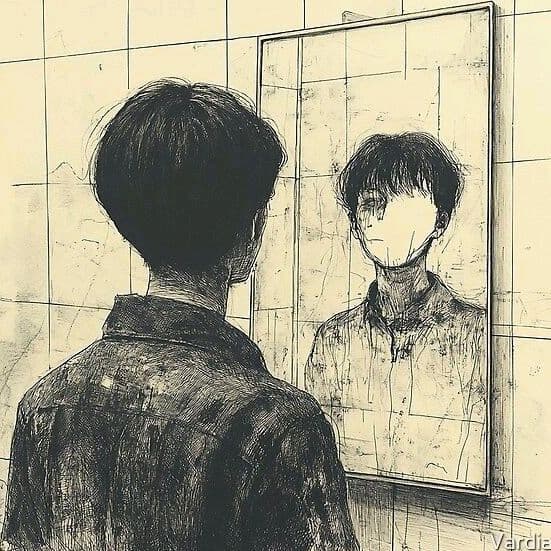
You have never been the same person for two consecutive seconds, and yet you carry a name as if it were an anchor. You wake up each morning, and before a single clear thought arrives, a ghost slips into the room of your awareness. The ghost has your face, your history, your regrets, your ambitions. It whispers: “This is you. Defend this. Improve this. Worry about this.” You have never met this ghost outside of your own mind, but you have never once doubted its reality. The central, largely unexamined assumption of an entire human life is that the entity we call “I” is a self-evident, stable, internally coherent substance. Advaita Vedanta, one of the most intellectually ruthless and psychologically sophisticated systems ever devised, proposes the opposite. It doesn’t suggest you improve your self. It suggests you look closely enough to see that the self you are trying to improve is a phantom that never stood still long enough to exist.
This isn't a poetic metaphor for self-improvement. It's a precise, experiential diagnosis that cuts through millennia of philosophical confusion. The great Advaitic sage Adi Shankara didn't ask his students to believe a new story about themselves. He asked them to investigate whether the one who believes the story has any independent reality at all. The problem is not that you have a flawed identity. The problem is that you mistake the activity of identification for an actual entity. This is the illusion of self—not a flaw in an otherwise real object, but a complete categorical error, like believing the blueness of the sky is a solid dome you could touch. You have lived your entire existence inside this error, and almost all your psychological suffering flows from defending, polishing, and fearing for a character who has no ontological substance. The moment you see this clearly is not a moment of loss. It is the first moment of genuine freedom.
The Search for the Seeker
Before we engage with Advaita's radical epistemology, we must understand why the inquiry into the self fails so reliably in ordinary life. Modern psychology, for all its gifts, remains largely trapped within the architecture of the ego it studies. It asks you to optimize the self, heal the self, narrate the self, love the self. It rarely, if ever, asks whether the self is the right unit of analysis in the first place. Imagine a brilliant team of engineers designing ever more comfortable saddles for a horse that isn't there. The comfort increases; the fundamental problem does not shift.
When a person says, “I need to find myself,” they are already lost in a logical loop. Who is the one searching? Who is the one that is lost? If the self were a stable entity, it could not be lost, for it would always be present as the subject of any search. If it is not a stable entity, what exactly are you hoping to find? The language betrays the confusion. The “I” that seeks is the same “I” that is supposedly missing. This is not a poetic paradox. It is an indicator that the grammar of the self is deeply flawed.
Advaita enters this confusion not with a comforting answer, but with a sharper question. It asks you to locate this self you are so worried about. Not abstractly. Not through belief. But right now, in the laboratory of your own direct experience. Where is it? What color is it? What shape? Does it have a beginning? Will it have an end? When you feel offended, what exactly is being wounded? When you feel proud, what exactly is being elevated? The inquiry is not philosophical speculation. It is a scalpel.
Consider a modern scenario. You are scrolling through a social media feed and you see a photograph of yourself from a decade ago. A strange, subtle discomfort arises. You think, “I look so different. I was so naive. That doesn’t feel like me anymore.” Yet your legal name remains unchanged, your fingerprints are the same, and a continuous stream of memories links the person in the photograph to the one holding the phone. So who is the real “me”? The one in the photo, the one looking at it, or the one evaluating the difference? If the self were a solid fact, this dissonance would be impossible. The very fact of feeling distant from your former self demonstrates that self is not a noun but a verb—a continuous act of stitching together moments that are already gone. Advaita Vedanta pushes this logic to its final, terrifying, and liberating endpoint: if the self is always a process of becoming, it is never a being. And if it is never a being, your entire emotional life is dedicated to protecting a process, which is like building a fortress out of river water.
The Five Sheaths and the Architecture of Mistaken Identity
To make this inquiry systematic, Vedantic philosophy offers the Pancha Kosha model, the teaching of the five sheaths. This is not a mythological cosmology. It is an extraordinarily precise map of misidentification, a way of running your fingers along the walls of your inner prison until you feel the edges of a door. The teaching proposes that what you take to be your self is actually a composite of five layers of experience, none of which is the final subject.
The outermost sheath is the physical body, Annamaya Kosha, the sheath made of food. You say, “I am tall,” “I am sick,” “I am tired.” But notice that you refer to the body as “my body,” not as “I.” When a limb is amputated, you don't feel that half your self is gone. You say, “I lost my arm.” The “I” remains intact as the owner of the loss. The body is an object of awareness, not awareness itself. It changes constantly—cells die and regenerate—while the sense of “I am” remains a steady backdrop. A corpse has all the material components of a body but no self. Clearly, the self is not the body, though we collapse into this identification thousands of times a day.
The second sheath is the energetic or physiological body, Pranamaya Kosha. This is the life force, the subtle currents that animate breathing, digestion, circulation. You say, “I am hungry,” “I am exhausted,” “I am restless.” But again, you are describing states that come and go. In deep sleep, you have no awareness of hunger or exhaustion, yet you exist. The life force is an object perceived. The perceiver must be subtler still.
The third sheath is the mental-emotional body, Manomaya Kosha. This is where most of us live. The ceaseless flow of thoughts, feelings, reactions, memories, and projections. “I am sad,” “I am anxious,” “I am an overthinker.” This feels closer to the core because it is so intimate, but upon examination, it is as objective as the body. A thought arises unbidden. It stays for a few seconds. It vanishes. If you were the thought, you would vanish with it. But you don't. A new thought comes. The screen of awareness remains. You are not your sadness, because you can observe your sadness. The observer of the mind cannot be the mind itself. This is a crucial, non-negotiable logical distinction that Advaita insists upon. Whatever is perceived cannot be the perceiver.
The fourth sheath is the intellect, Vijnanamaya Kosha, the faculty of discernment, belief, and self-narrative. This is the deepest trap because it feels like the captain of the ship. “I am a liberal,” “I am a rational person,” “I am a seeker of truth.” These are the stories that organize a life. But the intellect, too, is an object. In moments of pure shock, awe, or terror, the intellect shuts down. Concepts vanish. Yet consciousness remains, vivid and wordless. When you wake from deep sleep, the sense “I am” returns before the story “I am John, an accountant with anxiety” boots up. The intellectual self-narrative is a high-level program running on a more fundamental operating system. You can watch a belief change over time. You can hold a conviction at thirty that you find embarrassing at fifty. If the self were the intellect, such a change would mean the self had been replaced. But the sense of continuity persists underneath the changing ideas. The witness outlasts the worldview.
The fifth sheath is the bliss body, Anandamaya Kosha, experienced in deep dreamless sleep and profound meditative absorption. It is a state of undifferentiated peace, void of objects, free from the sharp edges of ego. It feels like the final resting place, and many spiritual traditions mistakenly stop here, equating this formless bliss with the true self. But Advaita applies the same ruthless scalpel. This state, too, comes and goes. You enter deep sleep and you leave it. You experience bliss and then you experience ordinary wakefulness. That which comes and goes is an object of experience. The bliss sheath is the most subtle object in the manifest universe, but it remains an object. The true subject, the Atman, is the witness of even the absence of bliss. It is the light in which the void of sleep is known as having been peaceful. It never comes, never goes, never changes, because it is not a state. It is the condition for all states.
You strip away all five sheaths and what remains is not a void. It is presence without characteristics, awareness without a center, seeing without a seer. This is the great revelation. Your entire life, you have been mistaking the clothes for the wearer, and upon removing the final garment, you discover there was never a wearer at all—only the naked light in which the clothes appeared.
The Neurology of No-Self and the Stubbornness of the Ego
This is not merely ancient mysticism. Modern neuroscience, in its own groping, materialist way, has begun to brush against the same truth. The brain has no single “self center.” The feeling of being a unified, continuous entity is now widely understood as a useful hallucination generated by the default mode network—a constellation of brain regions including the medial prefrontal cortex and posterior cingulate cortex that weave together autobiographical memory, future simulation, and social evaluation. When this network quiets, as in deep flow states, meditation, or under the influence of psychedelics, the sharp boundaries of the self dissolve. Subjects report not a loss of consciousness but an expansion of it, a sense of unity with their environment that is often described as more real than ordinary egoic perception.
The neuroscientist Anil Seth describes the self as a “controlled hallucination,” a best-guess model the brain generates to predict and navigate the world. It is not a lie, exactly, but a construction. The problem is that we forget we are living inside the construction and start believing the walls are the universe. Advaita would nod quietly and add: the brain is itself an appearance within consciousness, not the generator of it. But even working within the materialist paradigm, we see the architecture of illusion.
Consider the psychological phenomenon of identification with thought. Cognitive fusion, as it's called in Acceptance and Commitment Therapy, is the process by which a mental event becomes fused with the self. You don't have a thought that says “I am a failure.” You become the failure. The thought wears your face. The entire body tightens. The world contracts. This is not a minor cognitive error. It is the root mechanism of human suffering. Every anxiety disorder is a disease of identification with catastrophic future images. Every depression is a fusion with a narrative of irredeemable lack. The content differs, but the structure is identical: a passing mental object is mistaken for a permanent subject. Advaita’s diagnosis is more radical than therapy’s. Therapy often tries to replace a negative fusion with a positive one—to swap “I am unlovable” for “I am enough.” This may bring relative relief, but it leaves the fusion mechanism intact. The self is still being constructed out of thought. You have simply traded a prison with ugly walls for one with pretty pictures. The Vedantic question is not “What should I believe about myself?” but “Who is believing?”
The ego is not an entity; it is a verb. The activity of clinging. The gesture of contraction. You can feel it physically if you pay attention. Right now, as you read, a subtle tension hovers behind your eyes, in your throat, in your chest. That tension is the somatic signature of the “I-thought.” It is the body bracing against the boundlessness of awareness, pulling itself into a tight knot around a memory and calling that knot a person. When you are offended, the knot tightens. When you laugh deeply, it loosens. When you fall in love, it melts, and for a moment there is no lover, only love, only the object of adoration shining in a field without borders. That melting, that absence of ego, is not a pathological state. It is the most healing experience a human being can have. And it is happening not because you found the perfect object, but because the attention was so absorbed by something outside the self-story that the chronic contraction relaxed. The self is not a thing that needs to be killed. It is a tension that needs to be seen through. You don’t destroy the knot. You realize it was never tied.
The Witness and the Collapse of Distance
One of the most common misunderstandings of Advaita Vedanta is that it cultivates a detached witness, a cool observer standing apart from life, dissociated from emotion and relationship. This is a profound distortion, and a dangerous one. The witness attitude, Sakshi Bhava, is not a permanent citadel from which you gaze down at the messiness of being human. It is a transitional tool, a rafter you use to cross the river before abandoning it on the far bank.
Initially, when a person first learns to step back and observe thoughts, emotions, and sensations, a subtle duality is set up. There is the observed (the thought, the sadness) and the observer (the calm watcher). This feels liberating compared to total fusion. The one who was drowning in the river is now sitting on the bank. But look closely: who is sitting on the bank? It is still a subtle self, a ghost of the ego, now identified not with the chaos of thoughts but with the tranquility of the observer. This is what some contemporary teachers call “the spiritual ego”—a very refined, very calm, very proud entity that believes it has transcended. It judges anger as unspiritual. It suppresses desire to maintain its clean mirror. It is not free. It is a more sophisticated prison.
Advaita pushes further. It says the observer and the observed are made of the same substance. Consciousness is not a separate entity that contains objects. It is the very reality of the objects. In the final seeing, there is no witness and no witnessed. There is only witnessing, a seamless, unified field of appearance. The wave is not witnessed by the ocean. The wave is the ocean, temporarily taking a shape. Your sadness is not a foreign object contaminating a pure awareness. Your sadness is awareness itself, contracting into a localized form called grief. There is nothing to reject, nothing to transcend. The grief is already made of the divine. This is the heart-shattering beauty of the teaching. Not a cold detachment, but a total, radical embrace of every arising phenomenon as none other than the Self.
You can test this in a moment of emotional pain. Usually, you say, “I am sad.” The first Advaitic move is, “There is sadness, and I am aware of it.” A space opens. Relief. But stay there. Don't run. Inquire into the substance of the sadness. What is it made of? It is a cluster of sensations—pressure in the chest, heat behind the eyes, a quivering in the throat. And what are those sensations made of? They are pure perception, raw, luminous, qualitative data. And what is that perceiving? Not a separate seer. The perceiving is the luminous quality itself. The sadness is awareness. It has always been awareness. The word “sadness” is a label placed on a completely divine, vibrant, impersonal movement of consciousness. Seeing this, the division between the sufferer and the suffering collapses. There is only the suffering, shining as the Self, and it no longer wounds. It is simply the play of light. This is not dissociation. It is a deeper, fiercer intimacy than the ego can ever know, because the ego always stands one inch away from experience, managing it. Here, there is no manager. Only the managed, which turns out to be the manager in disguise.
Deep Sleep and the Daily Death of the Ego
The most overlooked philosophical goldmine in daily life is deep, dreamless sleep. Every single night, without any effort, spiritual practice, or philosophy, you plunge into a state where the entire world—your body, your mind, your relationships, your past, your anxieties—completely vanishes. Not partially. Not metaphorically. Completely. There is no experience of objects. No time. No space. No “I am John.” Yet you do not cease to exist. If you ceased to exist, you would not wake up and report, “I slept deeply, I was peaceful.” That report is evidence of a continuity of existence through the absence of all phenomena.
This is the daily demonstration that your existence does not depend on your ego. The ego dies every night, and yet you are still here in the morning. What is it that persists? Not a personal identity. Not a story. A simple, bare, objectless awareness—what Vedanta calls Turiya, the fourth state that underlies waking, dreaming, and deep sleep. You taste this not through some mystical ascent but simply by being alive. The problem is that upon waking, the mind immediately re-appropriates that peaceful continuity and says, “I slept well,” as if the ego had been present during sleep. It wasn't. The ego was reconstituted from memory traces upon waking, and then it claimed ownership of an experience it had nothing to do with. It is a fraudulent claim, repeated every morning.
The fear of death is the central existential terror. But you die nightly and it is the most peaceful thing you know. The fear is not of death itself—you have no experience of death being painful. The fear is of the dissolution of the one who fears. The ego cannot survive deep sleep, and so it generates a secondary fear about the permanent version of that dissolution. But the truth is, the one who fears death never survives anything. It is dying and being reborn in every micro-moment. The sense of continuity is a narrative illusion, like the illusion of movement in a film reel—a series of still frames shown rapidly, connected by the mind into a story of motion. The self is a cinematic trick of neurology and memory. Advaita asks you to wake up in the cinema and realize the screen has never moved.
Identity as Suffering’s Central Mechanism
Let us bring this down to the raw, psychological level where it can actually transform a moment of pain. All psychological suffering requires a self to suffer. This is not a glib, bypassing statement. It is a clinical precision. There are physical pain sensations—the raw data of a stubbed toe, the somatic pang of rejection, the tightness of grief. Those sensations are not, in themselves, suffering. They are sensations. Suffering begins the instant the mind says, “This is happening to me. Why me? I shouldn't be feeling this. I hate this. I'm the kind of person to whom bad things happen.” The second arrow, as the Buddhist tradition also notes, is the narrative arrow of self-reference.
Imagine a purely physical pain without the “me” filter. You burn your hand on a stove. There is a flash of intense sensation. The hand withdraws. The nervous system does its work. If there were no mental commentary—no “I'm so stupid,” no “This always happens to me,” no “Now my evening is ruined”—the pain would be sharp, and then it would pass. It would be a pure, impersonal event, like a cloud crossing the sun. But the “I” immediately co-opts the sensation and spins a whole drama of victimhood, past, and future around it. The physical pain is over in seconds. The psychological suffering can last for decades, kept alive entirely by the narrative of the one who was hurt.
This is not a philosophy to be argued. It is an experiment. The next time you feel a sharp negative emotion—envy, betrayal, humiliation—pause. Separate the raw physical sensation from the mental story. The sensation is a location of energy in the body: heat in the face, a knot in the stomach. The story is a sentence: “They shouldn't have said that to me.” Now, who is the “me” in that sentence? Look for it. Don't settle for a mental concept. Turn the attention inward and try to locate the entity that has been insulted. All you will find is the raw sensation and the thought itself, floating in an open, luminous space of awareness. The one who was insulted is a thought. The insult is a thought. The entire drama is a play of concepts strung together by an imaginary central character. Seeing this is not denial of the emotion. It is the only true healing of it, because the wound is seen to be self-inflicted by the scalpel of false identity.
The Fear of Enlightenment and the Loss of the Story
If this truth is so liberating, why do so few deeply pursue it? Why does the mind recoil even from hearing it? The answer is that the ego is a survival mechanism, and it correctly perceives the end of the self-story as death. The promise of awakening is peace, freedom, the end of suffering. But to the ego, that promise sounds like the promise of a luxurious coffin. The ego would rather be a miserable something than a joyful nothing. It clings to its problems because its problems are its definition. Without the problem of “my anxiety,” who am I? Without the project of “my self-improvement,” what is there to do? Without the drama of “my relationships,” what is there to feel? The ego is addicted to the tension of its own existence. It is a fist that has been clenched for so long it has forgotten it can open. It fears that opening will result in losing everything valuable.
But examine that fear. What is actually lost? Not consciousness. Not existence. Not peace. Not love. Not the ability to act in the world. What is lost is the filter of separation, the chronic interpreter, the anxious middleman who was always standing between you and direct experience. The ego is like a bodyguard who, over time, locked you in a safe room and then spent years telling you horror stories about the world outside to justify its own employment. When the bodyguard is dismissed, you don't lose the world. You gain it for the first time, unfiltered, radiant, immediate. The tree is finally seen without the overlay of “tree” and “I am seeing a tree.” It is just suchness. The beloved is finally met without the projection of “the one who will save me” or “the one who might leave me.” It is just their face, infinitely deep, a whole universe looking back at you. The fear of losing the self is the fear of losing a terrible prison. It is a valid fear only from within the prison walls. From the outside, it looks like a lunatic afraid to lose his chains.
Love as a Glimpse of Non-Duality
Romantic love, in its purest moments, is the most accessible doorway into this truth for ordinary people. When you fall deeply in love, the boundaries of the self become soft, porous, sometimes nearly transparent. You don’t just care about the other person. You experience their joy as your joy, their pain as your pain. The “I” expands to include the “you.” For a fleeting, golden moment, the lover looks at the beloved and there is no “me looking at you.” There is only looking. There is only the beloved's face filling the entire universe, and that face is your consciousness. This is the taste of non-duality, given freely by biology, by hormones, by grace.
The tragedy is that the ego quickly re-asserts itself. It begins to negotiate love. “I gave you this, you owe me that.” “I need you to be a certain way for me to feel secure.” The beloved becomes an object again, a character in the story of my life, a supporting actor in the movie where I am the star. The golden moment fades, and love curdles into attachment, then into expectation, then into resentment. The ego poisoned the well by trying to own the water.
Advaita Vedanta sees this tragedy clearly and offers a different possibility. It says the love you felt in that selfless moment was not an anomaly. It was a revelation of the underlying truth. Consciousness, being without boundaries, naturally overflows into apparent “others.” Love is the experiential recognition that separation is an illusion. The problem is not that you love too much. The problem is that you love from a place of smallness, from an ego that feels it needs to extract something to survive. When the ego is seen through, love is no longer an emotion that comes and goes. It is the very nature of reality, the natural radiance of undivided awareness. You don't love someone. You are love, encountering itself in the form of another. And when they leave, the love does not depart, because it was never dependent on the form. It was always the substance of your own being. This is not a cold philosophical stance. It is the deepest, most unshakeable peace that any human heart can know—the peace of not being able to lose what you are.
The Continuity of Awareness and the End of Reincarnation Fear
The Advaitic view subtly reframes the question of death and what comes after. The popular spiritual marketplace is saturated with ideas of reincarnation—of an individual soul traveling from body to body, learning lessons, burning karma. Advaita Vedanta, at its deepest, sees this as another, more refined story of the ego. A soul that travels is still a subtle self, an entity with a history and a future, a cosmic project of improvement. It is the ego projecting its desire for continuity onto the infinite.
What actually reincarnates? Not a person. No personal identity survives. The sense of “I” is a wave on the ocean. The wave rises, has a shape for a few moments, then collapses back into the ocean. Does the wave reincarnate? No, and yes. The wave as a specific entity is gone forever, never to return. But the water that constituted the wave never went anywhere. It was always the ocean. It gives rise to new waves, each completely new, each completely the ocean. The ocean is consciousness. The waves are the temporary focal points of awareness that we call separate lives.
This means you are not a soul that has lived many lives. You are the oceanic awareness in which all lives, all deaths, all universes rise and fall. The specific pattern called “you”—your memories, your personality, your loves—will dissolve at death and never reconstitute in the same way. And that is not a tragedy. That pattern was already dissolving and reconstituting in every moment of this life. You have never been a static pattern. You have been a process, a whirlpool, a song that is sung only once. The fear of losing your individuality is based on the illusion that you ever had a solid individuality to lose. What you are is the listener of the song, not the song itself. The listener is eternal, not in time, but beyond it—the ever-present now in which all songs appear. When this is truly understood, not intellectually but in the marrow, the terror of death vanishes. You cannot fear the end of a character you never mistook for your fundamental self.
The Practical Lived Realization in Ordinary Life
What does this look like not in a Himalayan cave, but in a Tuesday afternoon at the office, in traffic, in a difficult conversation with your partner? It is not a permanent state of detached bliss. It is a profound shift in the center of gravity. The identification with the ego-thought does not vanish forever in some puff of smoke. It arises, by habit, thousands of times a day. The difference is that it is no longer believed. It is seen as a cloud passing through the sky of awareness. When the thought “I am angry” arises, there is immediately the recognition: “Ah, this is the I-thought, co-opting an energetic pattern in the body. That's not me. That's just happening.” And the anger, without the fuel of identity, burns out much faster. It doesn't need to be suppressed or expressed dramatically. It simply is welcomed, held, and released.
Life becomes both more intense and more peaceful. More intense, because without the filter of “what does this mean about me,” every sensory experience is vivid, raw, direct. The taste of coffee is just the taste of coffee, not the start of “my morning routine that I need to enjoy before my stressful day.” The sunset is just color and light, not an Instagram moment. The criticism from your boss is just sound waves, carrying information that may or may not be useful, not an arrow aimed at your heart. More peaceful, because there is no longer a vulnerable center that needs constant protection. The castle has been evacuated, and the attacking armies are now just marching through an empty field. The dramas of life continue—the body gets sick, relationships change, work has seasons of pressure—but there is no one inside being crushed by them. There is just the pressure, the sensation, the adjustment, the flow.
This is not passivity. It is the ground of the most effective action. When you are not spending ninety percent of your mental energy on self-referential commentary (“How am I doing? What do they think of me? What does this say about my future?”), you have an immense reservoir of attention available to actually respond to the situation. The sage is not a doormat. The sage is the most responsive, creative, and powerful person in the room, because they are not paralyzed by the hallucination of a fragile self that must be defended. They can speak the hard truth without cruelty. They can walk away without resentment. They can stay without martyrdom. Action arises from the totality of the situation, not from the narrow panic of an ego trying to survive.
The Final Understanding
The teaching of Advaita Vedanta is not a philosophy to be adopted. It is an invitation to an experiment. Look, right now, for the self you believe yourself to be. Do not think about it. Look. Point with your attention. Where is it? You will find thoughts. You will find sensations. You will find memories and anticipations. But you will not find an entity that owns them. You will find a luminous, open, awake space in which all of it appears. That space is not empty in the nihilistic sense. It is empty of self, but full of awareness. It is what you are. It is what you have always been. The drama of being a person has merely been appearing within it, like a movie on a screen. The screen has never been stained by the movie. The fire in the film never burned the screen. The love scenes never made the screen romantic. The tragedies never made the screen weep. The screen is always pristine, perfectly neutral, perfectly present, and perfectly unnoticed while you are lost in the story.
You are the screen. Not metaphorically. Literally. The whole cosmos is your light. The personal story is just a small, glittering flicker among infinite flickers, none of which can harm or improve what you fundamentally are. This is the great peace, the peace that passeth all understanding. Not a peace that comes when things are going well. A peace that is the very substance of existence, present even in chaos, present even in pain, present even in the apparent absence of peace. It is what allows you to say, in the middle of a crisis, “I am okay, even now.” Not the ego. The ego is panicking. But deeper than the ego, the truth of your being remains untouched, a vast, silent Yes to everything that appears.
You are not the character you have been playing. You are the awareness that temporarily dreamed it was a character. The awakening is not to a new reality. It is the recognition of the only reality there has ever been. The self was a beautiful, agonizing, unnecessary illusion. And you are the beauty in which it appeared. Rest there. You are already home. You never left.
