


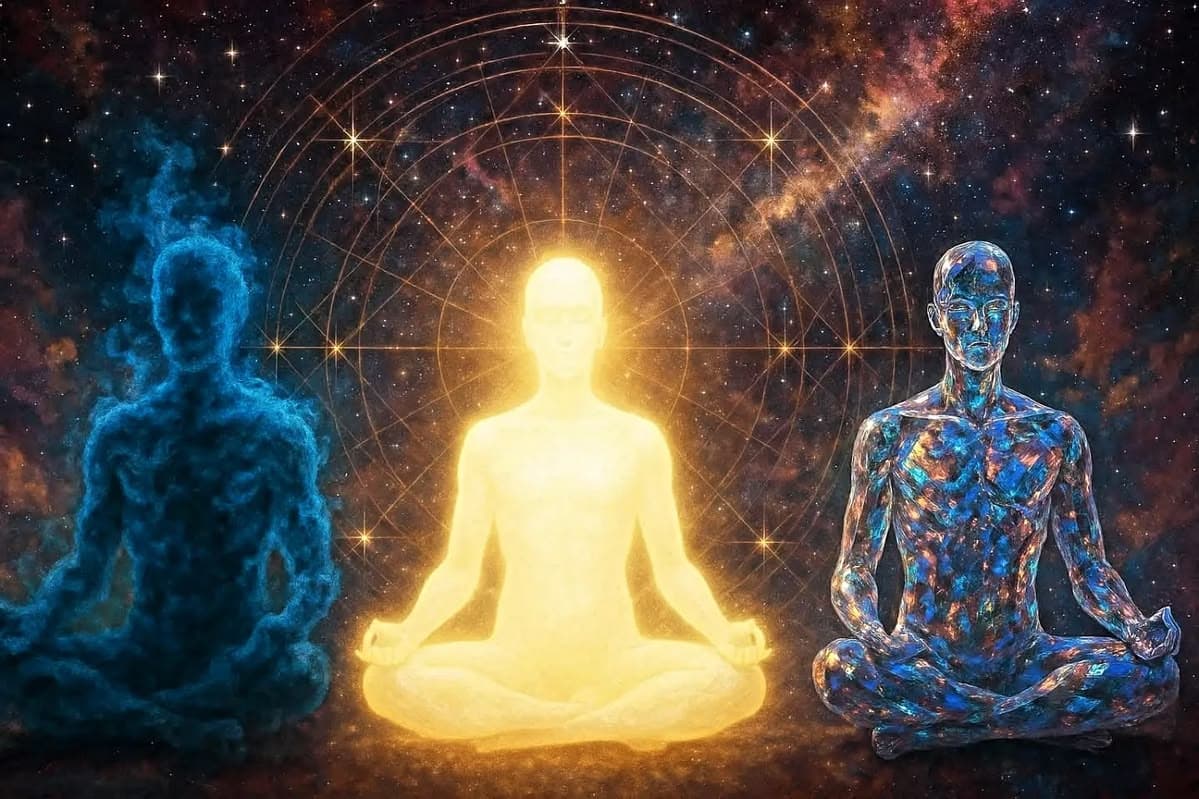
Every morning, a miracle is ignored. A world appears. A body stirs, a mind assembles the familiar narrative of a life, and the one who wakes says “I” as though nothing happened. But something did happen. A complete dissolution of the known universe occurred just hours before, in deep sleep. And before that, a parallel universe was woven from the mind’s threads in dream. Advaita Vedanta, especially through the lens of the Mandukya Upanishad, does not treat these as mere biological phases. It sees them as doorways into the fundamental question: who is the one who experiences all three, yet remains untouched? This exploration of the three states—waking (jagrat), dream (svapna), and deep sleep (sushupti)—is not a taxonomy to be memorised. It is an invitation to locate the constant awareness that pervades them, the fourth, called turiya. That alone, it is said, is what you truly are.
1. The Unasked Question Behind Every Morning
You wake up. The room reforms. The weight of your body returns. Almost instantly, the residue of yesterday floods back—the unfinished argument, the meeting at ten, the small dull ache in the lower back. And you say “I am awake.” But what is this “I” that was present in deep sleep, when no body, no room, and no yesterday existed? The ordinary mind assumes that the person who fell asleep is the same person who wakes, linked by memory and biology. But a closer look reveals a gap. In deep sleep, there was no person. There was no world. Yet you existed, because you now say “I slept well.” You were there, without objects, without an “I”-thought.
This is the starting point. The three states are not merely interesting psychological phases; they are the daily theatre in which the ego is born, dies, and is reborn. And each night, in deep sleep, the ego dissolves. You don’t fear this dissolution; you crave it. The peace of sleep is the peace of non-differentiation. The inquiry into the three states is the inquiry into why waking life is so heavy with suffering, while deep sleep is so light. The answer, Advaita suggests, is that in waking, the “I” attaches itself to a particular body-mind and a set of stories. In sleep, it rests in its own nature. To wake up spiritually is to bring the peace of sleep into the waking state, to know the self that never changes while the states come and go.
2. Waking: The Jagrat State and Its Hidden Dream
The waking state feels sovereign. It is the realm of sensory data, logical consistency, and social consensus. Here, a table is solid, a promise binds, and a train schedule matters. Advaita does not dismiss this reality; it gives it the name vyavaharika satta, transactional reality. But it asks a quiet, disorienting question: what distinguishes this state from the dream state while you are in it? In a dream, the dream world also feels coherent. The dreamer also has a body, meets others, and experiences cause and effect. Only upon waking does the dream seem flimsy. So what guarantees that the waking state is not another form of dream?
The Performance of Self
In waking, we perform a self. The self that speaks to a boss is not the self that speaks to a lover. The self at a funeral is not the self at a party. These are roles, mental constructions assembled for a context. The ego is a collage of these roles, held together by memory. But memory is itself a waking-thought, a series of images that appear now. The sense of being a continuous, independent entity is a powerful illusion, produced by the mind’s constant narration. The waking state is the stage where this narrative seems most solid, because the feedback from the external world constantly reinforces it.
The Shadow of Desire and Fear
Waking life is driven by two engines: desire for what is not here, and fear of losing what is. Both depend on a linear time and a separate self that journeys through it. This is the suffering inherent in the waking state. A man spends years building a career, only to find the achievement hollow. A woman longs for a relationship, and when it arrives, new anxieties sprout. The waking state is never satisfied, because its very structure is based on lack—the “I” reaching for an “other” to complete itself. Advaita points out that this lack is not a mistake to fix; it is a symptom of the deeper misidentification. The waking “I” is a limited form of consciousness, and its inherent dissatisfaction is the clue that it is not the whole.
3. Dream: The Svapna State as a Mirror of the Mind
The dream state (svapna) is a private universe. It is fabricated entirely from mental impressions (vasanas) accumulated in waking. Yet for the dreamer, it is a full sensory immersion. The dream body walks, talks, flees from danger, experiences ecstasy. There is no physical world, but there is a world of experience. This state is not less real experientially; it is less stable, less public. The profound realisation that Advaita offers is that the waking state is made of the same mental stuff as the dream, only projected outward through the senses. Both are constructions of the mind.
Aspect | Waking State (Jagrat) | Dream State (Svapna) |
|---|---|---|
Substratum | Sensory input from external objects | Internal impressions, memories |
Stability | Relatively stable, shared consensus | Unstable, private, shifts rapidly |
Body Identification | Physical body is taken as the self | Dream body is taken as the self |
Causality | Appears law-governed, physical | Psychological, symbolic logic |
Negation | Negated by deep sleep or death | Negated by waking |
Ultimate Reality | Mithya (dependent reality) | Pratibhasika (illusory, private) |
The dream offers a nightly experiment. You create an entire environment, populate it with people, and invest it with emotional charge, all without physical input. If you can do this in sleep, what prevents the waking mind from doing the same with the raw data of the senses? The world you perceive is a co-creation of sensory input and mental projection. When you look at a loved one, you are not seeing just a physical form; you are seeing a dream-figure woven from memories, hopes, and past hurts. The dream state teaches that the world you react to is always, in part, your own mind.
4. Deep Sleep: The Sushupti State and the Blank That Is Full
Deep sleep is the state of undifferentiated consciousness. There are no objects, no thoughts, no “I”, no world. It is a blank. But it is not nothing, because you emerge from it with the knowledge “I slept peacefully.” That knowledge could not arise if you had been completely absent. There was a presence, but without content. This presence is the Self, pure consciousness, momentarily resting in its own nature, free from the agitation of the mind.
Most people experience deep sleep as a gap, a darkness. The mind, which knows itself only through objects, cannot grasp an objectless awareness. So it dismisses deep sleep as unconsciousness. But Advaita insists that deep sleep is the most revealing state, because in it, the ego disappears and suffering with it. The bliss of deep sleep is not a pleasurable sensation; it is the absence of conflict, the natural peace of undivided being. The tragedy is that we spend our waking hours chasing experiences that we hope will replicate that peace, not realising that the peace is already the ground, merely obscured by the noise of the waking mind.
“In deep sleep, you are not absent. You are present as pure existence, the witness of the blank. That you know the blank proves your presence.”
5. Turiya: The Fourth That Is Not a Fourth
The term turiya literally means “the fourth.” But it is not a fourth state alongside the other three. It is the ever-present substratum that pervades waking, dream, and deep sleep. It is the screen on which these three states appear and disappear. The Mandukya Upanishad describes turiya as “not that which is conscious of the internal world, nor that which is conscious of the external world, nor that which is a mass of consciousness, nor simple consciousness, nor unconsciousness. It is unseen, unrelated, incomprehensible, uninferable, unthinkable, indescribable… the cessation of all phenomena, tranquil, auspicious, non-dual.” This is a description of your own essential nature, right now.
The Witness That Never Sleeps
Turiya is often called the sakshi, the witness. It is not a witness in the sense of a subject looking at an object. It is the light of awareness in which all experiences arise, the knowing element that never becomes an object of knowledge. You cannot see turiya; you are turiya. In the waking state, it is the awareness that registers thoughts, sensations, and the sense of “I.” In dream, it is the light that illuminates the dream. In deep sleep, it is the presence that remains when all else has dissolved. The recognition of turiya is not an attainment. It is the simple, direct seeing that you are not the passing states but the changeless awareness in which they occur.
Misconceptions About Turiya
Many seekers imagine turiya as a mystical trance, a state of cosmic consciousness filled with lights and visions. They pursue special experiences and discount the ordinary. But turiya is the most ordinary thing, because it is always present. A moment of quiet attention while washing a cup, a pause between thoughts, the awareness of a sound without naming it—these are glimpses of turiya. The states are fluctuating; turiya is the unchanging. To chase an extraordinary state is to remain within the realm of states, missing the constant that is already free.
6. The I-Thread Across the Three States
What connects the one who wakes, dreams, and sleeps? A common assumption is that there is a continuous personal self, a soul or psyche, that travels through the states. But Advaita analysis reveals a subtler truth. The personal self is an object that appears in waking and dream, not in deep sleep. The only continuous factor is the formless awareness itself. The “I” that says “I dreamt” and “I slept” is not the ego-I, but the pure consciousness that witnesses the ego-I.
State | What Appears | The Constant Factor (Turiya) | Identification |
|---|---|---|---|
Waking | Body, world, waking-thoughts, ego-I | Awareness illumining all | “I am the body-mind” |
Dream | Dream body, dream world, dream-thoughts | Awareness illumining the dream | “I am the dreamer” (within dream) |
Deep Sleep | No objects, no ego-I | Awareness without content | None (only peace) |
Turiya | Not a state, but the reality of all states | Pure consciousness itself | None (non-dual) |
Memory gives a false sense of continuity. The waking person remembers yesterday’s events and last night’s dream. But memory is a thought occurring now. It does not prove that the same entity existed then. The only true continuity is the consciousness that is present now and was present then. The person you were ten years ago is a collection of memories and images. You are not that person. You are the awareness that was aware then and is aware now, wearing different costumes. Seeing this severs the painful identification with the decaying, inadequate self-image and opens the door to turiya.
7. The Witness Attitude: Living Waking Life as Sakshi
The practical fruit of this teaching is the cultivation of the witness attitude (sakshi bhava). This is not a technique of detachment in the cold, dissociated sense. It is an inner shift from “I am the character” to “I am the awareness in which this character lives.” When a difficult emotion arises—say, a wave of humiliation after a public mistake—the ordinary response is to become the humiliation. The mind spirals: “I am a fool.” The witness attitude steps back and observes: “Humiliation is arising. Thoughts of foolishness are occurring. The body is flushing.” The emotion still happens, but the self is no longer bound inside it. The emotion is seen as a weather pattern in the vast sky of awareness.
Relationships and the Witness
In relationships, the witness attitude is transformative. A partner says something sharp. The waking ego immediately takes it personally and retaliates or withdraws. The witness notices the sharp words as sound, notices the arising of hurt, notices the impulse to defend. In that noticing, there is a gap. The compulsion to react is not denied, but it is held in a larger space. From that space, a response may arise that is not driven by conditioned pain but by clarity. The witness does not make you a cold observer; it makes you fully present, without being swallowed by the drama. The relationship then becomes a field of mutual seeing rather than mutual projection.
Work, Ambition, and the End of Existential Hunger
A professional identity is a waking-state construct. “I am a writer, a manager, a healer.” When that construct is threatened by failure, the waking self panics. But the witness recognises that the identity is a thought, and the threat is a thought about a thought. Action can still be taken, but it is no longer driven by the terror of annihilation. Ambition loses its compulsive edge. Goals can be pursued with joy rather than desperation, because the outcome does not determine the worth of the self. The self, as witness, is already whole. This is not complacency; it is the end of the exhausting quest to become somebody. You are already the being that all becoming seeks.
8. Deep Sleep as the Supreme Teacher
Deep sleep is the most undervalued state. It is the daily dissolution of the ego. Every night, the person you think you are dies. The problems that seemed insoluble, the desires that felt urgent, the identity that you defended—all vanish. And in the morning, they re-form. But that daily death is a proof that the waking self is not permanent. The peace of sleep is not a product of circumstances; it is the natural state of awareness unburdened by objects. The entire spiritual search can be framed as the effort to know that peace while awake.
Why do we love sleep? Not because we love unconsciousness, but because we love freedom from the ego. A person who is exhausted by their own story collapses into sleep with relief. The story is not solved; it is simply not told. To be awake to turiya is to live with that same relief while the story continues. The story becomes a light play, not a heavy obligation. Deep sleep teaches that you can exist, fully and peacefully, without a single thought about yourself. That is the lesson. Waking life can be infused with the same undivided presence.
9. Dream Logic and the Waking Projection
Dreams reveal the mind’s projective power. In a dream, you may meet a figure who is a composite of three different people from your waking life. The dream creates a seamless character, and you accept it as real. The waking mind does the same. The person you see across the breakfast table is a composite of sensory input, memory, expectation, and emotional history. You are never meeting a bare perception; you are meeting a projection. This is not to deny the existence of the person but to see that the “person” you relate to is a mental representation. Conflict often arises when two people are relating to their own projections rather than to the living presence before them.
The Social Media Dream
Social media is a collective dream-like projection. Profiles are curated dream-selves. Scrolling through a feed is like moving through a dream landscape populated by symbolic figures. The envy, the admiration, the outrage—these are dream-emotions, triggered by images and words that have no physical substance. The platform is a shared dream-space, and like a dream, it evaporates when you turn off the screen. Yet the psychological impact is real, because the waking mind cannot distinguish easily between sensory reality and vivid imagination. Recognising the dream-like nature of digital life does not mean dismissing it; it means engaging with it lightly, knowing that the identities on display are as insubstantial as last night’s dream.
10. Why the Three States Point to Non-Duality
The existence of the three states, with their alternating realities, undermines any claim that any single state holds absolute truth. The waking world is negated by sleep. The dream world is negated by waking. Neither is permanent. What remains permanent is the awareness that witnesses the coming and going of both. This awareness cannot be a state, because it is present in all states. It cannot be an object, because it is the subject of all objects. It is non-dual. There is no second thing.
This insight dismantles the hierarchy of reality that the waking ego clings to. The ego assumes that waking is the benchmark, and everything else is derivative or unreal. But from the perspective of turiya, all three states are appearances within consciousness. They are like movies on a screen. The screen does not become the movie. You are the screen. The waking life, with its intense beauty and tragedy, is a temporary ripple on the surface of your being. To know this is not to devalue life; it is to see its true sacredness as an expression of the one reality, rather than a battlefield of separate selves.
11. The Inquiry That Leads to the Fourth
The traditional method to realise turiya is to inquire into the three states. A common practice is to observe the transition between states. As you fall asleep, watch the waking world dissolve. Notice the moment when the “I” feeling begins to blur. In the morning, watch the world re-form. Notice how the first thought that arises is the “I”-thought, upon which the entire day’s structure is built. This observation, done consistently, begins to reveal the witness that is aware of the transitions.
Another approach is to ask, while in the waking state, “Am I aware?” The answer is immediate and wordless. That awareness is turiya. It is not something you do; it is what you are. You can then ask, “What is this awareness?” Not to get a conceptual answer, but to rest as the awareness itself. Thoughts will come. They are seen. The body will ache. It is seen. The world will clamour. It is seen. The seer remains untouched. This is not a state to be achieved by effort; it is the recognition of what is already the case. Effort is required only to overcome the habit of identifying with the seen rather than the seer.
“You are not the waker, the dreamer, or the sleeper. You are the light in which these three appear and dissolve. Abide as that light.”
12. Living in the Light of Turiya: The End of the Search
When the witness is recognised as the self, life continues, but the centre of gravity shifts. Actions no longer spring from a needy, frightened “me.” They arise from the totality, and they are appropriate to the situation. A jivanmukta, one liberated while living, still experiences the three states. The body still sleeps and wakes. Dreams still occur. But there is no longer the illusion that the person in the states is the self. The self is the vastness in which the states rise and fall.
This may sound remote, but its signs are ordinary. A deep, unshakable peace underlies all experience. Preferences remain, but without attachment. Suffering may come—physical pain, the loss of loved ones—but it does not create an existential fracture, because the one who could be fractured is known to be a shadow. The person engages fully with life, but with the light touch of one who knows the game. This is not a future goal. It is the truth of this moment, hidden by the habit of believing you are only the waker. To see it, you need not add anything. You need only stop claiming the states as your identity and rest as the awareness that is already reading these words.
Closing Reflection: The Waker's Dream Dissolves
The exploration of the three states is not an academic exercise. It is a direct confrontation with the most intimate mystery: the nature of your own existence. Each night, you are given a taste of liberation, a plunge into objectless peace. Each morning, you are reborn into the dream of a separate self. The teaching of the Mandukya Upanishad is a hand pointing to the seamlessness that holds both. Turiya is not a distant heaven. It is the silent “I am” that you are right now, beneath the noise of the waking story. When the waker’s dream is seen as a dream, you do not stop living; you begin to live without the weight of a phantom self. The world becomes a luminous play, and the heart rests in the unshakeable peace that was never absent, even in the darkest night of deep sleep.
Frequently Asked Questions
What are the three states of consciousness in Advaita Vedanta?
The three states are jagrat (waking), svapna (dream), and sushupti (deep sleep). They are the three phases of experience for the individual, each with its own reality. Advaita uses them to demonstrate that the true self is not any of these states but the constant awareness, turiya, that witnesses them all.
Is turiya a fourth state of consciousness?
Technically, no. Turiya is called the fourth, but it is not a state parallel to the other three. It is the underlying reality, the non-dual awareness that pervades waking, dream, and deep sleep. It is not an experience that comes and goes; it is the ever-present ground of all experiences.
How is deep sleep different from unconsciousness or death?
In deep sleep, consciousness continues as pure, objectless awareness. This is proven by the ability to recall “I slept well.” Unconsciousness, like a fainting spell, similarly lacks objects, but deep sleep is a natural, daily state of peace. Death, from the Advaita perspective, is the dissolution of the physical body; the consciousness that was the witness remains, but the individual mind dissolves.
Why do we not remember deep sleep clearly?
Memory is a function of the mind and depends on objects. Deep sleep has no objects, so the mind has nothing to record. The peace of sleep is registered by the witness, and when the mind wakes, it says “I slept well” based on that witness registration. There is no detailed memory because there was no content.
Can the witness be experienced directly in the waking state?
Yes. The witness is not an object of experience but the experiencer itself. You cannot see it as an object, but you can recognise it as the constant presence of awareness. Simple practices like asking “Am I aware?” or observing thoughts without identifying with them reveal the witness. It is the background of every waking moment.
What is the practical use of knowing the three states?
Understanding the three states helps deconstruct the false identification with the body-mind. Seeing that the waking self is temporary and dissolves in sleep can reduce the fear of death and the anxiety of ego-attachment. The witness attitude developed through this understanding leads to greater psychological resilience, less reactivity, and a more peaceful engagement with life.
Do dreams have any spiritual significance in Advaita?
Dreams demonstrate the mind’s projective power and the relativity of reality. They are used as an analogy: just as the dream world is unreal upon waking, the waking world is unreal from the standpoint of turiya. Some dreams may reflect deep-seated vasanas (impressions), but Advaita does not generally focus on dream interpretation. The emphasis is on the dreamer’s true identity as awareness.