


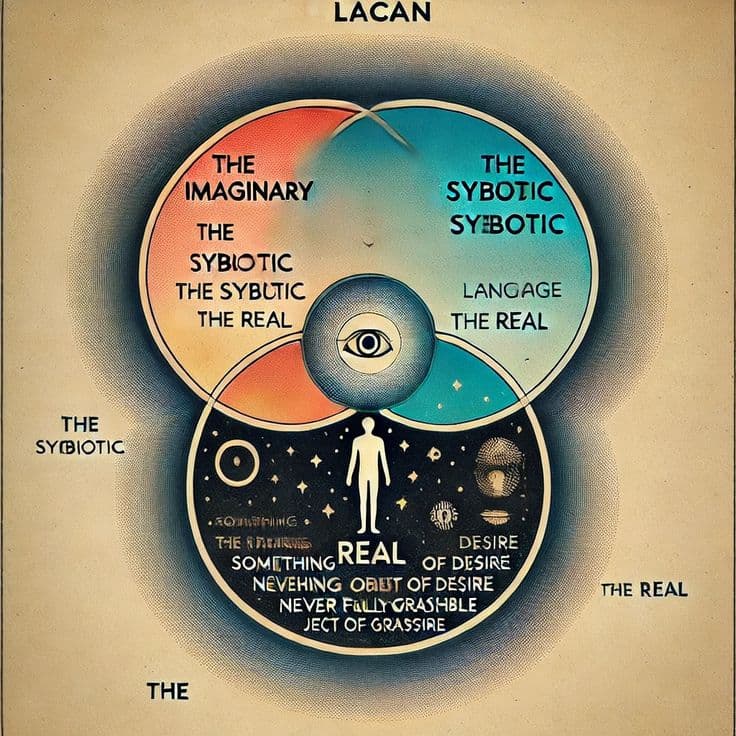
Overview
Popular renderings often mistake Lacanian desire for a simple want—a longing for an object, an unmet need. This misreading collapses the most radical contribution of Lacan’s teaching. Desire, for Lacan, is not a relation to an object but to a constitutive lack that no object can fill. It is an effect of the subject’s entry into the Symbolic order, the linguistic and social law that severs the human animal from any immediate relationship to its living body. The speaking being (parlêtre) is a split subject, marked by the signifier, and desire arises precisely in the gap between biological need and the demand for love addressed to the Other. This archive unpacks the architecture of desire as it emerges through the Lacanian triadic logic of need–demand–desire, the three registers (Imaginary, Symbolic, Real), the pivotal concept of the objet petit a, and the Graph of Desire. It traces the philosophical and linguistic roots of Lacan’s theory, details its clinical operations in the transference and the traversal of fantasy, and contrasts it with ego psychology, object relations, and cognitive models. The analysis reveals that desire is not an internal drive but a dialectical construct structured by the signifier, forever sliding along metonymic chains, sustained by the fantasy that frames the lost object. Far from promising fulfillment, Lacanian psychoanalysis aims at subjective destitution—a confrontation with the radical emptiness at the core of being.
Historical Background
Lacan’s theory of desire emerged from a deep dissatisfaction with post-Freudian ego psychology, which he saw as a betrayal of the Freudian discovery of the unconscious. In the 1953 Rome Discourse (“The Function and Field of Speech and Language in Psychoanalysis”), Lacan launched his program of a “return to Freud” by way of structural linguistics. The key premise: the unconscious is structured like a language. This linguistic turn recast desire entirely. It was no longer a biological drive seeking discharge but an effect of the signifying chain—a metonymy of lack. Lacan’s intellectual genealogy for this move is crucial. He absorbed the structural anthropology of Lévi-Strauss, who had shown that kinship and myth are organized by symbolic exchange systems. He drew on Saussure’s linguistics, subverting the sign by inverting the signifier–signified relationship: the signifier has primacy, with the signified as an effect of the play of signifiers. He integrated Jakobson’s distinction between metaphor (substitution) and metonymy (contiguity), identifying condensation with metaphor and displacement with metonymy. Philosophically, Lacan relied on Alexandre Kojève’s celebrated lectures on Hegel’s Phenomenology of Spirit, where desire is the motor of history, specifically the desire for recognition from another desire, not for an object. Kojève’s reading, which Lacan heard in the 1930s, located human desire in a struggle for prestige that gives birth to self-consciousness. Lacan transposed this dialectic of recognition into the analytic setting, making desire always the desire of the Other. The symbolic order, then, is the linguistic universe into which the subject is born, the network of signifiers that preexists and determines the subject’s place even before birth—the family name, the desires of the parents, the social rules. It is this order that introduces the fundamental manque-à-être (want-to-be) that is desire.
Origins and Development
From Hegel to the Signifier
Lacan’s early formulation in the 1930s and 1940s already centered on the image and the mirror stage. But the concept of desire as a symbolic function matured in the 1950s. His seminar on “The Purloined Letter” (1954-55) showed how a signifier’s trajectory determines the positions of subjects entirely independent of their individual psychology. The symbolic order is a chain of signifiers that situates the subject as an effect, not a cause. In Seminar V (1957-58), “Formations of the Unconscious,” Lacan introduced the dialectic of need, demand, and desire. The infant’s cry, initially a signal of organic need (hunger), becomes a demand addressed to the (m)Other. Because the Other responds not merely with the object of need (milk) but with love and presence, demand is always twofold: a demand for something and a demand for love. The object that satisfies need thus also becomes a sign of the Other’s love. The excess beyond need—the inarticulable longing for absolute love and recognition—is what Lacan calls desire. Desire is thus the remainder, the irreducible gap left when demand subtracts need.
The Graph of Desire
The Graph of Desire, developed across Seminars V and VI, is Lacan’s formal mapping of the relations among subject, signifier, jouissance, and desire. It moves from the elementary cell (the vector of the subject intersecting the signifying chain) to the complete graph with the formulas of fantasy ($ ◇ a) and the drive ($ ◇ D). The graph demonstrates that desire is not a simple vector but a circuit: the subject’s demand passes through the Other’s discourse and returns as an enigmatic desire of the Other—“Che vuoi?” (What do you want from me?). The subject’s own desire is constituted as an answer to this riddle, a defense against the abyss of the Other’s desire. This is where objet petit a emerges: the object-cause of desire, the lost object that gives desire its consistency, but which is itself a void, a remainder of the Real.
The Paternal Metaphor and Symbolic Castration
Desire’s inscription in the symbolic order requires the installation of the Name-of-the-Father, the signifier that substitutes the maternal desire (the mother’s comings and goings) with the Law of prohibition. The paternal metaphor creates a hole in the mother-child dyad: the child’s desire for the mother is barred, and the mother’s desire for the child is regulated. This castration is not a real event but a symbolic operation that inscribes lack and separates the subject from the immediate object, thereby producing desire as permanently insatiable. The phallus emerges not as the penis but as the signifier of this lack, the signifier of desire itself, which circulates between subjects without anyone possessing it. Thus, desire is caught in the symbolic economy; it is desire for a signifier to represent the subject for another signifier, never for a real object.
Late Lacan: Jouissance and the Real
In Lacan’s later work (1968–1981), the focus shifts from desire as a symbolic formation to jouissance as a real kernel that exceeds and sustains the symbolic. Desire is now seen as a defense against jouissance, regulating the excessive, painful enjoyment that transgresses the pleasure principle. The Borromean knot binds the three registers, with the sinthome as a fourth ring. This does not abandon desire but recasts its function: desire is the symbolic apparatus that keeps jouissance at a livable distance. The clinic of the end of analysis moves beyond interpreting desire to the traversal of the fantasy, the moment when the subject confronts the lack in the Other and the inconsistency of the symbolic order, assuming a new position toward the drive.
Theoretical Foundations
Lacanian desire is built upon a triangular logic. Need is biological, rhythmic, satisfiable—it can be met with an object (food, warmth). Demand articulates need in language, addressing the Other; it is always also a demand for love, for the Other’s unconditional presence. The object that satisfies need is thereby invested with a symbolic value—it becomes a proof of love. The shortfall between the object of need and the sign of love is desire. Desire is absolutely non-natural; it is the effect of the signifier on the living organism. This is why desire has no proper object; any object it attaches to is a metonymic stand-in for the lost object—the mythical das Ding (the Thing), the original mother or the primordial real that the symbolization process has cut away. The object cause of desire, objet petit a, is the “object” that caused desire in the first place but is not the goal; it is the leftover of the real after symbolization, the gaze, the voice, the oral and anal objects, etc., that circulate around a central void. In the symbolic order, the subject appears as a $, a barred subject, divided by the signifier. Desire is therefore the desire of the Other in three senses: we desire what the Other desires (mimetic rivalry); we desire to be desired by the Other (recognition); and our desire is structured by the signifying system of the Other (the symbolic law).
Core Psychological Questions
If desire is an effect of language, what becomes of the biological drives? How does the symbolic order “hijack” the organism?
Can desire be distinguished from wish (Freudian Wunsch) in a way that changes clinical practice?
What is the status of the “object” of desire if it is essentially a lack? How can a lack cause anything?
Is desire a universal structure, or does it vary across cultures and kinship systems? Does the paternal metaphor function identically everywhere?
How does the analyst’s desire operate in the treatment? What does it mean to “not give ground relative to one’s desire”?
If the goal of analysis is traversing the fantasy and confronting the drive, does desire disappear, or is it restructured?
Key Concepts
Need, Demand, Desire
The three terms map the passage from animal to human. Need targets an object; demand uses language to address the Other; desire is the remainder of this operation—the unsayable something that escapes both need and demand and yet fuels them.
The Split Subject ($)
The subject is not a substance but an effect of the signifying chain, divided by its entry into language. One part is represented by signifiers, the other is the fading (aphanisis) of the being under the signifier.
The Big Other (A)
Not an empirical person but the locus of the signifying treasury, the symbolic order as such. The subject’s messages come back from the Other in inverted form. The Other is always incomplete, marked by a lack (S(Ⱥ)), the missing signifier that would ground meaning.
Objet petit a
The object-cause of desire, an unattainable remainder that sets desire in motion. It is not the object of satisfaction but the object that triggers desire and around which the drive circuits. Examples: the gaze, the voice, the breast, feces, the phallus (in its imaginary form).
The Phallus (Φ)
The signifier of desire and of lack. It circulates in the symbolic order, designating what the Other lacks. The subject’s position relative to the phallus determines sexuation and the structure of desire (having or being the phallus).
Fantasy ($ ◇ a)
The formula linking the barred subject to the objet petit a. Fantasy stages a scene that frames desire, providing the subject with an answer to the enigma of the Other’s desire. It both sustains desire and screens the real of jouissance.
The Name-of-the-Father (Nom-du-Père)
The signifier that introduces the symbolic law, separating the child from the imaginary capture of the mother’s desire. Its foreclosure leads to psychosis, where desire is unregulated by the paternal metaphor.
Conceptual Mapping: The Graph of Desire
Stage | Description | Key Elements | Clinical Implications |
|---|---|---|---|
Elementary Cell | Intersection of intentional vector (Δ→$) and signifying chain (S→S') | Subject is represented by one signifier for another; retroaction of meaning | Speech reveals desire only après-coup; meaning is never fixed. |
Level of Demand | Vector loops through the Other (A), demand addressed | Code versus message; Other as locus of signifiers | The patient demands interpretation but really demands love. |
Upper Floor – The Enigma | Question “Che vuoi?” (What does the Other want?) emerges | d (desire) as question mark; s(A) as message | Desire is desire of the Other; analyst refuses to answer the enigma directly. |
Complete Graph | Fantasy ($ ◇ a) and drive ($ ◇ D) circuits added | Fantasy frames desire; drive bypasses symbolization | End of analysis: traversal of fantasy, identification with sinthome. |
Primary Research Traditions
Lacan’s system is not primarily empirical in the Anglo-American sense. Research traditions divide into: (1) Exegetical and philosophical elaboration within Lacanian schools (École de la Cause Freudienne, World Association of Psychoanalysis) and philosophy departments. This tradition refines theory through close reading, case presentation, and cartels. (2) Clinical case studies following Lacan’s distinctive practice (variable-length sessions, scansion, the analyst’s position as object a). These are published in journals like La Cause du Désir and Psychoanalytical Notebooks. (3) Applied Lacanian analysis in cultural, political, film, and literary theory, inaugurated largely by Slavoj Žižek and the Ljubljana school, which examines desire’s manifestations in ideology, cinema, and art. (4) Empirical attempts to operationalize Lacanian constructs, though sparse, have emerged in neuropsychoanalysis (e.g., linking the Real to subcortical affective circuits, the Symbolic to cortico-thalamic loops) and in qualitative research on the structure of psychosis. There is also a tradition of discourse analysis using the four discourses to map institutional dynamics, pioneered by researchers at the University of Ghent and elsewhere.
Major Theories and Models
Lacanian vs. Freudian Wish
Freud’s wish (Wunscherfüllung) is a hallucinatory reproduction of a satisfying experience, bound to the pleasure principle. Lacan translates wish into the signifying chain: the wish is a message, a rebus. But desire differs from wish because it persists beyond satisfaction; it is the metonymic sliding of the signifier. A wish can be fulfilled in a dream; desire cannot be “fulfilled” at all—it is only articulated, recognized, or traversed.
Lacanian vs. Object Relations (Klein, Winnicott, Fairbairn)
Object relations theories see the psyche as constituted by internal object relations and the quest for good objects. Lacan vigorously opposed this view, arguing that the object is not a relational partner but a cause, a void. The breast is not a “good object” but the objet a, the lost part-object that never was possessed. Desire is not for an object but for the lack inaugurated by the symbolic. Furthermore, object relations conflate the symbolic function with imaginary relations, reducing the analyst to a good mother, missing the symbolic dimension of the transference.
Ego Psychology and the Conflict Model
Ego psychology (Hartmann, Kris, Loewenstein) prioritized strengthening the ego’s adaptive capacities. Lacan saw this as a betrayal: the ego is an imaginary mirage, a méconnaissance. Desire is not a conflict between id and ego but a dialectic between the subject of the signifier and the objet a. The aim of analysis is not adaptation but subjective destitution—the fall of the ego’s identifications.
The Ljubljana School (Žižek, Dolar, Zupančič)
This school reads Lacan through German Idealism, emphasizing the ontological dimension of desire. Desire reveals a fundamental negativity at the heart of being. The symbolic order is not just a social structure but the transcendental condition for subjectivity. Their work connects Lacanian desire to politics, ethics, and ontology, arguing that the subject’s desire is a gap that capitalist discourse both exploits and forecloses.
Comparative Analysis: Three Schools on Desire
Dimension | Freudian Drive Model | Object Relations (Klein/Winnicott) | Lacanian Symbolic Approach |
|---|---|---|---|
Origin of desire | Bodily excitation, instinctual pressure | Innate object-seeking, relational needs | Symbolic lack, entry into language |
Object | Contingent object of drive discharge | Whole or part objects sought for satisfaction | Object a, cause of desire, a void |
Goal | Satisfaction, tension reduction | Good internalized objects, integration | Recognition of lack, traversal of fantasy |
Subject | Structured by id/ego/superego conflict | Formed by internal object relations | Barred subject ($), effect of signifier |
Clinical focus | Interpretation of repressed wishes | Containment, transitional space, repair | Scansion, punctuation, analyst’s desire |
Role of language | Secondary, representing unconscious ideas | Maturational, symbolic play | Constitutive: unconscious structured like a language |
Table 2: The Three Lacanian Registers and Desire
Register | Nature | Relation to Desire | Phenomena |
|---|---|---|---|
Imaginary | Specular, dual relations, images, rivalry | Desire captured in the image of the similar other; aggressivity | Mirror stage, ego ideal, paranoia, illusions of wholeness |
Symbolic | Signifiers, law, differential system | Desire as metonymy of the signifier; lack inscribed by castration | Paternal metaphor, phallus, unconscious formations, symptoms |
Real | Impossible, unsymbolizable, traumatic | Desire as defense against jouissance; objet a as real remainder | Anxiety, uncanny, traumatic kernel, repetition compulsion |
Table 3: Need, Demand, Desire – A Structural Breakdown
Need | Demand | Desire | |
|---|---|---|---|
Source | Biological organism | Address to the Other via signifiers | Remainder of demand minus need |
Object | Specific, satiable (food, warmth) | Object of need plus proof of love | No proper object; objet a as cause |
Satisfaction | Temporary, rhythmic | Conditional; love can never be fully proven | Impossible; desire persists indefinitely |
Relation to Other | Not originally addressed | Absolute demand for unconditional presence | Desire of the Other, question “Che vuoi?” |
Clinical Example | Hunger, thirst | Patient’s plea for interpretation | Transference as love, search for analyst’s desire |
Empirical Evidence and Experimental Findings
Lacanian theory has had a complex relationship with empirical research. Unlike cognitive psychology, it does not proceed by hypothesis testing of isolated variables; its central constructs—signifier, the Real, objet a—are inherently structural and cannot be operationalized without losing their conceptual specificity. However, several lines of inquiry bear on its plausibility. The discovery of “mirror neurons” (Rizzolatti et al.) gave some neurobiological credence to the imaginary register and specular identification, though Lacan’s point is that the mirror stage is a structural misrecognition, not a simulation. Research on symbolic capacities in infants, such as early categorical perception and phoneme discrimination, suggests a readiness for the signifier. Studies of psychosis and language structure have identified failures in the use of metaphor and metonymy, which align with Lacan’s view of foreclosure of the Name-of-the-Father. For example, in schizophrenia, the paternal function (law, metaphor) is disrupted, resulting in a “push-to-the-woman” or delusional metaphor. The work of Paul Verhaeghe and colleagues has attempted to map Lacanian diagnostic structures onto empirical psychopathology research, distinguishing between neurosis, psychosis, and perversion based on the subject’s relation to the Other’s desire and lack. The four discourses have been used qualitatively to analyze institutional communication, revealing dynamics of power and knowledge. Still, rigorous experimental tests of the Graph of Desire are nonexistent; the theory stands or falls on its clinical fruitfulness and philosophical coherence.
Interpretive Traditions
Within Lacanian circles, divergent readings of desire exist. Jacques-Alain Miller’s “orthodox” line emphasizes the late Lacan, the Borromean knot, and the sinthome as a mode of jouissance beyond the Oedipus. Here, desire is less central than the drive; analysis ends with identification with the sinthome. Slavoj Žižek and the Ljubljana school stress the political-ontological dimension: desire is the negativity that resists ideological interpellation, the “desire of the hysteric” that challenges the master’s discourse. Bruce Fink offers a clinically detailed, pragmatic Lacan, translating the theory into a step-by-step process of symbolization of the real, with desire as a necessary dialectical moment before traversing the fantasy. Charles Shepherdson focuses on the pre-Oedipal, the Real of the body, and the role of the Thing in constituting desire. Feminist Lacanians (Copjec, Rose, Salecl) have argued against the biological essentialism of Freud’s Oedipus, showing that sexuation is a symbolic choice, not anatomy; desire is not gendered by nature but by one’s relation to the phallic function. Queer theory extensively appropriates Lacan to conceptualize desire beyond normative heterosexuality, focusing on the contingency of the signifier and the failure of the sexual relation.
Internal Debates
Desire versus Drive: Which has primacy? The early Lacan privileges desire and the symbolic; the late Lacan subordinates desire to drive and jouissance. This division remains unresolved, with clinicians arguing over whether the goal of analysis is the articulation of desire or the assumption of the drive.
The Father and Sexuation: Is the Name-of-the-Father a necessary structural function, or can it be substituted by other signifiers (the “pluralization of names-of-the-father”)? Can desire exist outside the Oedipal framework, and does the “beyond Oedipus” in late Lacan render desire post-patriarchal?
Clinical Applicability: Is Lacanian analysis suited for borderline and psychotic structures? Lacan himself specified that the clinic of the symbolic and desire is for neurosis; psychosis requires a different treatment of the real and the sinthome. Yet many Lacanians treat a wide range of patients using these concepts.
Relation to Science: Can Lacanian concepts be integrated into neuropsychoanalysis without losing their specificity? Mark Solms has argued that the Lacanian “unconscious structured like a language” is a left-hemisphere function, but this reification runs counter to Lacan’s notion that the unconscious is a gap, not a substance.
Cognitive Dimensions
Lacanian desire recasts cognitive processes as effects of the signifying chain. Attention is captured by the enigmatic signifier of the Other’s desire. Memory is not a storehouse but a symbolic inscription; remembering is a retroactive reconstitution through speech. Decision-making, from a Lacanian standpoint, is always an act determined by the subject’s relation to the lack in the Other: the “forced choice” at the heart of subjectivation. Cognitive dissonance can be reinterpreted as the subject’s defense against the traumatic real that disrupts the fantasy frame. While experimental cognitive psychology has no place for a “subject of the unconscious,” the cognitive study of metaphor, metonymy, and narrative structure echoes the Lacanian attention to linguistic organization, albeit without the concept of desire as lack.
Behavioral Dimensions
Desire manifests behaviorally through repetition. The subject repeatedly seeks objects that resemble the objet a but are never it—the endless series of love affairs, career changes, consumer acquisitions. This is the metonymy of desire: each new object promises fulfillment but leaves the subject unsatisfied, propelling further searching. Compulsive behaviors, addictions, and fetishes are attempts to locate a fixed object that would stop the sliding, to convert the metonymy into a kind of metaphor, anchoring jouissance. Clinical work observes how desire is enacted in the transference: the analysand tries to make the analyst into the subject supposed to know, or into the objet a, structuring the relationship as a demand for love or an appeal to a hidden knowledge.
Emotional Dimensions
Desire is not an emotion but a structural position that generates emotional states. Anxiety, for Lacan, is not the absence of desire but the proximity of the desire of the Other when its object is no longer screened by fantasy—anxiety signals the approach of the real jouissance. Guilt often arises from “giving ground relative to one’s desire,” betraying one’s own desirousness to accommodate the Other. Envy and jealousy trace imaginary relations, where the other seems to possess the objet a that would complete me. Love, as a symbolic phenomenon, is giving what one does not have (one’s lack) to the Other. Thus, emotions are not biological givens but signifiers of the subject’s position in the circuit of desire.
Social Dimensions
Desire is intrinsically social because it passes through the Big Other. Ideologies function by offering master signifiers that suture the lack in the Other, providing a semblance of full meaning and organizing desire collectively. Consumer capitalism, as many Lacanians argue, exploits the metonymy of desire: the market presents an endless series of objet a substitutes, promising satisfaction while perpetuating lack. Political movements mobilize desire by channeling it toward a shared Cause. The four discourses (Master, University, Hysteric, Analyst) articulate different social bonds: the hysteric’s discourse, for instance, is the discourse of desire, constantly provoking the master to produce knowledge, embodying the subject’s insistent questioning of the Other’s desire. Understanding desire at the social level reveals that what is often taken as personal pathology is a structural feature of the symbolic order.
Clinical Relevance
In a Lacanian analysis, desire is not interpreted in terms of content—what the analysand “really” wants—but is punctuated and articulated through scansion and the analyst’s ambiguous silence. The analyst occupies the position of semblance of objet a, the cause of desire, refusing to answer the demand for love and thereby mobilizing the analysand’s own desire. Interpretation aims not at revealing a hidden wish but at isolating signifiers that mark the subject’s fundamental fantasy. The clinical goal is not happiness or normativity but that the analysand assumes his or her desire in its radical contingency, and eventually traverses the fantasy, confronting the lack in the Other and the drives. The late Lacan’s concept of the pass—the procedure by which an analysand becomes an analyst—involves testifying to the hole in knowledge, the point where desire gives way to the real of jouissance. This makes Lacanian practice distinctively oriented toward the ethics of desire: “Have you acted in conformity with the desire that inhabits you?”
Cultural Perspectives
Lacan’s structuralism is often accused of universalism, yet its framework can accommodate cultural variance. The paternal metaphor is a function, not a specific family arrangement; thus matrilineal societies or non-nuclear families still institute symbolic lack through other signifiers. The content of the symbolic order—the specific signifiers, myths, and prohibitions—varies culturally, but the triadic structure of need, demand, and desire may be invariant as long as language exists. Cross-cultural psychiatry has used Lacanian ideas to analyze culture-bound syndromes as expressions of the real that a particular symbolic order cannot articulate. For example, spirit possession can be read as the return of the foreclosed real when the paternal function is perturbed by rapid social change. The universality of the Oedipus complex has been contested; but if Oedipus is understood as a structural operation of substitution and lack, not a literal family drama, it retains its force across cultures.
Contemporary Research
Recent Lacanian scholarship has engaged with neuropsychoanalysis, AI, and new forms of subjectivity. The notion of a “capitalist discourse” (Lacan, 1972), which forecloses castration and promotes a direct jouissance without the mediation of the symbolic, has been applied to understand phenomena like social media addiction, online pornography, and the erosion of traditional authority. Research at the intersection of Lacanian theory and affect studies (e.g., Alenka Zupančič’s What IS Sex?) rethinks sexuality as the encounter with the real of the body’s jouissance, beyond the symbolic. Developments in topology and the knotting of the registers offer formal models for the structure of the subject. Empirical work by neuropsychoanalysts like Ariane Bazan attempts to correlate the signifier with cortical processes, suggesting that the “letter” is a neural inscription that insists beyond meaning. However, the most vibrant arena remains the clinic, where Lacan’s teachings continue to be refined through thousands of case presentations worldwide, grappling with the enigmas of desire in an era of shifting symbolic coordinates.
Common Misunderstandings
Desire equals wanting something: Desire is not about getting; it is about lacking. When the subject attains the object, desire shifts—because the object was never it.
The Big Other is a person: The Big Other is the symbolic order, not God or a specific authority figure, though it can be embodied.
The phallus is the penis: It is the signifier of lack and desire, not an anatomical organ. Both sexes are positioned in relation to the phallic function.
Lacan rejects biology: He rejects biological reductionism but maintains that the real of the body is the substrate that the symbolic fails to capture. Jouissance is a property of the living body.
Lacanian analysis is purely linguistic: While it starts with the symbolic, late Lacan integrates the real, jouissance, and the body; analysis involves the real presence of the analyst and the act.
Methodological Criticisms
The primary criticism is that Lacanian theory is unfalsifiable and hermetic. Concepts like objet petit a and the graph of desire are so abstract that they can explain anything after the fact, resembling a metaphysical system rather than a science. Clinically, the variable-length session and scansion are contentious, accused of fostering dependence and arbitrariness. Unlike empirically supported therapies, there are no randomized controlled trials of Lacanian analysis. The theory’s reliance on structural linguistics may be dated; cognitive linguistics and neuroscience have moved beyond Saussure. Furthermore, the claim that the unconscious is structured like a language has been challenged by evidence that unconscious processes are primarily affective and imagistic, not propositional. Nevertheless, proponents argue that psychoanalysis is not a natural science but a science of the subject, requiring different validity criteria. Qualitative case studies, coherence, and clinical efficacy within its own tradition serve as evidence.
Scholarly Criticisms
From outside, Lacanian theory has been criticized for obscurantism and deliberate complexity (Alan Sokal famously included Lacan in his hoax). Feminist critics like Judith Butler have challenged the paternal metaphor’s normativity and the rigid symbolic positioning of sexuation, proposing instead that the symbolic is more open to subversion than Lacan allowed. Post-structuralists (Deleuze and Guattari) accused Lacan of a “molar” Oedipus that reterritorializes desire onto lack, when desire is actually productive and positive. From within psychoanalysis, relational and intersubjective analysts find the Lacanian analyst too detached and the theory dehumanizing, missing the mutual recognition of two subjectivities. Cognitive psychologists find no evidence for a subject of the signifier, proposing that desire is an aggregate of reward prediction error, not a symbolic lack. Defenders retort that these critiques mistake the register: Lacan describes the structure of the speaking being, not a psychological mechanism, and that reducing desire to neurobiology misses the dimension of meaning and address.
Unresolved Questions
What is the ontological status of the Real? Is it a noumenal remainder, or is it produced retroactively by the symbolic itself?
Can the paternal function be separated from its patriarchal legacy? Is the name-of-the-father a necessary logical operator or a historically contingent form?
How does the shift from the clinic of desire to the clinic of jouissance change the handling of psychotic and borderline states?
Does the graph of desire have a mathematical or topological formalization that could be tested computationally?
Is Lacan’s subject compatible with emerging models of the Bayesian brain and predictive processing, which also emphasize a constitutive lack—the minimizing of prediction error?
To what extent does the Lacanian ethics of desire offer a viable alternative to the adaptation model in mental health?
Related Concepts
The Imaginary: Register of images, identifications, and the ego’s méconnaissance. Desire in the imaginary is captured by rivalry and the lure of the specular other.
The Real: The register of the impossible, the unsymbolizable traumatic kernel that disrupts the symbolic chain and is linked to jouissance.
Jouissance: Excessive, painful pleasure beyond the pleasure principle; what desire seeks to regulate and what the drive circuits around.
The Mirror Stage: The formative moment when the infant assumes a totalizing image of the body, laying the foundation for the ego and imaginary desire.
Foreclosure: The expulsion of a primordial signifier (the Name-of-the-Father) from the symbolic order, characteristic of psychosis, causing desire to be structured differently (e.g., the push-to-the-woman).
The Four Discourses: Formal structures of social link: Master, University, Hysteric, Analyst; the hysteric’s discourse is the discourse of desire, provoking knowledge from the master.
Related Books
Lacan, J. (1966). Écrits: The First Complete Edition in English. Trans. B. Fink. Contains “The Signification of the Phallus” and “The Subversion of the Subject and the Dialectic of Desire.”
Lacan, J. (1973). The Seminar, Book XI: The Four Fundamental Concepts of Psychoanalysis. Trans. A. Sheridan. The definitive elaboration of desire, drive, transference, and the field of the Other.
Fink, B. (1995). The Lacanian Subject: Between Language and Jouissance. A systematic presentation of the subject’s constitution and the logic of desire.
Fink, B. (2007). Fundamentals of Psychoanalytic Technique: A Lacanian Approach for Practitioners. Connects theory to clinical work, including the handling of desire in sessions.
Žižek, S. (1989). The Sublime Object of Ideology. Applies Lacanian desire and objet a to political ideology.
Copjec, J. (1994). Read My Desire: Lacan Against the Historicists. Argues that desire is not a historical construct but a structural necessity.
Verhaeghe, P. (1999). Does the Woman Exist? From Freud’s Hysteric to Lacan’s Feminine. An accessible yet rigorous exploration of desire and sexuation.
Shepherdson, C. (2008). Lacan and the Limits of Language. Examines the pre-symbolic foundations of desire.
Related Researchers
Jacques Lacan: The originator; reconceptualized desire through structural linguistics and the triadic logic.
Jacques-Alain Miller: Lacan’s son-in-law and executor, developed the late teaching, the clinic of the sinthome, and founded the World Association of Psychoanalysis.
Slavoj Žižek: Philosopher, applied Lacan to Hegel, ideology, and popular culture, emphasizing the ontological negativity of desire.
Bruce Fink: Leading English-language clinician-translator; systematized Lacanian clinical theory and technique.
Joan Copjec: Feminist Lacanian, challenged historicist accounts of desire and argued for the concept of the real.
Alenka Zupančič: Philosopher, explored the ethical and ontological dimensions of desire, notably in sexuality and comedy.
Paul Verhaeghe: Clinician and researcher, integrated Lacanian diagnosis with contemporary psychopathology.
Charles Shepherdson: Scholar, focuses on pre-Oedipal structure, the thing, and the limits of symbolization.
Related Archives
The Unconscious: Structure and Dynamics: The broader field of the dynamic unconscious, to which Lacan’s “structured like a language” is a key contribution.
The Architecture of Repression: Inside the Unconscious: The Freudian mechanism; Lacan’s foreclosure is a distinct form of exclusion relevant here.
The Mirror Stage and the Formation of the Ego: The imaginary precursor that sets the stage for the symbolic and the birth of desire.
Defense Mechanisms: A Comprehensive Taxonomy: Includes Lacan’s transformation of defense into operations on the signifier.
Trauma, Memory, and the Mind: A Psychoanalytic Exploration: The real of trauma and its relation to the failure of symbolization and desire.
Closing Reflection
Lacanian desire dismantles the intuitive idea that we are driven by clear, attainable goals. By locating desire in the gap between need and demand, in the insatiable metonymy of the signifier, Lacan reveals the subject as a lack seeking to fill a void that is constitutive, not accidental. The symbolic order is both the condition of desire and its prison; it gives shape to the want-to-be while forever frustrating it. The radical clinical implication is that mental suffering is not primarily due to frustrated wants but to the failure to articulate desire within the symbolic, to being caught in the demand of the Other. The traversal of the fantasy does not bring a happy plenitude but an acceptance of the fundamental absence that makes the subject what it is. In an era saturated with promises of full jouissance—from wellness industries to algorithmic desire—Lacan’s teaching functions as a rigorous anti-ideology, insisting that the only authentic position is not the fulfillment of desire but the assumption of one’s singular mode of enjoying the unconscious. To grapple with this architecture is to engage the profound question: what does it mean to live a life oriented by a lack that nothing can fill, yet which alone makes us subjects?