


B. Guy Peters
B. Guy Peters fundamentally reshaped the study of governance by insisting on a functional, steering-centric definition of the concept, refocusing the field on the essential question of 'how to govern' rather than simply 'who governs.' As the Maurice Falk Professor of American Government at the University of Pittsburgh, he is the preeminent authority on the 'new institutionalism' in political science, masterfully synthesizing its diverse schools into a coherent analytical framework [citation:7][citation:14]. His work on the 'governance without government' paradigm with Jon Pierre challenged the state-centric model, arguing that governance persists through networks and markets, while simultaneously arguing that hierarchy and the state remain indispensable for steering and coordination [citation:2][citation:4][citation:9].
.webp?alt=media&token=a654646a-3c02-4a3a-bb20-421e64251f83)


✦What is B. Guy Peters' central concept of governance?
For Peters, governance is fundamentally about the capacity to steer society toward collective goals. He rejects definitions focused solely on the decline of the state. Instead, he provides a functional model identifying the tasks of governing, arguing that these can be performed by a mix of state, market, and civil society actors. This focus on function allows for a truly comparative analysis of how different societies address the core problem of coordination and control [citation:9][citation:14].
✦What is the 'new institutionalism' and how does Peters define it?
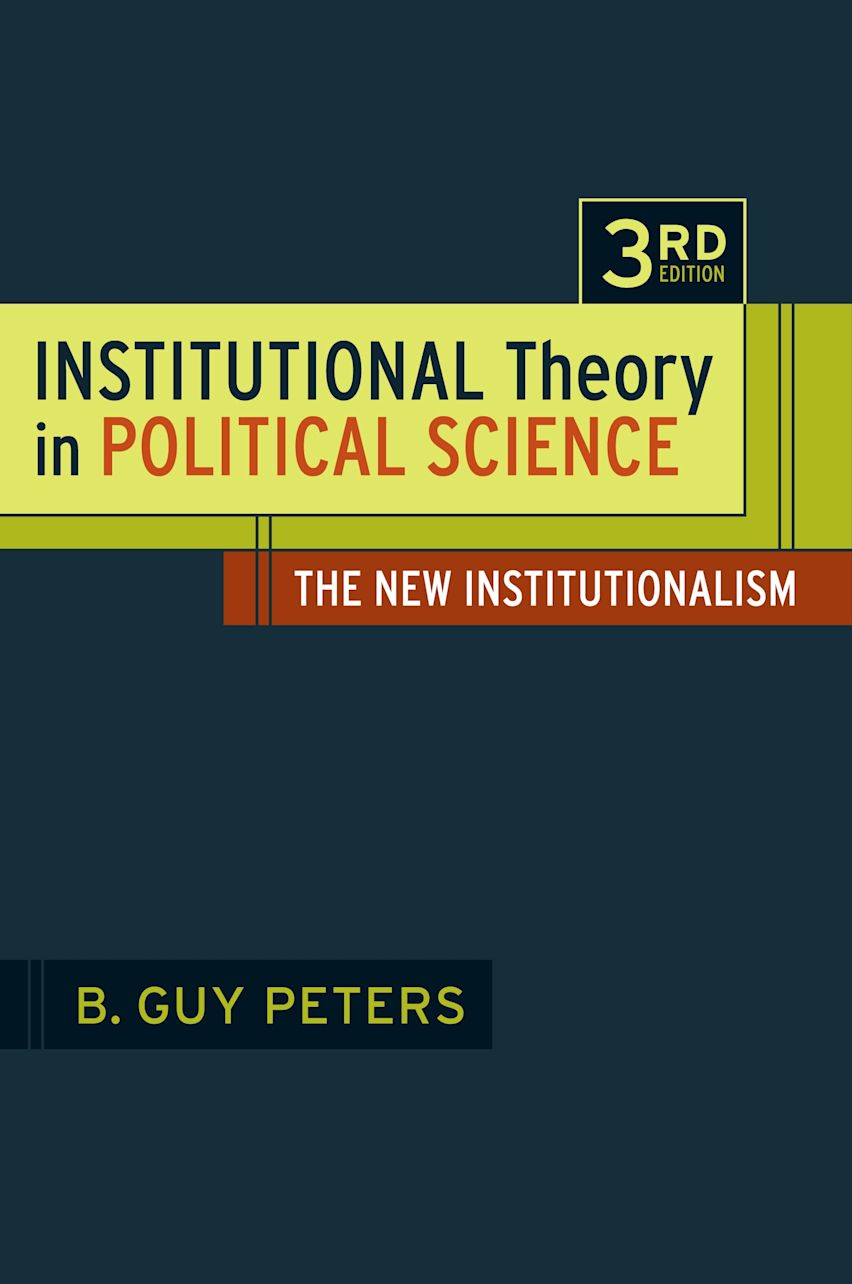
Peters is the key synthesizer of new institutionalism, which posits that institutions—the formal rules, norms, and procedures of political life—are not just background but are central to explaining political outcomes. In his defining text, 'Institutional Theory in Political Science,' he dissects the major variations of this theory, including normative, rational choice, historical, and discursive institutionalism. His contribution is to provide a coherent framework for understanding how these seemingly different schools of thought share a common foundation: the belief that institutions matter [citation:3][citation:6][citation:8].
✦What is the 'governance without government' idea and how does Peters approach it?
In a landmark 1998 article with Jon Pierre, Peters engages with the European literature on 'governance without government,' which emphasizes the role of networks and markets in creating order. He acknowledges this shift away from the state but also provides a crucial corrective. He argues that 'governance without government' is incomplete because governments still operate 'in the shadow of hierarchy,' possessing the ultimate authority to step in and reassert control. The state is transformed, not rendered obsolete [citation:2][citation:4][citation:10].
✦How does Peters' work on coordination apply to modern public policy?
Peters tackles the core dilemma of modern public administration: the conflict between specialization and coordination. In his book 'Pursuing Horizontal Management,' he argues that government specialization leads to fragmentation and inefficiency. Through case studies like U.S. Homeland Security and the European Union, he explores the political and practical barriers to 'horizontal management' and evaluates the instruments governments use to achieve policy coherence. His work is directly applicable to tackling complex, cross-cutting 'wicked problems' [citation:5][citation:13].
✦How does Peters' work differ from the 'New Public Management' (NPM) movement?
While NPM advocates for market-like competition and managerial autonomy within the public sector, Peters takes a broader and more critical view. He sees NPM as one potential solution to the coordination problem, but not the only one. His work focuses on the political and institutional realities of reform, arguing that a 'return to the fundamentals' of governance—understanding state capacity and the role of institutions—is more important than a simplistic focus on efficiency and privatization. He is a comparative analyst of reform, not a proponent of a single model [citation:7][citation:14].
✦What are some of Guy Peters' most influential books?
His most seminal works include 'The Politics of Bureaucracy,' a definitive comparative introduction to public administration now in its seventh edition [citation:7]; 'Institutional Theory in Political Science,' the standard text on the new institutionalism [citation:3][citation:6]; and 'Governance, Politics and the State' with Jon Pierre. He has also authored key works on policy coordination ('Pursuing Horizontal Management') and the future of the state, demonstrating his unparalleled breadth in the field [citation:4][citation:5].