


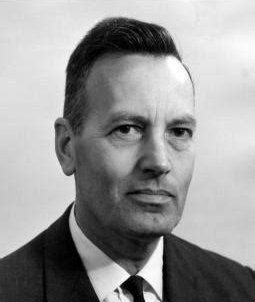
Paul Morris Fitts
0Paul Morris Fitts was an American psychologist and a pioneering figure in human factors engineering and engineering psychology. He served as a lieutenant colonel in the U.S. Air Force, where he spearheaded the Aviation Psychology Program and later became the first Director of the Psychology Branch at the Wright-Patterson Air Force Base AeroMedical Laboratory, a site now recognized as the 'birthplace of human factors engineering'. A professor at Ohio State University and later the University of Michigan, he conducted seminal research on stimulus-response compatibility and human performance. In 1954, he formulated Fitts's law, a quantitative model predicting the time required for rapid, aimed movements. He was a founding member and president of the Human Factors Society, and president of APA's Division 21. His landmark 1951 chapter 'Engineering Psychology' defined the field for a generation. His career was cut short by his untimely death in 1965.
Similar Minds
All authors →Key Insights
- ✦
What is Paul Fitts best known for?
Paul Fitts is best known for formulating Fitts's law in 1954, a fundamental quantitative model that predicts the time required for humans to move rapidly and accurately to a target. He is also a pioneering figure in human factors engineering and engineering psychology. His research on stimulus-response compatibility provided crucial principles for designing aircraft cockpits and human-machine interfaces, significantly reducing pilot errors. He served as the first Director of the Psychology Branch at the Wright-Patterson Air Force Base AeroMedical Laboratory and was a founding member of the Human Factors Society.
- ✦
What is Fitts's law?
Fitts's law is a mathematical model of human movement that predicts the time (MT) it takes to move from a starting point to a target, based on the target's distance (D) and width (W). The law is expressed as MT = a + b log₂(2D/W), where a and b are empirical constants. It demonstrates a speed-accuracy trade-off: the farther away or smaller the target, the longer the movement time. Originally derived from experiments on rapid, aimed movements, Fitts's law has become one of the most robust and widely adopted models in experimental psychology, and is a cornerstone of human-computer interaction and interface design.
- ✦
What is Fitts's contribution to aviation safety?
Fitts made significant contributions to aviation safety through his research on human factors in aircraft cockpits. During his time as a lieutenant colonel in the U.S. Air Force, he spearheaded the Army Air Forces' Aviation Psychology Program. He carefully studied stimulus-response compatibility, which provided important principles for arranging flight instruments and control devices to facilitate safe and efficient cockpit operations. His work helped reduce pilot errors and fatal plane crashes by ensuring that controls and displays were designed to match human perceptual and motor capabilities.
- ✦
Where did Paul Fitts study and work?
Paul Fitts was born in Martin, Tennessee, in 1912. He earned his bachelor's degree from the University of Tennessee, his master's from Brown University, and his doctorate from the University of Rochester. He served in the U.S. Air Force as a lieutenant colonel from 1942 to 1946. He was a professor at Ohio State University, where he created the Aviation Psychology Research Laboratory, and later joined the University of Michigan in 1958. At Michigan, he co-founded the Human Performance Center, which became internationally renowned for its research on perception, learning, memory, and action.
- ✦
What is engineering psychology?
Engineering psychology is the field that applies psychological principles to the design of systems and equipment to optimize human performance and safety. Paul Fitts preferred this term to 'human factors engineering'. His landmark 1951 chapter, 'Engineering Psychology,' in the 'Handbook of Experimental Psychology,' provided a definitive introduction to the field. Engineering psychology focuses on understanding human capabilities and limitations—such as perception, attention, memory, and motor control—to inform the design of user interfaces, controls, displays, and work environments. It bridges the gap between basic experimental psychology and applied system design.
- ✦
What is stimulus-response compatibility?
Stimulus-response compatibility refers to the natural relationship between a stimulus and the response it evokes. Paul Fitts conducted seminal research on this concept, demonstrating that performance is faster and more accurate when the spatial arrangement of stimuli and responses is compatible. For example, a control located to the right of a display is more compatible with a stimulus appearing on the right side of that display. Fitts's findings provided crucial principles for designing aircraft cockpits and other human-machine interfaces, ensuring that controls and displays are arranged to match human expectations and reduce errors.
- ✦
What awards and honors did Paul Fitts receive?
Paul Fitts received numerous honors for his pioneering contributions. He was President of Division 21 (Division of Applied Experimental and Engineering Psychology) of the American Psychological Association (APA) in 1957–1958. He was also elected a Fellow and served as President of the Human Factors and Ergonomics Society (then the Human Factors Society) in 1962–1963. He was a founding member of that society. The APA now has a Paul Fitts honorary award, and the University of Michigan holds an annual Paul M. Fitts Psychology Awards Banquet and Fitts Memorial Lecture Series in his honor.
- ✦
How did Paul Fitts die?
Paul Fitts died unexpectedly from a heart attack on May 2, 1965, at the age of 52. At the time of his death, he was a professor at the University of Michigan, where he had been a faculty member for seven productive years. His untimely passing cut short a brilliant career that had already profoundly shaped the fields of human factors engineering and experimental psychology.