


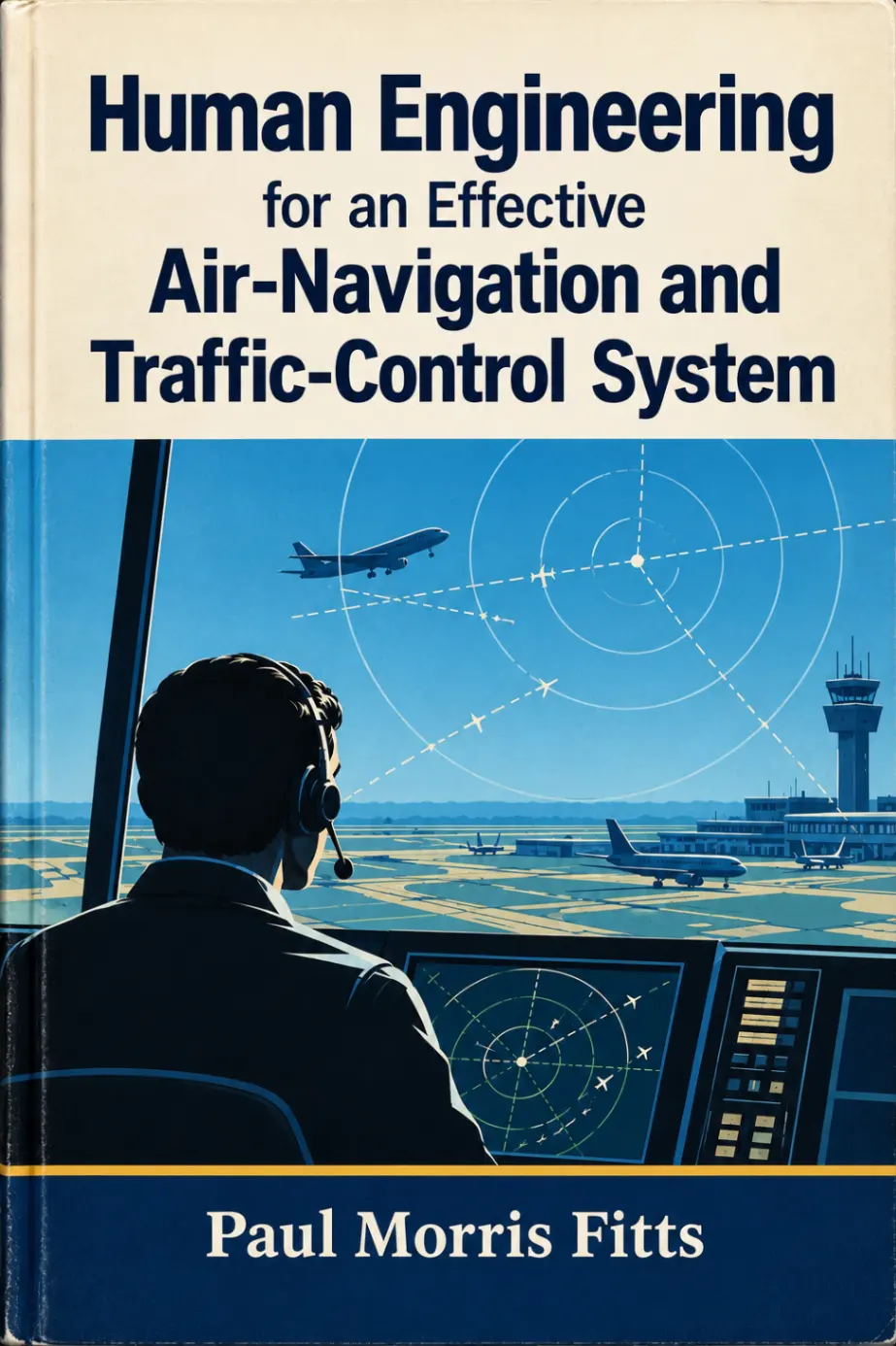
Human Engineering for an Effective Air-Navigation and Traffic-Control System
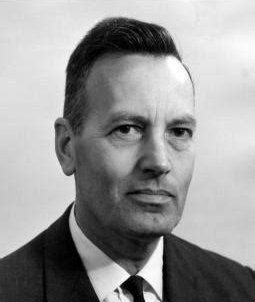 Paul Morris Fitts
Fitts's edited report argues that designing a safe, efficient air-navigation and traffic-control system requires treating the human operator as an integrated component of a man-machine communication system, not as an afterthought. Its distinctive mechanism is the systematic allocation of functions between humans and machines: the report surveys what people do better (detecting small energies, perceiving patterns, improvising, inductive reasoning, judgment) and what machines do better (rapid response, force application, short-term memory, deductive reasoning), a framework later known as the Fitts list. Prepared for the Air Navigation Development Board, the report also insists that human-engineering research must be conducted at an interdisciplinary level alongside engineers.
Key Details
Related Books
View AllSimilar books from the same category, ranked by shared topics and reader engagement.
Key Insights — Read in 10 Minutes
What is the central claim of this report, and what does it reject?
The central claim is that designing an effective air-navigation and traffic-control system requires treating the human operator as an integrated component of a man-machine communication system, with functions allocated between people and machines according to their comparative capabilities. The report rejects the assumption that human factors can be addressed after the engineering is complete; it argues that human-engineering research must proceed alongside equipment design and that engineers and behavioral scientists must cooperate from the start . It also rejects the 'machine model' of human behavior as insufficient, noting that human output is not simply a function of input and that selection, training, morale, and fatigue remain essential research problems . The report's purpose was to plan a long-range human-engineering research program for the Air Navigation Development Board.
What is the Fitts list, and where did it originate?
The Fitts list is a set of comparative statements about what humans do better than machines and what machines do better than humans, introduced in this 1951 report . It originated from Fitts's survey of the kinds of things men can do better than present-day machines, and vice versa, as part of the report's broader effort to determine how functions should be allocated in air-navigation and traffic-control systems . Humans were described as better at detecting small amounts of visual, auditory, or chemical energy, perceiving patterns, improvising, storing information over long periods, inductive reasoning, and exercising judgment. Machines were described as better at responding quickly to control signals, applying great force smoothly and precisely, storing information briefly and erasing it completely, and deductive reasoning . The list became a foundational concept in human factors and function allocation.
How was the report received, and what are the main criticisms of the Fitts list?
The report was influential and is widely cited as a foundational document in human factors and aviation psychology . The Fitts list, however, has attracted sustained criticism. Critics note that it proposes a static allocation of functions when actual human-machine allocation is often dynamic . Alphonse Chapanis observed that the list approach is only relevant to a particular stage of technological development and that it is not possible to predict human or system performance precisely in advance of the design cycle . Dekker and Woods argued that the list neglects the design of user-automation cooperation, and Sheridan noted that it is poorly suited to technological change and operates at too high a level of abstraction . Later research showed that present-day machines are considered to surpass humans in detection, perception, and long-term memory, reversing some of Fitts's original claims, though a close reading of the 1951 report suggests some of these disagreements were already anticipated .
What institutional context produced this report?
The report was prepared for the Air Navigation Development Board under the auspices of the National Research Council's Committee on Aviation Psychology . The project was first discussed in December 1949 by Morris S. Viteles, chairman of the NRC Committee on Aviation Psychology, Dean R. Brimhall of the CAA, and the editor. Plans were formulated during the following six months at NRC Committee meetings and conferences with the Air Navigation Development Board, and full-scale work began in June 1950 . The report was published in March 1951 by the National Research Council's Division of Anthropology and Psychology . This provenance matters because it shows the report was an applied, government-sponsored planning document aimed at a specific agency's research priorities, not a purely academic treatise.
What is a common misconception about this report?
A common misconception treats the Fitts list as the report's sole or primary contribution, when in fact the list emerged from a much broader research-planning effort. The report covered the nature of human-engineering research, the air-traffic control problem, basic design questions, the human operator as part of a communication system, visual displays, direct vision from aircraft, voice communication, system research and evaluation, and the problem of putting human-engineering data to use . It also included appendices on the present air-traffic control system, a survey of sixty control towers, and the criterion problem. Reducing the report to a list of human versus machine capabilities misses its argument that human factors must be integrated into system design through interdisciplinary research and that criterion problems are central to evaluating system effectiveness . The list is a memorable artifact of a larger programmatic document.
Wealthy Psyche is an intellectual archive. We do not host, distribute, or sell book copies — physical or digital. We provide structured knowledge to help you think better, faster.