


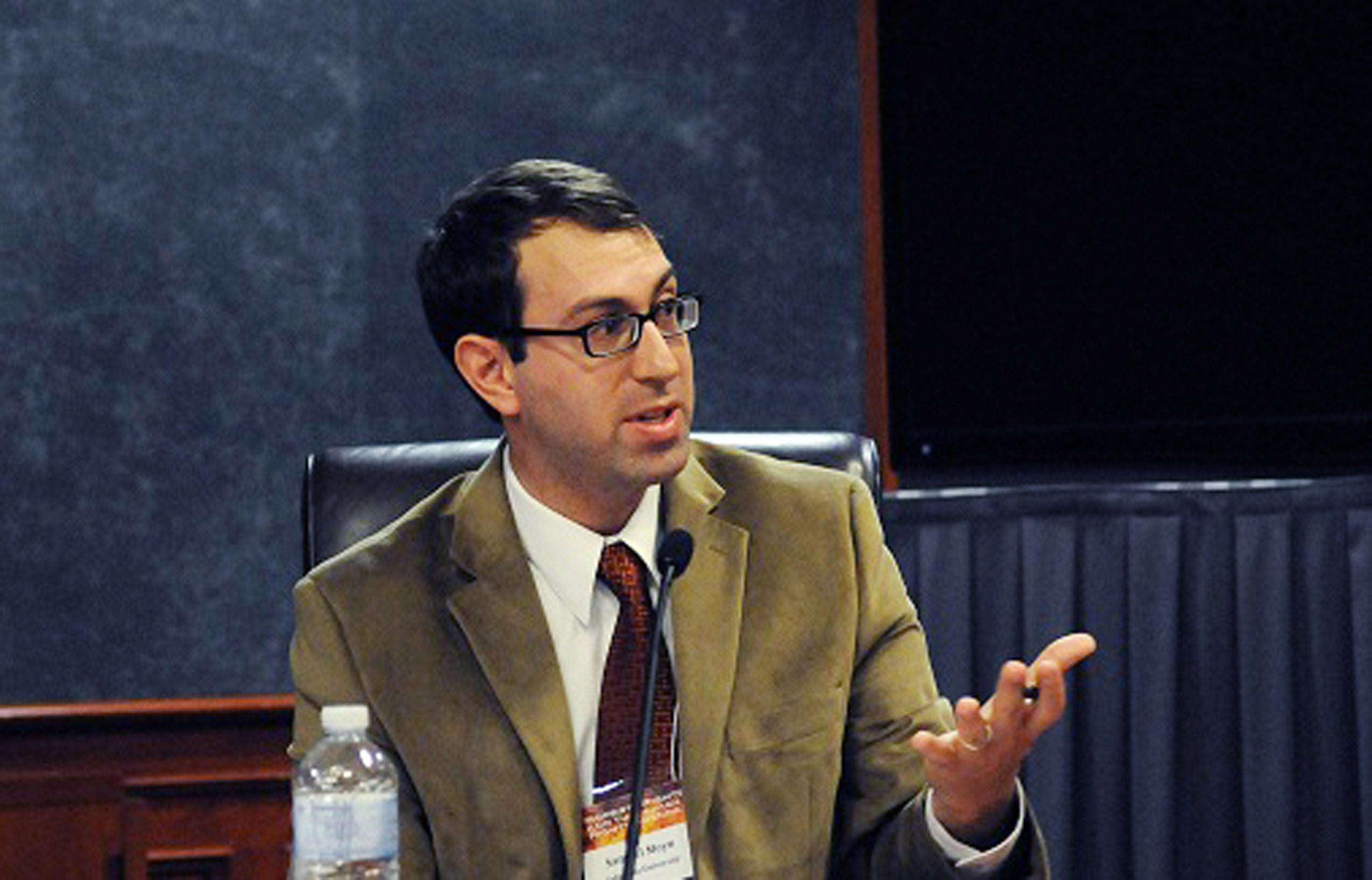
Samuel Moyn
0American legal historian who argued in The Last Utopia (2010) that human rights as a transnational movement began not with the Enlightenment or the Holocaust, but in the 1970s as a substitute for failed revolutionary politics. This revisionist claim forced scholars to separate the eighteenth-century 'rights of man'—which built state sovereignty—from modern human rights as a moral check on state power. His later work Not Enough (2018) contends that human rights have promoted sufficiency (a floor of basic protection) while remaining silent on inequality, thereby coexisting comfortably with neoliberalism. He is Chancellor Kent Professor at Yale Law School.



Key Insights
- ✦
Why does Moyn date the modern human rights movement to the 1970s rather than 1948?
Moyn's revisionist claim in The Last Utopia is that the Universal Declaration of Human Rights in 1948 was peripheral to postwar reconstruction—a construction made for and by strong state sovereignty, not a check on it. The rights of man that inspired the American and French Revolutions were about building the state, not transcending it. What we now call international human rights emerged only in the 1970s, when the collapse of socialism and anticolonial utopias left a moral vacuum that human rights filled as a 'last utopia.' Amnesty International's membership exploded, and Jimmy Carter made human rights a foreign policy pillar—marking a genuinely new phenomenon, not the culmination of a centuries-old tradition.
- ✦
What is Moyn's 'sufficiency versus equality' critique of human rights?
In Not Enough (2018), Moyn argues that human rights have been comfortable with sufficiency—ensuring everyone has a minimum floor of material provision—but silent on equality, or how far individuals are from one another. This allowed human rights to coexist with neoliberalism's massive growth in inequality. The international human rights movement rose alongside neoliberal economics in the 1970s, and while it condemned state repression, it never demanded a ceiling on wealth. The New International Economic Order's egalitarian demands failed in the 1970s, and sufficiency alone survived as the distributive ideal.
- ✦
How does Moyn differ from Lynn Hunt on the origins of human rights?
Lynn Hunt's Inventing Human Rights (2007) traces human rights to eighteenth-century empathy and the novel, locating their origins in the Enlightenment and the rights of man. Moyn directly challenges this continuity thesis. He argues that eighteenth-century rights were about constructing state authority, not limiting it—they were 'part of the authority of the state, not invoked to transcend it.' Hunt emphasizes cultural and psychological preparation over centuries; Moyn emphasizes a sharp rupture in the 1970s when human rights became a transnational social movement. The debate between them became one of the most contested in human rights historiography.
- ✦
What did Moyn argue in Humane about the American way of war?
Moyn's 2021 book Humane: How the United States Abandoned Peace and Reinvented War argues that Americans made a moral choice to prioritize humane war over a peaceful globe. The laws of armed conflict—international humanitarian law—were developed to make war less cruel, but this obsession with civilian casualties and cruelty distracted from the crime of waging war itself. By focusing on making war humane, the antiwar movement lost its radical edge: if you fight to make war better, you accept that there must be a war to humanize. Moyn traces this shift to the 1970s, when humanitarian law expanded permissively, enabling drones and targeted killings.
- ✦
What is the most common criticism of Moyn's historical claims?
Critics argue Moyn stretches his argument too far by decoupling human rights entirely from what came before. The antislavery campaign and nineteenth-century laws of war contained universalist and internationalist aspects even if not framed as 'human rights.' Nuremberg applied international law directly to crimes against individuals—a crucial contribution Moyn underplays. Others note his Eurocentric focus on Western Europe and North America neglects the Global South, where social rights litigation has been most active. His claim that human rights and neoliberalism shared the same lifespan also faces empirical challenge: rights norms and institutions rose in the 1940s, not the 1970s.
- ✦
What is Moyn's current institutional position and recent work?
Moyn is Chancellor Kent Professor of Law and History at Yale Law School. His recent books include Humane (2021), Liberalism against Itself (2023), based on his Carlyle Lectures at Oxford, and the forthcoming Gerontocracy in America: How the Old Hoard Power and Wealth—and What to Do About It, scheduled for 2026. He remains a fellow of the Quincy Institute for Responsible Statecraft and writes for outlets including the New York Times, the Guardian, and the London Review of Books. His work continues to explore constitutionalism, democracy, legal theory, and the Vietnam War.
- ✦
What does Moyn mean by calling human rights 'the last utopia'?
The title captures Moyn's argument that human rights succeeded earlier political utopias—socialism, anticolonial nationalism, revolutionary communism—after they failed or were discredited. In the 1970s, as the radical dreams of the 1960s collapsed, human rights emerged 'seemingly from nowhere' as a depoliticized, moral response. It offered a vision of international justice that transcended politics, appealing to a fatigued audience weary of ideological conflict. Moyn's phrase carries ambivalence: if human rights is a utopia, can it be realized? The book questions whether this moralized vision of global justice has the political resources to achieve its own promises.