


Samuel P. Huntington
Samuel P. Huntington (1927–2008) fundamentally reoriented comparative politics by insisting that political order—not democracy, economic development, or cultural modernization—is the primary variable explaining state stability and failure. In *Political Order in Changing Societies* (1968), he challenged the developmental orthodoxy that 'all good things go together,' demonstrating that rapid social mobilization without institutional capacity produces political decay, not progress. This 'gap' thesis—that the mismatch between participation and institutionalization drives instability—became the foundational framework for understanding state fragility. Huntington later identified three waves of democratization (*The Third Wave*, 1991), theorized post-Cold War conflict as civilizational (*The Clash of Civilizations*, 1996), and examined American national identity (*Who Are We?*, 2004). A Harvard professor for 58 years, he served as president of the American Political Science Association (1986–87) and shaped generations of scholars through his insistence on asking inconvenient questions.




✦What is Huntington's most fundamental contribution to comparative politics, and why did it challenge the orthodoxy of the 1960s?
Huntington's most fundamental contribution is the argument that political order—the institutional capacity to aggregate and channel demands—is prior to democracy, economic growth, and modernization. In *Political Order in Changing Societies* (1968), he showed that rapid social and economic change in developing countries generates exploding political participation, which outruns the capacity of weak institutions to process it, producing instability and decay. This directly challenged the prevailing modernization theory, which assumed that economic development would naturally produce stable democracy. Huntington insisted that 'the degree of order, rather than the form of the political regime, mattered most', making institutional strength the central variable in comparative political development.
✦How does Huntington's 'gap' thesis explain state fragility and failure?
Huntington's 'gap' thesis holds that political instability arises from the disjuncture between the level of political participation (social mobilization) and the level of political institutionalization. When participation expands rapidly—through urbanization, literacy, media exposure—without a corresponding growth in institutional capacity (parties, bureaucracies, courts), the system becomes overloaded, producing violence, coups, and state collapse. This framework explains why many post-colonial states experienced decay despite economic progress: they lacked the institutional infrastructure to absorb and channel newly mobilized populations. The thesis remains foundational for understanding state fragility, failed states, and the challenges of state-building in conflict-affected regions.
✦What is Huntington's 'third wave' of democratization, and what factors did he identify as driving it?
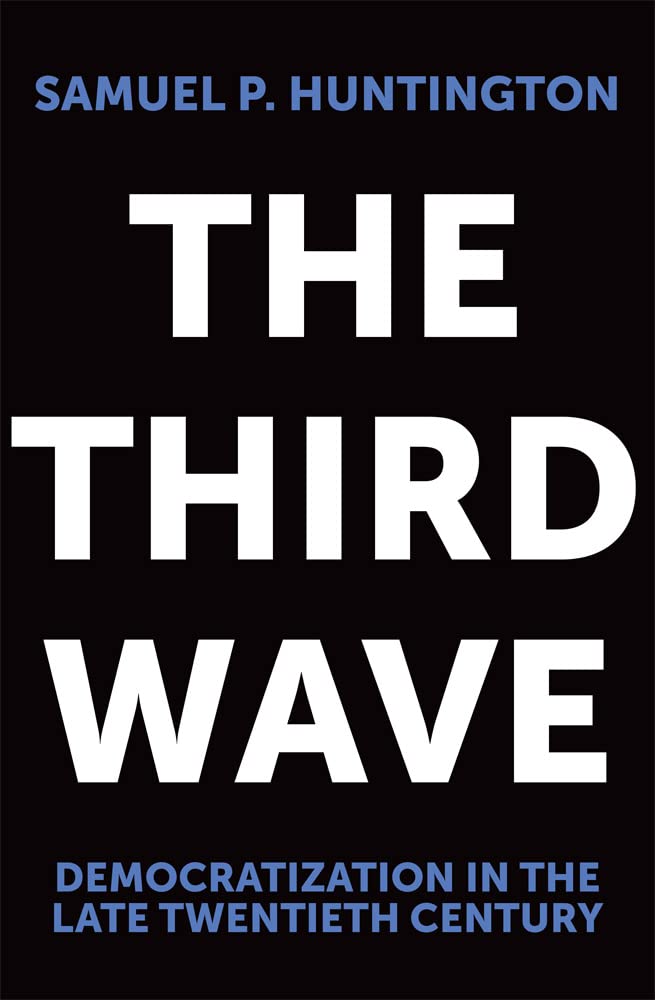
In *The Third Wave* (1991), Huntington identified a global democratic surge from 1974 to 1990, during which more than thirty countries in Southern Europe, Latin America, East Asia, and Eastern Europe transitioned from authoritarian to democratic rule. He argued this was the third major wave of democratization in modern history, following the 19th-century expansion of suffrage and the post-WWII decolonization wave. The key drivers included: legitimacy crises of authoritarian regimes, economic development, the Catholic Church's turn toward democracy, changes in international actors (especially the European Community and the US), and the demonstration effect of earlier transitions. He also warned that waves can reverse, as the first two did, and analyzed the conditions for consolidation.
✦What is the 'clash of civilizations' thesis, and why did it become so controversial?
Huntington's 1993 *Foreign Affairs* article and 1996 book argued that after the Cold War, the fundamental source of conflict would shift from ideology and economics to culture and religion. He divided the world into eight major civilizations—Western, Latin American, Islamic, African, Orthodox, Hindu, Japanese, and Sinic—and predicted that future wars would be fought along civilizational fault lines, with the most dangerous conflicts arising between the West and Islam or the West and China. The thesis sparked furious global debate: critics accused him of oversimplification, cultural determinism, and legitimizing Western hostility to Islam. However, after the 9/11 attacks, many viewed his analysis as prescient. Huntington himself used the framework to oppose the 2003 Iraq War, arguing it would ignite a civilizational clash.
✦How does Huntington's approach to comparative politics differ from that of other major theorists like Arend Lijphart or Samuel Finer?
Lijphart focused on institutional design—how electoral systems and constitutional arrangements manage conflict in divided societies. Finer emphasized the historical and organizational dimensions of state-building. Huntington, by contrast, centered his comparative framework on the *dynamic* relationship between social change and institutional capacity. He was less interested in static institutional typologies than in the processes of political development and decay. His core question was not 'what form of government is best?' but 'under what conditions do political institutions emerge, persist, or fail?' This processual, historically-grounded approach, combined with his willingness to ask politically inconvenient questions, distinguished him from more formalist or legalistic comparativists.
✦What did Huntington get right, and what remains contested in his work?
Huntington's insistence that institutions matter more than constitutions or elections for state stability has been validated by decades of state-building experience—from Somalia to Afghanistan. His 'gap' thesis remains the default framework for diagnosing state fragility. However, critics argue his work is overly state-centric, underestimating the role of civil society, international actors, and informal institutions. The 'clash of civilizations' thesis has been criticized for reifying cultural boundaries, ignoring intra-civilizational conflicts, and neglecting economic and strategic factors. Moreover, his framework offers limited tools for understanding hybrid regimes or democratic resilience. Nonetheless, his core insight—that political order is a precondition for, not a consequence of, development—remains the foundational premise of modern comparative politics.
✦What is a common misconception about Huntington's political views and intellectual legacy?
A common misconception is that Huntington was a neoconservative or an ideological defender of American hegemony. In fact, he was a lifelong Democrat who advised Hubert Humphrey and Jimmy Carter. He was deeply skeptical of American interventionism, opposed the Iraq War on civilizational grounds, and worried about the erosion of American national identity in *Who Are We?* (2004). His work was analytically driven, not ideologically partisan. Another misconception is that he was primarily an international relations theorist known only for the 'clash' thesis. In comparative politics, his *Political Order* and *Third Wave* are arguably more influential, shaping how generations of scholars understand political development, state-building, and democratization.