


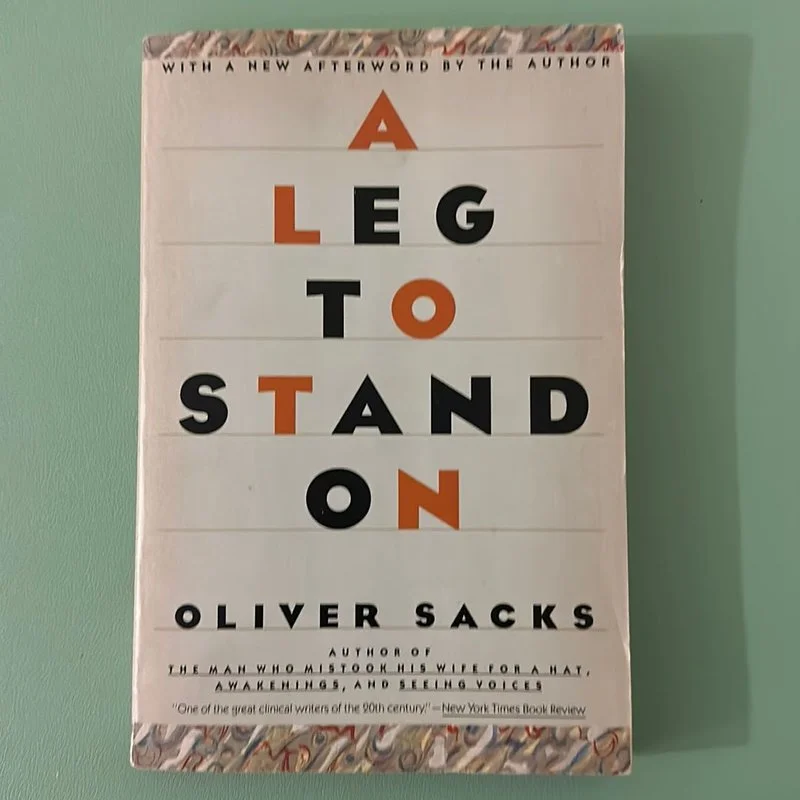
A Leg to Stand On
 Oliver Wolf Sacks
Sacks's memoir recounts his own experience as a patient after a severe leg injury in Norway, arguing that peripheral nerve damage can produce a profound disorder of body-image and identity. The central mechanism is 'alienation': his leg ceased to feel like part of his body, becoming an alien object over which he had no control. Sacks rejects the diagnosis of 'hysterical paralysis' as a top-down disorder, attributing his symptoms instead to a bottom-up neurological disruption of body-ego. The book is both a clinical case study of the self and a critique of medicine's neglect of patients' subjective experience.
Key Details
Related Books
View AllSimilar books from the same category, ranked by shared topics and reader engagement.



Key Insights — Read in 10 Minutes
What is the central neurological phenomenon Sacks describes, and how does he explain it?
Sacks describes a profound 'alienation' of his injured leg: it ceased to feel like part of his body, becoming an alien, inanimate object over which he had no control [citation:1][citation:4]. He attributes this to a disorder of body-image and body-ego induced by peripheral nerve injury—a bottom-up neurological disruption rather than a psychological one [citation:1][citation:3]. He explicitly rejects the diagnosis of 'hysterical paralysis' as it was then understood, arguing that neuropsychological syndromes like his are bottom-up disorders, whereas hysteria is top-down, originating in higher-order consciousness [citation:4]. His own explanation emphasizes the primary disturbance of local mapping and primary consciousness in the affected area.
How has Sacks's own diagnosis been reappraised by later researchers?
In a 2012 article in the Journal of Neurology, Neurosurgery and Psychiatry, Jon Stone and colleagues proposed that Sacks's experiences deserve reappraisal as a genuinely experienced functional (psychogenic) leg paralysis following injury [citation:1][citation:3][citation:6]. They note that Sacks explicitly rejected the diagnosis of 'hysterical paralysis' in the first edition, though he approached it more closely in subsequent revisions [citation:1][citation:4]. The researchers argue that in light of better understanding of functional neurological symptoms, Sacks's account provides unique insight into the experience of functional paralysis [citation:1]. His own 1993 Afterword in later editions acknowledges the complexity of the diagnosis without fully resolving it.
How does the book function as a critique of medicine and the doctor-patient relationship?
A Leg to Stand On is partly a story of being 'unmanned by medicine,' as reviewer Michael Neve put it [citation:12][citation:17]. Sacks describes his hostility to the unimaginative surgeon who treated him and medicine's failure to acknowledge the patient's subjective experience of illness. He calls for 'a neurology of the self, of identity'—a medicine that integrates the patient's story into the neurological model rather than confining itself to observing gross structure and function [citation:12][citation:17]. The book's concluding chapter attacks the mind/body dualism that pervades neurological thought, arguing that clinical and personal experience shows 'the bankruptcy of the classical model' [citation:4]. This critique of medicine's existential gaps became a central theme of his later work.
What role did the recovery process play in Sacks's understanding of his condition?
Recovery came through what Sacks's surgeon called 'spontaneity'—being 'tricked into action' [citation:4]. After weeks of struggling to walk, a Harley Street surgeon sent him to a swimming pool, and the normal movement returned almost instantly. The surgeon told him: 'What one needs is spontaneity, to be tricked in to action' [citation:4]. This experience reinforced Sacks's view that the condition involved a disruption of automatic, non-conscious body schemas rather than a simple structural deficit. His walking still had not returned to 'normal' even after the alienation had gone, indicating the depth of the disturbance to his body-ego.
How does this book relate to Sacks's other case studies of his patients?
A Leg to Stand On is unique in Sacks's oeuvre because the doctor becomes the patient. As Sacks later wrote, 'Here the roles were reversed and I was the patient myself, bewildered by an experience, a sort of "alienation" of an injured leg, which I could not comprehend or communicate to my doctors. My only relief was to write about it' [citation:13]. The book provided Sacks with firsthand insight into the patient's experience of illness that he had previously observed only from the outside. Steve Silberman described it as building 'a bridge of understanding between himself and his patients that became the foundation of what he called "a new and deeper medicine"' [citation:9][citation:13].
How was the book received by contemporary reviewers?
Reviews were strongly positive, emphasizing its literary quality and humanistic insight. The New England Journal of Medicine called it 'a gem of a book' that is 'at one and the same time an absorbing adventure story, a poetic evocation of a man struggling to become whole again, and a philosophical exegesis on the unity of body and mind' [citation:8]. Jerome Bruner in The New York Review of Books described it as 'a story about the nature of selfhood—a narrative comparable to Conrad's The Secret Sharer' [citation:9][citation:13]. The Washington Post said it 'raises issues of profound importance for everyone interested in health care and the humane application of science' [citation:9][citation:13].
Show 1 more insights
What is the significance of the title and the chapter structure?
The title suggests both literal recovery—regaining the ability to walk—and a plea for a foundation, a basis for understanding selfhood. The chapter headings trace the arc of the experience: 'The Mountain' (the accident), 'Becoming a Patient,' 'Limbo,' 'Quickening,' 'Solvitur Ambulando' (it is solved by walking), 'Convalescence,' and 'Understanding' [citation:11]. This structure mirrors the recovery narrative while emphasizing the existential dimensions of the illness. The Latin chapter title 'Solvitur Ambulando'—a phrase associated with Diogenes—captures Sacks's eventual insight that recovery came not through analysis but through spontaneous action, a resolution that informs his critique of purely observational medicine.
Wealthy Psyche is an intellectual archive. We do not host, distribute, or sell book copies — physical or digital. We provide structured knowledge to help you think better, faster.