


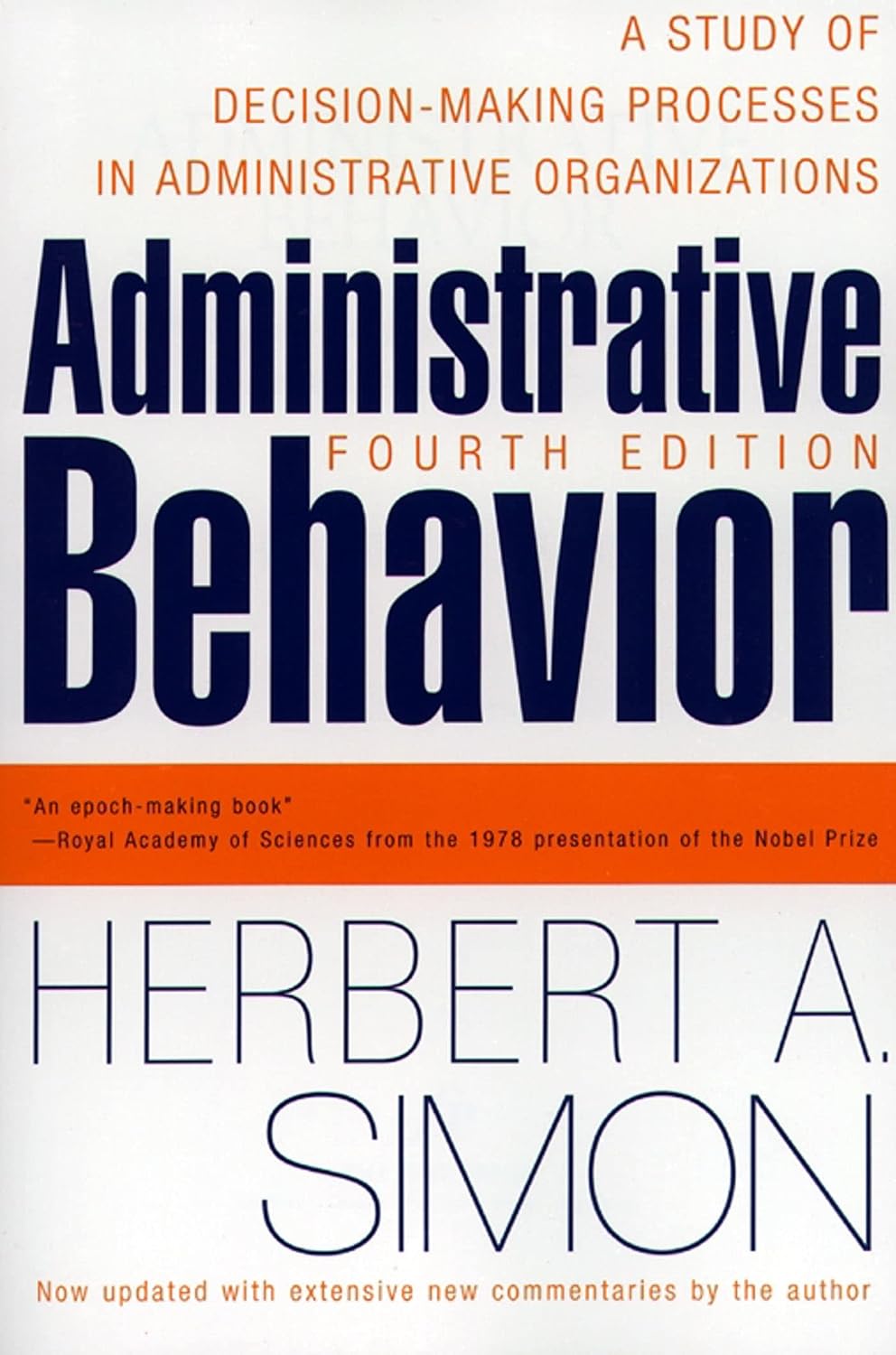
Administrative Behavior: A Study of Decision-Making Processes in Administrative Organization
 Herbert A. Simon
Simon's 1947 book replaces the 'principles of administration' with a behavioral science of decision-making. Its central claim is that decision-making is the heart of administration, and that the vocabulary of administrative theory must derive from the logic and psychology of human choice. Against the omniscient 'economic man,' Simon substitutes 'administrative man,' who satisfices—searches for a course of action that is good enough rather than optimal—because real administrators face limits of memory, attention, and knowledge. Organizations matter because they structure decision premises, channeling boundedly rational individuals toward goals they could not achieve alone.
Key Details
Related Books
View AllSimilar books from the same category, ranked by shared topics and reader engagement.



Key Insights — Read in 10 Minutes
What is the central claim of Administrative Behavior, and what does it reject?
Simon argues that decision-making is the heart of administration, and that administrative theory must be grounded in the logic and psychology of human choice rather than in normative 'principles' of organization. He rejects the classical administrative management school's proverbs—unity of command, span of control, departmentalization by purpose or process—as contradictory and unscientific. He also rejects the omniscient 'economic man' of classical economics and game theory, substituting instead the 'administrative man' who satisfices because cognitive limits, incomplete knowledge, and time constraints prevent full optimization.
What specific concept did this book introduce, and how has it been used?
The book introduced 'satisficing'—a portmanteau of satisfy and suffice—to describe how administrators make decisions that meet aspiration levels rather than maximize expected utility. It also laid the groundwork for bounded rationality, though the exact phrase 'bounded rationality' does not appear in the original text; Simon added it to the Introduction of the third edition in 1976. Together these concepts founded the Carnegie School of behavioral economics and organizational theory, influenced Lindblom's 'science of muddling through' and Wildavsky's budgeting work, and shaped Thaler and Sunstein's choice architecture.
Did Simon actually use the term 'bounded rationality' in the original 1947 edition?
No. The phrase 'bounded rationality' does not appear anywhere in the original text of Administrative Behavior across the first, second, third, or fourth editions. It first appears in the Introduction to the third edition (1976), where Simon retrospectively labeled his argument about the 'limits to rationality' as 'bounded rationality.' The original text described the 'triangle of limits'—skills, values, and knowledge—that bound administrative man's decision-making. This distinction matters because it shows Simon coined the term to defend his priority against game theory, not as the book's original framing.
How does Simon's theory of administration differ from Woodrow Wilson's or Frederick Taylor's?
Wilson and Taylor sought scientific principles of administration: Wilson wanted a politics-administration dichotomy grounded in stable maxims, Taylor wanted time-motion efficiency. Simon rejected both as prescriptive rather than descriptive. His science of administration would describe how decisions are actually made under cognitive constraints, not dictate how they should be made according to proverbs. Taylor assumed workers could be optimized as machines; Simon assumed decision-makers are boundedly rational actors whose choices organizations can structure but never fully control. The shift is from normative prescriptions to empirical behavioral analysis.
What was the book's academic reception and lasting influence?
The Royal Swedish Academy of Sciences called it 'epoch-making' when awarding Simon the 1978 Nobel Prize in Economics. A 1990 Public Administration Review survey of twenty experts named it the 'public administration book of the half century' (1940–1990). It laid the foundation for the Carnegie School and crossed disciplinary boundaries into political science, economics, and organizational theory. A 2022 PAR symposium marking its 75th anniversary found its concepts still fueling behavioral public administration research, with Simon's citation count approaching half a million on Google Scholar.
Wealthy Psyche is an intellectual archive. We do not host, distribute, or sell book copies — physical or digital. We provide structured knowledge to help you think better, faster.