


Herbert A. Simon
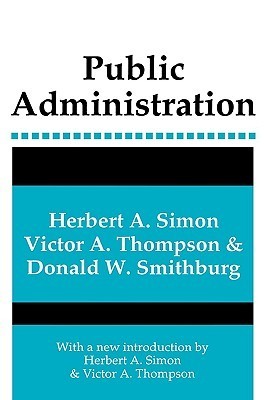
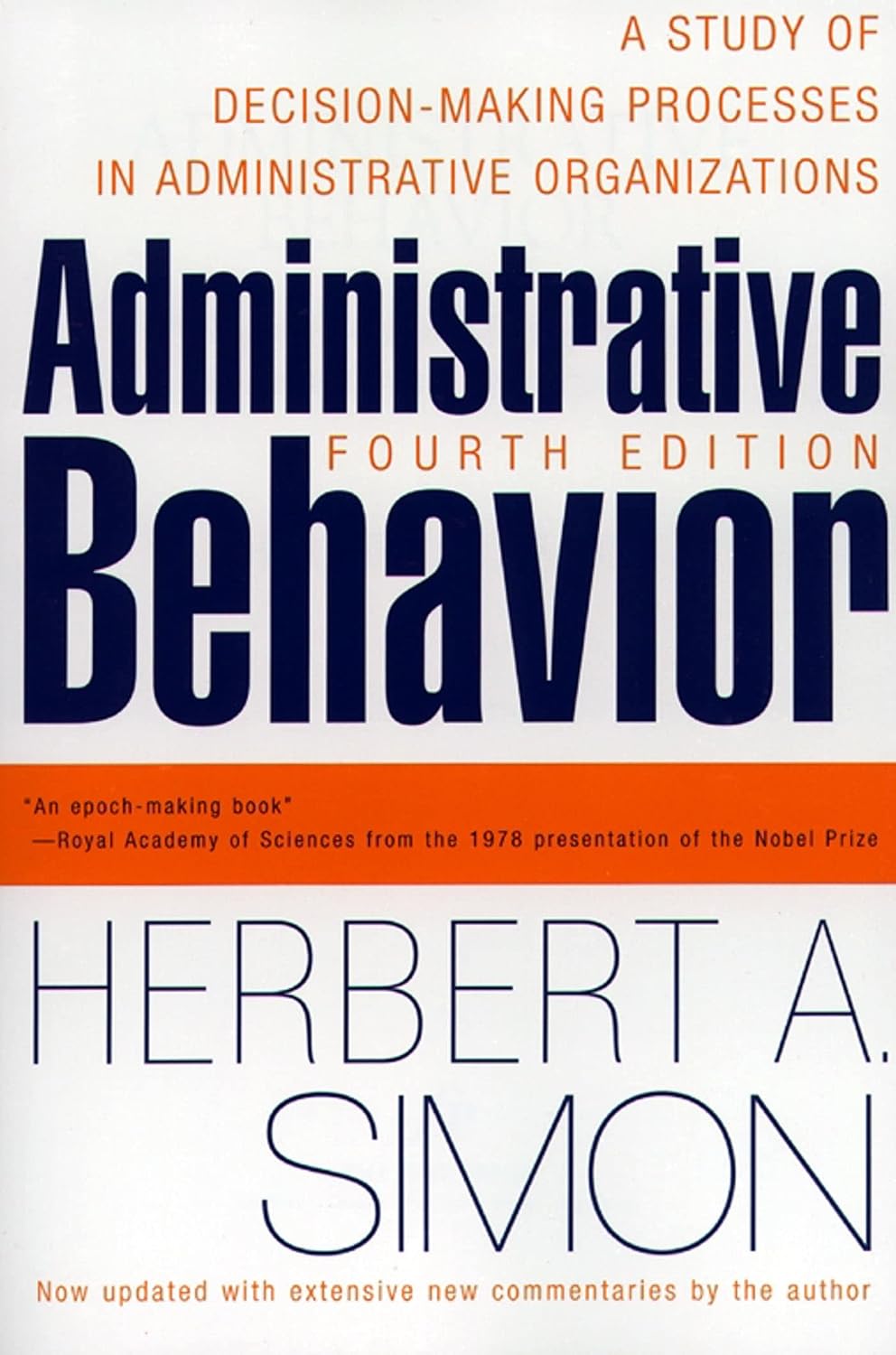
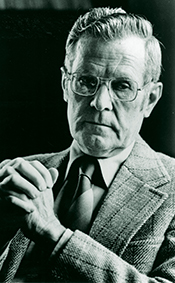
Herbert Simon transformed public administration by replacing the rational-comprehensive model with the concept of bounded rationality. In his landmark 1947 book *Administrative Behavior*, he argued that administrative decision-making is constrained by cognitive limits, incomplete information, and organizational routines—rather than by the pursuit of optimal solutions. This led to his theory of satisficing, where administrators accept 'good enough' options rather than searching for the best one. A professor at Carnegie Mellon University for over five decades, Simon won the 1978 Nobel Memorial Prize in Economic Sciences. His work effectively founded the behavioral approach to public administration and organization theory.




✦What is bounded rationality and why is it important?
Bounded rationality is the concept that human decision-making is constrained by cognitive limitations, incomplete information, and time constraints. In *Administrative Behavior* (1947), Simon argued that administrators cannot possibly evaluate all alternatives or predict all consequences. This challenged the rational-comprehensive model, which assumed decision-makers could identify all options and choose the optimal one. Bounded rationality is the foundation of the behavioral revolution in public administration and remains a core concept in policy analysis, organizational theory, and behavioral economics.
✦What is 'satisficing' and how does it differ from 'optimizing'?
Satisficing is Simon's term for decision-making that seeks a 'good enough' solution rather than the optimal one. Optimizing, the rational-comprehensive ideal, requires a decision-maker to search for the single best alternative. Satisficing, by contrast, acknowledges that administrators have limited cognitive resources and settle for an option that meets a threshold of acceptability. This is not a shortcut but a realistic description of how complex decisions are actually made. The term combines 'satisfy' and 'suffice' and has become a standard concept across the social sciences.
✦How does Simon's work differ from classical theories of public administration?
Classical theories, such as those of Woodrow Wilson and Max Weber, focused on formal structures, hierarchy, and the politics-administration dichotomy. They assumed that administrators could be objective and efficient. Simon directly challenged this by arguing that decision-making is inherently subjective and constrained by psychological and organizational factors. He rejected the 'proverbs' of classical theory—like unity of command and span of control—as unscientific and proposed a behavioral, evidence-based approach to studying organizations.
✦What is *Administrative Behavior* and what is its central argument?
*Administrative Behavior* is Simon's most influential book, published in 1947 and based on his doctoral dissertation. Its central argument is that decision-making is the core of administrative activity, and understanding how decisions are actually made requires recognizing the cognitive and organizational constraints on rationality. Simon proposed the concepts of bounded rationality and satisficing as alternatives to the rational model. The book won the American Political Science Association's Woodrow Wilson Award and is considered one of the most influential works in public administration and organization theory.
✦What is a common misconception about Simon's work?
A common misconception is that Simon's concept of bounded rationality means that administrators are irrational or make poor decisions. In fact, Simon argued that satisficing is a rational response to complex environments. Given time constraints and limited information, choosing a 'good enough' option is often the most sensible strategy. Simon saw human rationality as 'intendedly rational'—we try to be rational, but our cognitive architecture limits us. His work was descriptive, not pessimistic, and laid the groundwork for designing better decision-making processes.
✦What is Simon's 'zone of acceptance'?
The 'zone of acceptance' is Simon's concept of authority in organizations, introduced in *Administrative Behavior*. He argued that subordinates accept authority from superiors only within a certain zone—defined by their own personal values and the consequences of non-compliance. When a directive falls outside this zone, the subordinate will resist or ignore it. This concept reframed authority as a relational phenomenon, not a top-down command, and fundamentally influenced how scholars understand power and compliance in organizations.
✦How did Simon's work in public administration influence his later work in economics and AI?
Simon's work in public administration was deeply connected to his broader intellectual project of understanding human decision-making. His concepts of bounded rationality and satisficing were foundational for his Nobel Prize-winning work in economics, where he challenged the rational-actor model. He also applied these ideas to artificial intelligence, developing computer programs that simulate human problem-solving. Simon saw public administration, economics, psychology, and computer science as unified fields—all studying the same phenomenon of human decision-making.